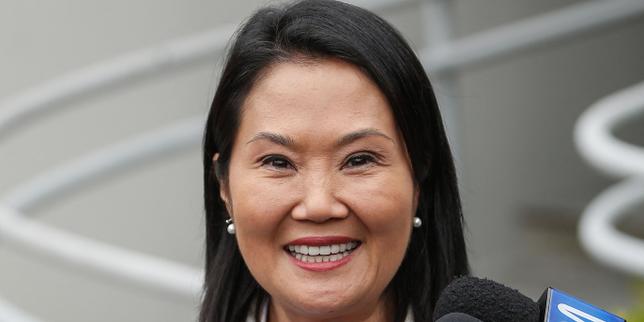
International correspondents love a simple narrative. When covering Peru, they inevitably fall back on a tired script: a high-stakes duel between a polarized left and a monolithic, business-friendly right, with Keiko Fujimori poised as the inevitable standard-bearer of the conservative establishment.
It is a comfortable framework. It is also completely wrong.
The lazy consensus in global reporting treats Keiko Fujimori’s recurring presence at the precipice of power as a sign of structural strength. They look at her tight margins, her disciplined party machine, and her corporate backing, and they conclude she is on the verge of cementing a right-wing hegemony. They misinterpret structural paralysis as political momentum.
The reality is far more volatile. Keiko Fujimori is not the solution for Peru's conservative establishment; she is its ceiling. Her political brand, Fujimorism, operates as a massive gravitational well that destabilizes the country's institutional architecture while ensuring that a genuinely modern, pro-market alternative can never take root.
The Myth of the Right-Wing Juggernaut
To understand why the mainstream analysis fails, look at the actual mechanics of Peruvian voting behavior. The international press routinely frames tight run-offs as a sign of an electorate warming up to Fujimori's platform of law-and-order and fiscal conservatism.
They ignore the anti-vote.
In Peruvian politics, the most powerful force is not ideological alignment, but visceral rejection. Fujimori does not advance to second rounds because she is widely loved; she advances because the left and center are so hopelessly fragmented that a disciplined 15% to 20% hard-core voter base is enough to guarantee a spot in the runoff. Once there, she acts as a political lightning rod.
[Fragmented First Round] -> Fujimori qualifies with ~18% of the vote
[Polarized Second Round]  -> Anti-Fujimorism mobilizes the remaining 80%
[Result]                  -> Razor-thin defeat or an unstable, paralyzed presidency
I have watched political analysts and foreign investors make the same mistake across multiple election cycles. They look at the polls, see her leading or tying in the final week, and assume a stable business environment is around the corner. They fail to understand that a Fujimori victory, or even a near-victory, triggers an immediate institutional antibodies reaction. The second she appears viable, a massive, unaligned coalition mobilizes not for her opponent, but explicitly against her family name and its authoritarian baggage from the 1990s.
Dismantling the Premise of Stable Capital Markets
The standard financial press argues that a Fujimori presidency would bring much-needed stability to the Lima Stock Exchange (BVL) and reassure mining conglomerates. This argument confuses a temporary market rally with long-term economic stability.
Yes, the copper majors and the traditional banking elite favor her on paper. But look at the systemic risk. Peru's economic engine relies heavily on the mining corridors of the southern highlands—regions like Apurímac, Cusco, and Arequipa. These areas are intensely anti-Fujimori.
Imagine a scenario where a right-wing government takes power with a razor-thin mandate and zero legitimacy in the country's economic heartland. The result is not stability. It is an immediate escalation of social conflicts, blockades of the Southern Mining Corridor, and a total freeze on greenfield extraction projects.
- The Conventional Wisdom: A right-wing presidency unlocks mining investment through deregulation.
- The Brutal Reality: A polarizing right-wing presidency triggers immediate, unmanageable social unrest in extraction zones, rendering deregulation useless.
True economic predictability requires social consensus, something a Fujimori candidacy inherently destroys. By forcing a binary choice between her brand of conservative populism and radical outsider alternatives, the traditional political class has trapped Peru in a cycle of permanent crisis management.
The Cost of Institutional Cannibalism
The real tragedy of the political landscape is that Fujimori's party, Fuerza Popular, has historically chosen institutional destruction over compromise whenever they lose. We saw this clearly after the 2016 election. Rather than acting as a responsible, pro-market opposition to Pedro Pablo Kuczynski, the Fujimorist majority in Congress weaponized the impeachment process, setting off a cascade of fallen presidents and dissolved legislatures that effectively broke Peru's governance model.
This is the nuance the international press misses. They write about her as a conventional right-wing candidate. She is not. She runs a personalist political vehicle designed primarily to protect its leadership from ongoing corruption investigations linked to the Odebrecht scandal.
When a political party’s primary objective is judicial survival rather than policy execution, institutional cannibalism is the inevitable result. They will ally with radical left-wing factions on specific congressional votes to weaken the judiciary, hollow out educational reforms, or undermine regulatory agencies if it serves their immediate tactical needs.
The Flawed Questions Everyone Keeps Asking
If you look at standard political analysis on Peru, the questions being asked are fundamentally broken.
Can Keiko Fujimori unite the Peruvian right?
This question assumes the right wants to be united under her. The truth is that her continued political viability suffocates the emergence of a modern, institutional right. As long as she dominates the conservative lane, no center-right reformer can gain traction. She holds the business community hostage: back her, or risk a radical leftist taking the presidency. It is a protection racket disguised as a political strategy.
Will economic growth continue despite political noise?
For two decades, economists boasted about Peru’s "twin tracks"—the idea that the economy ran on autopilot while the political class burned itself down. That track is dead. You cannot maintain a steady investment climate when the rules of the game change every eighteen months due to constant impeachments and cabinet shuffles. The structural weakness of the state is finally catching up to the macroeconomic numbers.
What Corporate Strategy Gets Wrong
If you are managing capital in the Andean region, relying on the mainstream narrative that a right-wing victory solves your country risk is a fast track to losing money.
Stop looking at presidential polling numbers as a proxy for stability. Instead, look at the fragmentation index of the incoming Congress and the localized protest metrics in the regions where your assets actually sit. A weak executive facing a hostile, predatory legislature will not save your contracts, regardless of what ideological label they wear.
The downside to this contrarian view is obvious: it offers no easy answers. It means admitting that Peru’s political crisis is structural, not cyclical. There is no white knight coming in a business suit to fix the institutional decay.
The international media will keep writing the same article, predicting a triumphant right-wing restoration every time a Fujimori climbs a few points in the polls. They will continue to misread the deep, structural anti-vote as a mere campaign hurdle rather than the defining characteristic of the system.
Stop waiting for an electoral outcome to stabilize Peru. The system is designed to produce volatility, and the candidate the establishment relies on to bring order is the very entity that guarantees chaos.