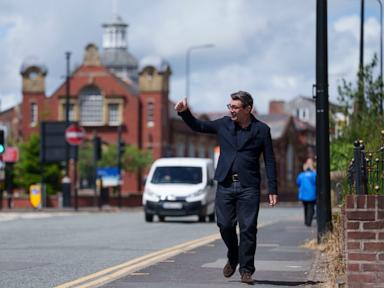
The rain in Manchester does not fall; it crowds. It hangs in the grey air, slicking the red brick of transformed cotton mills and sticking collars to necks. On days like this, the distance between the grand neoclassical pillars of Westminster and the damp pavements of Piccadilly feels like more than a four-hour train ride. It feels like an epoch.
Power in Britain has always had a specific accent. It is clipped, vowel-shortened, and smoothed out by the grinding stones of elite southern schooling. But walk through the dynamic, crane-studded skyline of Greater Manchester, and you hear a different cadence. You hear a voice that has spent years positioning itself as the authentic counterweight to London’s gravity. For an alternative view, check out: this related article.
That voice belongs to Andy Burnham.
To understand the modern British Labour Party is to understand a quiet, subterranean civil war. It is not fought with open mutinies or dramatic parliamentary floor-crossings. Instead, it is waged in the margins of regional ballot papers, in the unspoken tension of television studio green rooms, and in the shifting loyalty of voters who feel forgotten the moment a general election is won. Related reporting on this matter has been provided by The New York Times.
Sir Keir Starmer sits in 10 Downing Street, holding a massive parliamentary majority built on a fragile foundation. His victory was historic, yet it was achieved with a lower share of the popular vote than his defeated predecessor managed during a catastrophic loss years earlier. The mandate is wide, but it is thin as ice. And beneath that ice, the water is moving.
The Weight of the Badge
Consider a local council worker. Let's call him Thomas. For twenty years, Thomas has cleared the drains and maintained the parks in a post-industrial town just outside Manchester. He voted for Labour his entire life, abandoned them when the party seemed to lose its bearings, and tentatively returned because the alternative had become untenable.
Thomas does not read white papers. He does not care about the minutiae of Westminster factionalism. But he knows his bus route became cheaper and more reliable when the local mayor took control of the transport network. He knows that when the central government decided to scrap the northern leg of the high-speed rail line, it felt like a door being slammed in his face.
To Thomas, Keir Starmer is a distant figure in a sharp suit, speaking the language of fiscal discipline and cautious incrementalism. Andy Burnham, however, is the man in the dark reefer jacket standing at a podium in the drizzle, looking genuinely angry on Thomas’s behalf.
This is the emotional fracture line of British politics.
When a special election—a sudden by-election triggered by a resignation or a scandal—occurs in a northern constituency, the media treats it as a routine health check for the ruling party. They count the swing percentages. They interview voters on high streets who say they are fed up with everyone.
But the real tension lies in what that vote symbolizes. Every time a northern community goes to the polls, it is a referendum on whether London’s version of the future matches the reality on the ground.
Starmer’s strategy has always been rooted in reassurance. He won power by promising to be the adult in the room, the steady hand to guide a turbulent nation back to normalcy after years of chaotic governance. He speaks of stability. He embraces the caution of a former Director of Public Prosecutions.
But stability can easily look like stagnation when your local library is closed and the high street is boarded up.
Two Versions of the Soul
The contrast between the two men at the heart of this narrative is cinematic.
Starmer is methodical. His career was forged in the courtroom, where passion is distrusted and evidence is everything. He approaches politics like a complex brief to be mastered, assuming that if the logic is sound, the public will eventually follow. It is a top-down philosophy. Change happens through the levers of state, pulled carefully by competent hands in Whitehall.
Burnham is visceral. He was once a Westminster insider himself, a cabinet minister who ran for the party leadership and lost because he seemed too polished, too much a product of the system. Then he left. He went north, reinvented himself as the "King of the North," and discovered the immense power of place.
He learned to channel the collective grievance of a region that feels chronically underfunded and fundamentally misunderstood. Where Starmer offers a spreadsheet, Burnham offers a sermon.
+-----------------------------------------------------------+
|               THE TWO PATHS OF BRITISH LABOUR             |
+-----------------------------------------------------------+
| KEIR STARMER                      | ANDY BURNHAM          |
|-----------------------------------|-----------------------|
| Westminster Centric               | Regional Powerhouse   |
| Legalistic & Reassuring           | Populist & Visceral   |
| Top-Down Governance               | Place-Based Identity  |
| Focus on National Stability       | Focus on Local Equity |
+-----------------------------------------------------------+
When a unexpected electoral test arises, these two philosophies collide. A poor showing for the government in a traditional heartland seat does not just mean a lost member of parliament. It acts as an accelerator. It validates the argument Burnham has been making from his red-brick stronghold: that the capital is out of touch, and that the real energy of the nation lives elsewhere.
The mechanism of political decline is rarely a single, catastrophic explosion. It is a slow leak. A by-election loss here, a drop in the polls there, a growing murmur among backbenchers that the current message is not working.
Imagine the tea rooms of the House of Commons after a disappointing local result. The air thickens with anxiety. Newly elected members of parliament, who won their seats by wafer-thin margins, look at their leader and wonder if his caution will be their undoing. They look north, where a different leader wins re-election with thumping, undeniable majorities, and they begin to calculate.
The Ghost in the Machine
There is a peculiar vulnerability to being the Prime Minister of the United Kingdom. You are surrounded by the trappings of absolute authority, yet you are entirely dependent on the mood of a parliamentary party that can turn on you with terrifying speed. The British system does not have the fixed terms or the institutional protections of a presidency. A leader serves only as long as they are deemed a winner.
Every stumble by Starmer invites a comparison. If the government announces a tough welfare reform or hesitates on infrastructure spending, Burnham is there, providing a running commentary from the sidelines. He does not need to rebel; he merely needs to offer an alternative vision of what a compassionate government should look like.
It is a masterful exercise in political patience. Burnham has publicly stated his desire to return to Westminster eventually, to lead the party he once failed to capture. He is the ghost in Starmer’s machine, a constant reminder that there is another option waiting in the wings should the current project falter.
The stakes are higher than the careers of two ambitious men. The true stakes involve the faith of the electorate.
For decades, the working-class towns of England felt ignored by a globalized capital. They voted for radical change in the Brexit referendum, they lent their votes to the Conservatives to "get it done," and now they have returned to Labour, expecting tangible improvement. If they receive only competence without warmth, austerity with a smile, the disillusionment will be profound.
That is the danger of a sudden electoral setback for Starmer. It breaks the illusion of invincibility. It signals to the voters who gave him a chance that their skepticism was justified all along.
The Shift of Gravity
The rain continues to fall outside the Mayor’s office in Manchester. Inside, the focus is on the long game.
Power is a liquid substance; it flows toward the point of least resistance. For a century, that point was always London. But the creation of powerful regional metro-mayors has altered the geography of British politics permanently. It has created alternative platforms, alternative power bases, and alternative leaders who do not owe their careers to the whim of the Prime Minister.
A special election in a provincial town might seem like a minor footnote in the grand history of a government. It is easy for political commentators to dismiss a poor result as a mid-term blues phenomenon, a standard piece of turbulence that every administration must endure.
But look closer at the faces of the people leaving the polling stations. Listen to the conversations in the pubs and on the edges of the football pitches. They are not talking about national GDP statistics or international treaties. They are talking about their lives, their towns, and their sense of pride.
If the man in Downing Street cannot find a way to speak to that pride, to offer something more inspiring than a well-managed decline, the crowd will look elsewhere for a leader. They will look to someone who stands with them in the damp air, someone who sounds like them, someone who has spent years building a kingdom in the north, waiting for the capital to fail.
The transition of power rarely begins with a coup. It begins with a loss of faith, captured on a rainy Thursday night in a high school gym, as a returning officer reads out a verdict that everyone saw coming, but no one in London wanted to believe.


