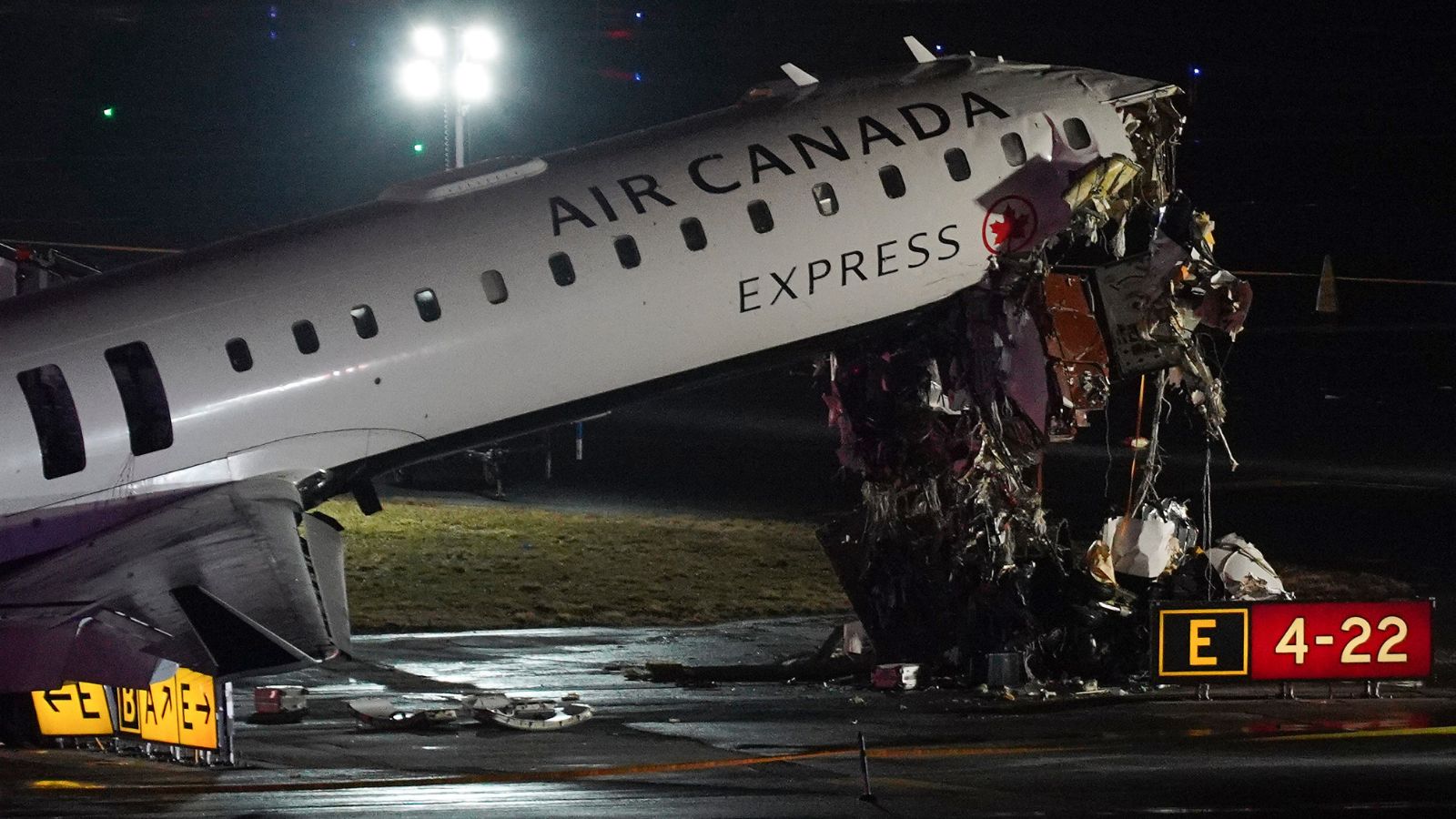
The terrifying close call involving an Air Canada Express flight at LaGuardia Airport was not an isolated stroke of bad luck. It was the predictable result of a systemic breakdown within the Federal Aviation Administration (FAA) and the Port Authority of New York and New Jersey. For years, pilots, air traffic controllers, and safety inspectors have filed reports highlighting a toxic mix of antiquated runway geometry, crumbling communication protocols, and a culture that prioritizes throughput over pilot sanity. The near-miss involving the Embraer 175 is merely the most visible symptom of a terminal illness at one of America's busiest transit hubs.
The fundamental issue is that LaGuardia is a 1930s-era layout forced to handle 21st-century traffic volumes. When you squeeze roughly 1,200 flight operations a day onto two intersecting runways, the margin for error disappears. While the airport has undergone a multi-billion dollar facelift in terms of passenger terminals and shiny glass facades, the "hot spots" on the tarmac remain as dangerous as ever.
The Paper Trail of Ignored Warnings
Long before the Air Canada Express incident, the Aviation Safety Reporting System (ASRS) was overflowing with red flags. These reports, often filed anonymously by pilots and controllers, describe a chaotic environment where "cluttered" radio frequencies and "confusing" ground markings lead to frequent incursions.
In the eighteen months leading up to the crash threat, there were at least twelve documented instances where miscommunication nearly resulted in a collision. These aren't just minor clerical errors. We are talking about pilots being cleared to land while another aircraft is still occupying the runway, or ground vehicles crossing active taxiways without proper authorization.
The FAA's internal logic often treats these as "pilot deviations," shifting the blame to the flight deck. This is a convenient fiction. When multiple crews from different airlines, with varying levels of experience, all make the same mistakes at the same geographical points, the fault lies with the infrastructure and the system design, not the individuals.
The Runway Geometry Trap
LaGuardia’s runways, 4-22 and 13-31, intersect in a way that creates a constant tactical headache. Unlike modern airports with parallel runways that allow for independent operations, LaGuardia requires a complex dance of timing.
- The Intersecting Conflict: If a plane on Runway 4 takes an extra five seconds to clear the intersection, a plane landing on Runway 13 is suddenly on a collision course.
- The High-Speed Exit Problem: Modern jets are larger and faster than the aircraft this airport was built for. They often overshoot their intended exits, forcing controllers to scramble and adjust the flow of incoming traffic in real-time.
- The Line-of-Sight Issue: In certain weather conditions or from specific angles, the control tower's view of specific taxiway intersections is physically obstructed.
These are not "challenges" to be managed. They are structural defects. While newer airports like Denver or Dallas-Fort Worth provide miles of "runway safety areas" (RSAs), LaGuardia is a concrete island surrounded by water. There is nowhere to go if a pilot needs to veer off to avoid a collision.
The Air Traffic Control Pressure Cooker
The men and women in the LaGuardia tower are working in a pressure cooker that has reached its limit. Internal staffing memos indicate that the New York TRACON (Terminal Radar Approach Control) has been operating at critically low levels for years.
When controllers are overworked, their "situational awareness"—the ability to keep a mental map of every moving piece on the board—begins to erode. They start relying on shortcuts. They talk faster. They compress the gaps between arrivals. In the Air Canada Express case, the speed of instructions was a contributing factor. A pilot, already task-saturated while navigating the complex "Expressway Visual" approach, has a limited capacity to process rapid-fire corrections from a stressed controller.
The "hear-back" error is a classic failure mode. A controller gives an instruction, the pilot reads it back incorrectly, and the controller, already moving on to the next three planes, fails to catch the mistake. This happened repeatedly in the months prior to the incident. The system is designed to catch these errors, but the safety net is being stretched so thin it has developed holes large enough for an airliner to fall through.
Why Technology Hasnt Saved Us
We are told that ASDE-X (Airport Surface Detection Equipment, Model X) and other ground-surveillance technologies are the ultimate safeguards. They are supposed to alert controllers when two targets are on a collision course.
The reality is more complicated. At an airport as dense as LaGuardia, these systems often trigger "nuisance alerts." Because planes are constantly operating in close proximity, the alarms go off so frequently that controllers can become desensitized. It’s the "boy who cried wolf" syndrome applied to aviation safety. By the time a genuine, lethal conflict arises, the warning might be dismissed as just another ghost in the machine for those crucial first three seconds.
The Economic Incentive of Congestion
The Port Authority and the airlines are in a symbiotic relationship that prioritizes the "slot" system above all else. A slot at LaGuardia is worth millions. If the airport were to implement the necessary safety buffers—such as increasing the spacing between arrivals or limiting the number of hourly operations—the economic fallout would be massive.
Airlines would lose revenue. The airport would lose landing fees. Passengers would face even higher ticket prices for the convenience of landing ten minutes from Manhattan.
This is the silent trade-off. Every time you fly into LaGuardia, you are participating in a high-stakes gamble that the current infrastructure can handle the volume. The Air Canada Express incident wasn't a fluke; it was a warning that the house is running out of luck. The reports flagged it. The pilots complained about it. The data proved it.
The Myth of the New Terminal
It is vital to distinguish between "passenger experience" and "operational safety." The recent $8 billion overhaul of LaGuardia has made the terminals world-class. You can now buy a gourmet meal and sit in a designer chair while waiting for your flight.
However, beneath that surface, the tarmac remains a relic. The taxiways are still narrow. The gates are still cramped. The "landside" improvements have done nothing to address the "airside" risks. In fact, some argue the increased capacity of the terminals has only added more pressure to increase flight frequencies, further taxing the already exhausted runway system.
We are essentially putting a Ferrari body on a Model T chassis and wondering why it struggles at 100 mph.
What Actually Needs to Change
If the FAA is serious about preventing a hull loss at LaGuardia, they must move beyond "increased training" and "safety memos." These are band-aids on a gunshot wound.
- Mandatory Slot Reductions: During peak hours and inclement weather, the airport must operate at a lower capacity. The current "demand-based" scheduling is a recipe for disaster.
- Redesigned Taxiway Logic: We need to eliminate the need for aircraft to cross active runways whenever possible. This may require radical construction that further encroaches on the bay, but the alternative is a collision.
- Voice-to-Text Cockpit Integration: To solve the "hear-back" error, instructions should be delivered digitally to the cockpit display simultaneously with the voice radio. This removes the ambiguity of a crackling radio transmission.
The Looming Crisis of Confidence
The aviation industry relies on the public's belief that the system is fail-safe. When reports emerge that safety issues were flagged and ignored, that trust evaporates. The Air Canada Express crew managed to avoid a catastrophe, but they did so in spite of the system, not because of it.
We cannot continue to rely on the "heroic save" by pilots to compensate for institutional negligence. The data is in the files. The warnings are on the record. The next time a plane is cleared into the path of another at LaGuardia, we won't be able to say we didn't see it coming.
The FAA needs to stop treating LaGuardia like a standard airport and start treating it like the high-risk environment it has become. This means admitting that the current pace of operations is unsustainable. It means telling the airlines that their schedules are fantasy. It means prioritizing the physical reality of the runway over the economic reality of the balance sheet.
Go to the FAA's safety database and look up the "hot spot" maps for LaGuardia. Look at the intersections of 4, 22, 13, and 31. See the red circles where "wrong surface landings" and "runway incursions" are most likely to occur. Then ask yourself why, despite all the billions spent on terminal renovations, those red circles haven't moved in twenty years.