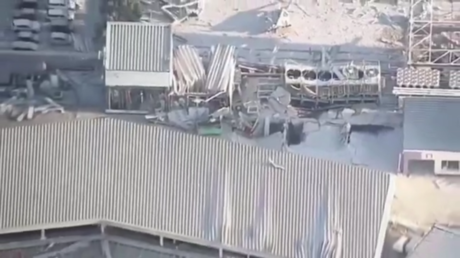
The ground doesn't just shake in Japan; it rips open with a violence that defies comprehension. When a 7.1-magnitude earthquake slammed into the Kumamoto region on the southern island of Kyushu, the terrifying reality of nature's raw power hit home once again. Shindo scale readings maxed out at the absolute peak of 7. At that intensity, standing upright becomes physically impossible. People are thrown through the air, and heavy concrete structures turn into dust within seconds.
Honest talk: most of us outside active seismic zones think earthquake preparedness begins and ends with a flashlight under the bed. That illusion shatters the moment structural flooring pancakes. In the town of Kashima, an explosion ripped through a crowded shopping mall after the initial jolt, collapsing the second floor and leaving a terrifying number of people unaccounted for. Emergency services rushed to the scene as thick smoke billowed into the afternoon sky, mirroring scenes from the devastating quake that hit the exact same prefecture a decade ago. You might also find this connected coverage interesting: The Battle for Ancient Soil Why Islamabad Claims Harappa While Sponsoring Terror.
The Anatomy of a Shindo 7 Disaster
You need to understand what happens when the Japan Meteorological Agency slaps a level 7 rating on a tremor. It is not just a high number on a chart. It means structural integrity fails entirely across entire neighborhoods.
During this latest event, the destruction wasn't limited to crumbling residential timber frames. Major industrial hubs took direct hits. At a Nippon Paper Industries plant in Yatsushiro, a massive smokestack snapped and crashed downward, leaving workers trapped and missing. High-speed Shinkansen bullet trains screeching across Kyushu slammed on emergency brakes, while passengers onboard reported injuries from the sudden, brutal deceleration. As discussed in detailed articles by The Washington Post, the effects are worth noting.
Prime Minister Sanae Takaichi scrambled an immediate response task force, deploying thousands of Self-Defense Force troops to assist local police and firefighters. Yet, rescue operations face a massive bottleneck. Roads are buckled. Expressways are shifted off their pylons. Bridges are cracked wide open. When infrastructure breaks down this fast, first responders can't simply drive to the crisis point. They have to fight their way through it.
Why Industrial Giants Shut Down Instantly
People often wonder why modern manufacturing centers halt operations over a single tremor. Look at the data. Semiconductor powerhouse TSMC evacuated its entire workforce from the Kumamoto fabrication plants immediately after the shaking started.
Precision manufacturing hates kinetic chaos. Microchips require sterile, stable environments where microscopic shifts ruin entire production batches. Beyond tech, power grids failed instantly. Nearly 50,000 households lost electricity across the region, plunging neighborhoods into darkness while gas leaks sparked localized fires. Water mains ruptured, leaving roughly 140,000 homes dry.
Surviving the Ring of Fire
Japan sits squarely on the Pacific Ring of Fire, accounting for roughly a fifth of all global earthquakes measuring magnitude 6.0 or higher. Citizens grow up running drills. Schools practice duck-and-cover before children learn algebra. But a magnitude 7.1 event at a shallow depth of just 16 kilometers tests the absolute limits of human engineering.
If you're tracking how modern societies handle catastrophic risk, look closely at how ordinary residents respond. Roughly 300,000 people received immediate evacuation instructions, moving methodically toward designated community shelters without waiting for second notices. That kind of cultural muscle memory saves lives.
The immediate danger has evolved past the initial shockwave. Aftershocks keep hammering the region, including a sharp 6.1-magnitude jolt that set rescuers on edge hours after the main event. Landslide risks remain dangerously high on saturated hillsides. Stay clear of damaged masonry, keep emergency packs accessible, and expect transport lines to remain paralyzed while recovery crews dig through the rubble.


