The sea does not care about borders. It rolls in gray and indifferent, slapping against the hull of a wooden fishing boat bobbing twenty miles off the coast of Hsinchu. A fisherman named Chen lights a cheap cigarette, squinting through the salt spray toward a horizon that looks empty. It is not empty. Beneath the surface, fiber-optic cables hum with billions of dollars in data, and just beyond the curvature of the earth, gray hulls cut through the deep water, watching, waiting, measuring the distance between peace and catastrophe.
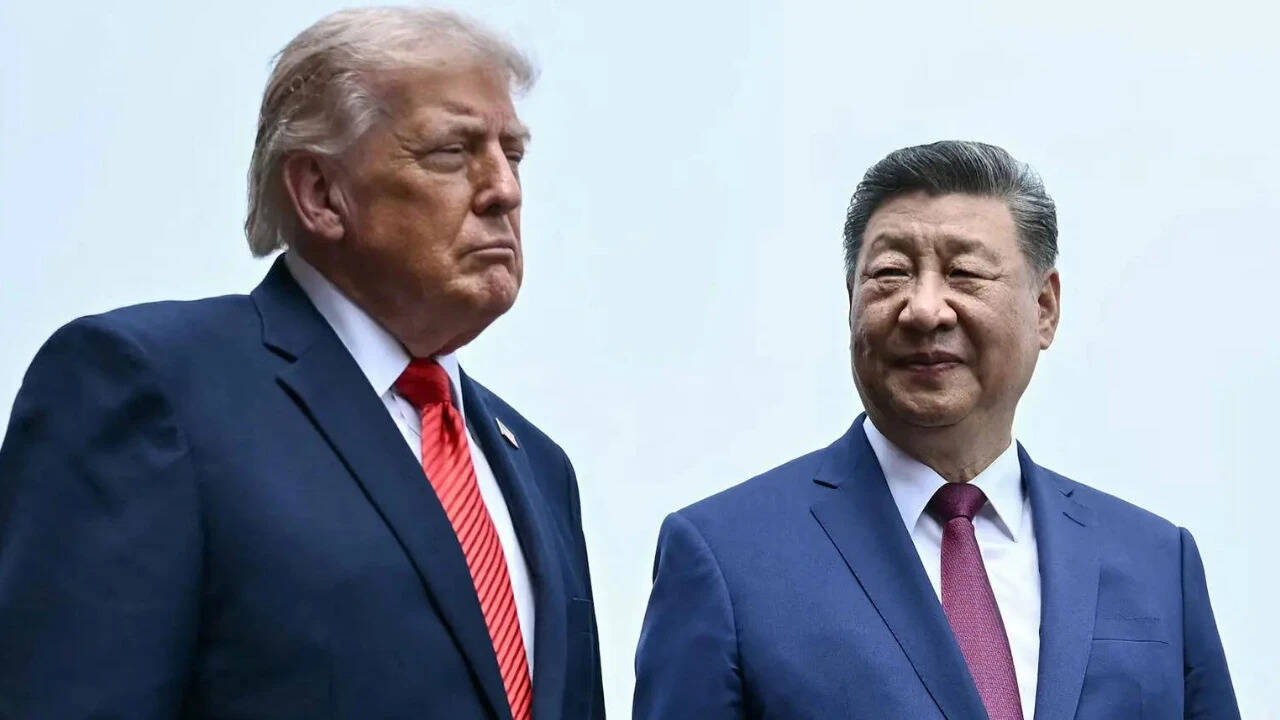
Thousands of miles away, inside a room where the air conditioning hums at a sterile, chilling precision, two men sit across a polished mahogany table. One wears the heavy, immovable armor of a political lineage stretching back millennia; the other carries the transactional impatience of a Manhattan builder who views every treaty as a draft waiting to be renegotiated. Building on this theme, you can also read: Why the Political Class Completely Misread the Trump and Burnham Meeting.
Between them lies a map. And on that map, a single, invisible line.
To understand why the world holds its breath when Xi Jinping and Donald Trump meet, you have to look past the economic tariffs, the posturing over microchips, and the midnight press releases. You have to look at the geometry of pride and survival. For Beijing, the island of Taiwan is not a geopolitical chess piece or a bargaining chip to be traded for soybean futures or intellectual property concessions. It is the unhealed scar of a century of humiliation, the final unfinished chapter of a civil war that grandfathered the modern Chinese state. Observers at The Guardian have shared their thoughts on this situation.
To Xi, it is an existential article of faith.
To Washington, caught in the vertigo of maintaining a global Pax Americana while domestic polarization eats away at its foundations, Taiwan represents something different. It is the credibility of an alliance system built after the Second World War. It is the silicon heart of the global economy, the place where the tiny chips powering everything from your smartphone to an intercontinental ballistic missile are baked in furnaces of near-absolute purity.
When these two forces collide across a negotiating table, the language changes. Diplomacy is rarely a polite conversation over tea; it is a high-stakes poker game played with national destinies. And in this particular hand, Taiwan is pushed directly into the center of the felt, framed not as a topic for debate, but as the ultimate red line.
The Architecture of a Red Line
A red line in international relations is a psychological boundary. Cross it, and the rules of the game dissolve.
Historically, superpowers establish these boundaries to prevent catastrophic miscalculation. During the Cold War, it was Berlin, or the missiles resting quietly under the Cuban sun. Today, it is the narrow strait of water separating an autonomous democracy from an ascendant authoritarian giant.
When Xi Jinping looks across that strait, he sees a province that drifted away during a moment of national weakness. When Donald Trump looks at the same strait, he sees an expensive entanglement, a distant obligation, yet also a vital strategic asset that cannot simply be handed over without unraveling America's standing in the Pacific.
The summit room captures this friction. Trump operates with the mindset of a dealmaker. He likes pressure. He likes tariffs as a hammer to force concessions, believing that everything—from steel imports to territorial integrity—can be cast in the crucible of a grand bargain. He looks at Xi and sees an adversary, a competitor, and occasionally, a peer he respects for his absolute control.
Xi, however, does not think in quarterly election cycles. He thinks in epochs.
When the Chinese delegation places the Taiwan question at the dead center of the bilateral agenda, they are telling the American president that commerce is subordinate to sovereignty. You can tax our goods. You can restrict our technology. You can challenge our maritime claims in the South China Sea. But touch the architecture of one China, cross the threshold of permanent separation, and the discussion ends.
This is the central paradox of modern geopolitics. The two largest economies on Earth are inextricably bound together by trade, debt, and shared survival, yet they are anchored to an ideology that makes compromise nearly impossible on this single, vital issue.
The Human Cost of Abstract Calculus
It is easy to speak of superpowers, red lines, and gross domestic products as if they were pieces on a board. But back in Hsinchu, Chen the fisherman knows nothing of trade deficits or executive orders. He knows the chop of the water. He knows the smell of diesel exhaust mixed with salt. He knows that his grandfathers fished these same waters without needing a passport or worrying about an air defense identification zone.
Yet, his world is shrinking.
Every time a diplomatic summit fails to find a durable accommodation, the military patrols increase. Coast guard vessels grow larger. Fighter jets streak across the stratosphere faster than the speed of sound, leaving white scars across a blue sky. The tension is no longer an abstract theory debated by think-tank analysts in Washington or party cadres in Beijing; it is the background radiation of daily life for twenty-three million people living on an island smaller than Maryland.
Consider what happens when a superpower summit breaks down over such an impasse. It is not just a headline on a morning news feed. It triggers a chain reaction across global financial markets. Insurance rates for cargo ships traversing the Taiwan Strait spike overnight. Semiconductor conglomerates begin contingency planning, quietly looking for alternative manufacturing hubs in Arizona, Japan, or Europe, knowing that a disruption in the supply chain would plunge the global economy into a depression deeper than anything seen since the nineteen-thirties.
The tragedy of the situation lies in its inevitability. Both leaders are trapped by the domestic expectations they have cultivated. Xi cannot afford to look weak on Taiwan without risking his historical legacy and the foundational legitimacy of the Communist Party. Trump cannot afford to abandon an ally without inviting accusations of weakness from political rivals who accuse him of selling out democratic principles for a temporary trade truce.
When two immovable objects meet, something must give. Or, more dangerously, something must break.
The Shadow of Miscalculation
History is littered with the wreckage of wars that nobody wanted, triggered by leaders who thought they were merely bluffing.
The danger of the Xi-Trump dynamic is its transactional unpredictability. In traditional diplomacy, diplomatic channels are greased by ambiguity. The United States practiced "strategic ambiguity" for decades—saying one thing, implying another, keeping both Taipei and Beijing guessing about what Washington would actually do if the worst came to pass.
Trump’s style shatters ambiguity. It is loud, direct, and inherently volatile. When a leader treats territorial sovereignty like a real estate negotiation, the other side responds by hardening its stance, drawing its red lines deeper in blood and iron.
During the summit, reports leak out of closed-door sessions where voices were raised, where documents were pushed across tables, and where the word "force" was used not as a remote hypothetical, but as a tangible possibility. The Chinese delegation leaves little room for maneuver. For Beijing, the clock is ticking. The reunification of Taiwan is cast not as a question of if, but when.
And that timeline is precisely what keeps military planners awake at night in the Pentagon.
If Beijing believes that the window for peaceful integration is closing—perhaps due to shifting political tides in Taipei or a hardening consensus in Washington—the calculus shifts from deterrence to preemption. That is the nightmare scenario that haunts every diplomat who has ever stepped foot in a summit room. It is a game of chicken where both drivers believe the other will swerve first, even as the distance between them narrows to zero.
The Unfinished Story
Back on the water, the diesel engine of Chen’s boat hums a steady, rhythmic thrum. He casts his net into the dark water, watching the white corks dance on the surface. He doesn't know what is being signed, argued, or threatened in rooms thousands of miles away. He only knows that the sea has always provided, and he prays it will continue to do so tomorrow.
Above him, the stars are indifferent.
The summit ends with handshakes for the cameras, careful communiques drafted by lawyers to save face for both sides, and a superficial calm that masks the underlying tremor. Nothing has been solved. The fundamental contradiction remains untouched, simmering beneath the diplomatic gloss like magma beneath a thin crust of earth.
The red line has been drawn, thicker and brighter than before. And the world waits to see who will be the first to test its edge.


