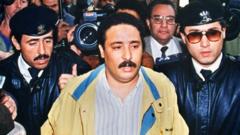
The death of Al Amin Khalifa Fhimah at age 70 marks a quiet, heavy finality for one of the darkest chapters in modern aviation security. Fhimah, the Libyan man who stood trial alongside Abdelbaset al-Megrahi for the 1988 bombing of Pan Am Flight 103, passed away in Tripoli. He leaves behind a legacy defined not by his acquittal, but by the lingering shadows of a tragedy that claimed 270 lives over a small Scottish town. With his death, both men originally indicted by British and American authorities in 1991 are gone. Yet the machinery of accountability continues to grind forward, even as the primary actors fade into history.
To understand the weight of Fhimah's passing, one must look past the simple headline of an aging man's death. Pan Am Flight 103 remains the United Kingdom's deadliest act of mass murder. When the Boeing 747 disintegrated over Lockerbie on December 21, 1988, it shattered global assumptions about civil aviation vulnerability. Baggage handling protocols, cargo security, and international intelligence sharing were forever altered. Fhimah, who worked as a station manager for Libyan Airlines in Malta, spent years under the intense microscope of international investigators who alleged he helped tag and route the suitcase containing the fatal explosive device.
The 2000-2001 special Scottish court convened at Camp Zeist in the Netherlands produced a fractured verdict that still reverberates through legal and geopolitical circles. While al-Megrahi was convicted on 270 counts of murder, Fhimah was acquitted of all charges. The panel of Scottish judges found that the prosecution failed to prove his guilt beyond a reasonable doubt, pointing to gaps in the timeline and conflicting evidence regarding his exact movements and access. Fhimah returned to Tripoli in 2001, living quietly while the geopolitical fallout of the bombing shifted across decades. Al-Megrahi, meanwhile, was sent to Barlinnie prison before receiving a controversial compassionate release in 2009 due to terminal cancer, returning to Libya where he died in 2012.
The conventional narrative often treats Fhimah's acquittal as a closed book, a symbol of judicial restraint where the innocent walked free. Experienced investigative reporters and security analysts know that reality is rarely so neat. Intelligence files declassified and scrutinized over the years point to a far more complex web of state-sponsored terror involving Libyan intelligence operatives, shifting loyalties, and hidden alliances. Fhimah's acquittal did not erase the suspicions of intelligence agencies that spent decades tracking the operational cells behind the attack. His position at Malta Luqa airport placed him at a critical logistical node during a period when security checks were porous compared to modern standards.
Decades after the event, the pursuit of absolute justice refuses to stay buried in the past. The legal saga surrounding the Lockerbie bombing extends far beyond the original two defendants. Just as Fhimah's death was announced, the judicial system was preparing for another chapter. The trial of Abu Agila Masud, a third Libyan national accused of manufacturing the bomb that destroyed the aircraft, faced fresh delays in Washington D.C., with jury selection postponed and further hearings scheduled. Masud's extradition and subsequent prosecution show that governments are willing to chase accountability across generations, even as the primary figures from the initial indictments pass away.
The passage of time inevitably erodes direct witness testimony and blurs physical evidence, transforming living history into archival record. Families of the victims, who have fought for decades to uncover every facet of the conspiracy, view these deaths with a mixture of sorrow and hollow resolution. For them, the loss of Fhimah and al-Megrahi means that avenues for direct confession or new revelations from the inside are permanently closed. The truth of precisely who ordered, built, and executed the bombing relies increasingly on paper trails, aging intelligence memos, and the contested confessions of defendants like Masud.
Security analysts studying the Lockerbie case often point out that the greatest failure was not merely the lack of technical screening, but the vulnerability of international logistics chains. A piece of luggage moved unchecked from Malta to Frankfurt, and then onto London Heathrow before finding its way into the cargo hold of Pan Am Flight 103. That operational blueprint exposed systemic flaws that civil aviation authorities spent the next thirty years frantically patching up. Every time a traveler encounters rigorous secondary screening or integrated baggage tracking today, they are interacting with the ghosts of the safety protocols born from the Lockerbie disaster.
Fhimah's death closes the book on the original courtroom drama of the Netherlands trial, but it leaves the broader historical ledger open. History rarely offers clean narrative arcs where every question finds a neat answer. Instead, it leaves us with partial verdicts, aging suspects, and an unrelenting pursuit of facts that stretches long past the lifetimes of those who stood accused.
The final chapter of accountability now rests entirely within a Washington courtroom, far from the skies of southern Scotland.


