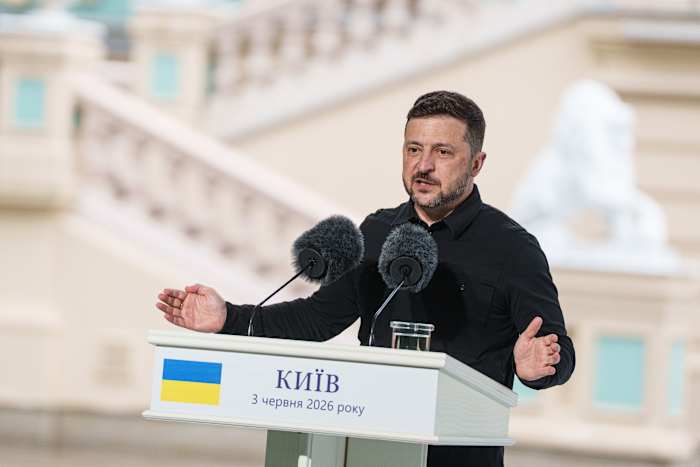
The convergence of British Prime Minister Keir Starmer, French President Emmanuel Macron, German Chancellor Friedrich Merz, and Ukrainian President Volodymyr Zelenskyy at Downing Street exposes the structural shift rewriting European security. Conventional journalistic narratives frame this meeting as a reactive diplomatic huddle triggered by the Kremlin’s overt rejection of direct negotiations. A rigorous strategic analysis reveals a different mechanism: the formalization of a European defense core engineered to manage long-term attrition independent of shifting transatlantic political configurations.
This diplomatic realignment operates across two distinct vectors: the creation of a European-led "coalition of the willing" to institutionalize security guarantees, and the tactical integration of deep-theater asymmetric warfare to establish a credible cost function for adversarial aggression.
The Strategic Asymmetry Matrix: Deep-Strike Infrastructure Attrition
The London summit took place immediately after a synchronized escalation of long-range drone strikes hitting St. Petersburg and surrounding industrial hubs. Evaluating these operations through an attrition framework shows that Kyiv has moved past purely symbolic operations, shifting toward a systemic disruption of the Russian economic and logistical architecture.
[Deep-Strike Long-Range Drone Incursions]
                │
                ├──> Logistics Disruption: Naval Arsenals & Oil Terminals (St. Petersburg)
                └──> Political Cost Function: Nullifying "Distant War" Narratives
The interception of 141 drones over the Leningrad region and a total of 376 nationwide demonstrates a deliberate strategy to saturate adversarial air defense networks. To understand how these long-range operations work, we must analyze the structural vulnerabilities they exploit:
- Air Defense Dilution: Russia’s air defense architecture is fundamentally optimized to protect localized frontline positions and high-value political installations. Forcing the redistribution of short- and medium-range systems (such as Pantsir-S1 and Tor-M2) over 1,000 kilometers deep into domestic territory creates severe, exploitable gaps along the active frontline.
- The Logistical Cost Asymmetry: Mass-produced, long-range Ukrainian uncrewed aerial vehicles (UAVs) cost a fraction of the advanced surface-to-air interceptors needed to stop them. Forcing the adversary to expend high-end munitions against low-cost kinetic swarms creates an unsustainable consumption ratio.
- Targeting Strategic Economic Assets: Striking naval arsenals in Kronstadt and oil infrastructure in St. Petersburg directly targets the fiscal drivers of the adversarial state. The proximity of these strikes to the conclusion of the St. Petersburg International Economic Forum systematically undercuts attempts to insulate domestic markets from the economic realities of the conflict.
The tactical reality of this phase is defined by a stagnant land frontline paired with intense long-range kinetic exchanges. While Russian forces continue minor tactical advances, such as claiming the settlement of Shevchenko in the Kharkiv region, the strategic return on these territorial gains is being offset by the systematic degradation of their domestic energy and military infrastructure.
The E3 Security Architecture: Mechanics of the Coalition of the Willing
The Downing Street meeting marks the operational debut of the E3 framework under its current leadership: Starmer, Macron, and Merz. This group represents the three largest defense spenders in Europe, and they are moving to fill the strategic void left by shifting priorities in Washington.
The structural foundation of this initiative is built on three core pillars:
1. The Security Guarantee Formula
The "coalition of the willing" led by London and Paris aims to replace vague political promises with legally binding bilateral defense pacts. The blueprint for this model is the recent UK-Poland security agreement, which established a baseline for long-term intelligence sharing, joint industrial production, and rapid deployment frameworks. By scaling this model across the E3, Europe is building an institutional framework designed to survive fluctuations in the broader alliance.
2. Defense Industrial Integration
The primary bottleneck for European strategic autonomy is not political will; it is industrial manufacturing capacity. The London talks aimed to align British, French, and German industrial pipelines to address structural shortages:
[Industrial Alignment Strategy]
  ├── UK-Poland Pact Model ──> Scale to E3 Blueprint
  └── Production Scaling  ──> Standardizing 155mm Art. Munitions & Advanced Air Defense
The second limitation is the lack of standardized procurement, which complicates maintenance and logistics at the front. The strategic objective is to create joint manufacturing hubs within Europe and western Ukraine to build sustainable, high-volume production lines for 155mm artillery ammunition, armored vehicles, and advanced missile systems.
3. Redefining the Escalation Threshold
By coordinating directly with Kyiv on deep-strike capabilities, the E3 is quietly redrawing the boundaries of Western intervention. The open support for Ukraine’s right to strike military targets deep within the adversary's borders marks a structural departure from early-stage conflict management, which was often paralyzed by fears of horizontal escalation.
Tactical Vulnerabilities and Operational Friction Points
A data-driven assessment requires acknowledging the severe operational vulnerabilities facing the European coalition. The adversarial strategy remains tied to high-mass attrition, leveraging drone and artillery saturation to exhaust Ukrainian civilian and military infrastructure.
The intercept profile from recent engagements highlights this systemic pressure:
| Attack Vector | Munitions Launched | Interception Rate | Operational Impact |
|---|---|---|---|
| Adversarial Shaded-Type UAVs | 272 | 91.5% (249 Intercepted) | Remaining 23 drones hit critical nodes, including energy storage and transport hubs. |
| Frontline Rocket & Artillery | Concentrated barrages | Highly Variable | Continuous attrition of civilian hubs and transit infrastructure (e.g., Zaporizhzhia). |
This data exposes a critical operational bottleneck. Achieving a 91.5% interception rate requires immense logistical and financial resources. The expenditure of air defense interceptors to counter mass-produced attack drones strains Western supply lines. Furthermore, incidents like the drone strike damaging a spent nuclear fuel storage facility near Chernobyl emphasize the high stakes involved. Even if radiation levels remain stable, these strikes place a heavy psychological and operational burden on localized defensive networks, drawing attention away from frontline operations.
The economic strain within Europe adds another layer of friction. While Chancellor Merz brings a renewed focus on fiscal discipline and industrial output to Germany, the E3 nations are balancing domestic economic pressures against long-term defense spending commitments. The adversary is explicitly betting that European political resolve will fracture under the weight of sustained inflation, high borrowing costs, and industrial energy constraints.
The Attrition Equilibrium: A Definitive Forecast
The diplomatic gridlock is now structurally locked in. The adversary's formal rejection of face-to-face negotiations confirms that Moscow is fully committed to a war of attrition, banking on the absolute exhaustion of Ukrainian personnel and Western material reserves. The open letter from Kyiv proposing a conditional ceasefire along current frontlines was less a bid for immediate peace and more a strategic stress-test of the Kremlin's diplomatic flexibility. The outright refusal of the offer clarifies the strategic landscape for European planners: negotiation is off the table until the material cost function becomes unbearable for the adversary.
The strategic play for the E3 coalition requires shifting from a policy of short-term crisis management to an institutionalized model of sustained containment. To establish a credible deterrent, the London framework must prioritize three immediate operational steps:
- Formalize the E3 Security Pact: Convert the "coalition of the willing" into a formal joint defense framework that legally commits the UK, France, and Germany to long-term equipment replacement and intelligence integration.
- Decouple Drone Defense Logistics: Radically accelerate the deployment of low-cost, directed-energy weapons and electronic warfare systems to replace expensive missile interceptors against tier-one and tier-two UAV threats.
- Expand Deep-Theater Interdiction: Provide the targeted intelligence and raw materials needed to expand Kyiv's domestic long-range strike capacity, raising the domestic economic cost for the adversary.
Europe's security architecture is shifting away from its reliance on external security umbrellas toward a self-sustaining continental core. The success of this transition depends on whether the E3 can transform their combined economic power into immediate, scalable military output before the frontline reaches a breaking point.