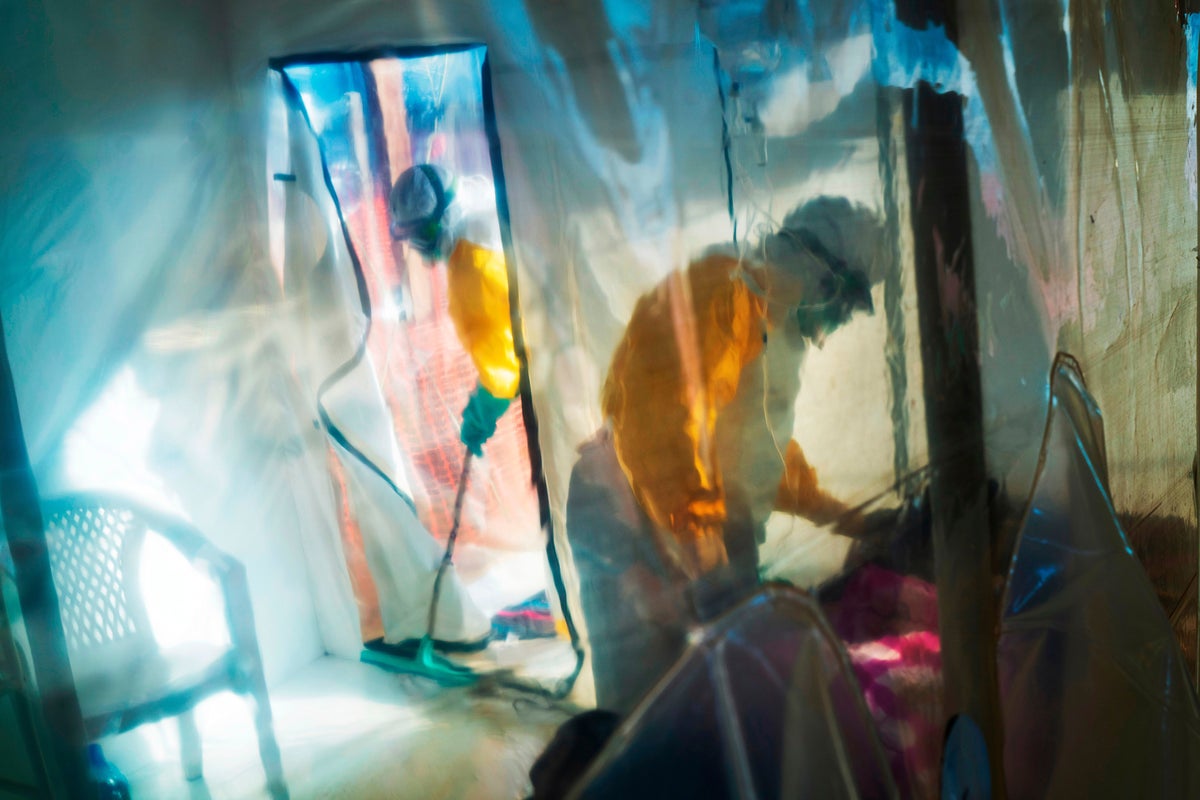
The air in eastern Democratic Republic of Congo does not circulate; it hangs. It smells of woodsmoke, rich red earth, and the faint, metallic tang of fear that settles over a community when an invisible killer walks the streets. To the outside world, an Ebola outbreak is a headline, a collection of numbers, a grim tally updated on a global health dashboard. But when you are standing on the dirt roads of North Kivu, Ebola is not a statistic. It is the sound of a plastic tarp rustling in the wind outside an isolation ward. It is the absolute, terrifying silence of a village that has stopped shaking hands.
When the health minister announced the construction of three new Ebola treatment centers, the international press ran standard, predictable copy. They listed the locations. They quoted the official press releases. They spoke of "capacity building" and "containment strategies."
They missed the entire point.
An Ebola treatment center is not just a building made of wood, concrete, and heavy-duty plastic sheeting. It is a battleground where human psychology fights against a biological horror. To understand why three new centers matter, you have to understand what it feels like to watch your child develop a fever in a zone of conflict. You have to understand the sheer weight of the choices being made in the dark.
Consider a hypothetical mother named Marie. She lives on the outskirts of Beni. Her six-year-old son, Alphonsine, woke up warm this morning. In any other part of the world, a childhood fever means medicine, a day off from school, and a damp washcloth on the forehead. In eastern Congo, a fever triggers a cascading sequence of terror. Is it malaria? Is it typhoid? Or is it the virus that liquefies cells and bleeds its victims from the inside out?
If Marie takes Alphonsine to a traditional healer, she risks infecting her entire family. If she keeps him at home, she watches him slip away. If she takes him to a government facility miles away, she fears she will never see him again. Rumors travel faster than the virus here. People whisper that the treatment centers are places where foreigners steal organs, or where people are sent to die alone, stripped of their dignity and buried in plastic bags by men who look like astronauts.
This is the psychological wall that health workers face every single day. The battle against Ebola is only ten percent medicine. The other ninety percent is trust.
The three new centers are being placed strategically, dropped directly into the heart of the most resistant communities. This isn't just about cutting down travel times, though logistically, transporting a highly infectious, vomiting patient over roads pitted with mud and controlled by armed militias is a nightmare. The real strategy is visibility. By bringing the centers closer to the people, the mystery evaporates.
When a facility is built within walking distance of a market, it stops being a mysterious fortress of death. It becomes part of the neighborhood. Mothers can see other mothers walking out of the front gates, cured, holding their children. They see that the people inside the yellow biohazard suits speak their language, Swahili or Lingala, and that under those heavy goggles are the eyes of neighbors, cousins, and friends.
The logistics of setting up these zones are dizzying. It requires a choreography that must be flawless. One mistake, one torn glove, one improperly mixed batch of chlorine solution, and the facility itself becomes a vector. The space is divided rigidly into the "hot zone" and the "green zone." The boundary between them is a physical line of tape on the floor, but conceptually, it is a border between life and death.
Health workers spend hours learning how to take off their protective gear. The process is agonizingly slow. It is a precise dance of peeling away layers, spraying disinfectant, washing hands, and stepping backward. It takes longer to exit the hot zone safely than it does to conduct a patient evaluation inside it. The heat inside those suits is oppressive. Within minutes, sweat pools in the rubber boots, making every step heavy and squelching. The goggles fog up. The breath comes short and fast. Yet, the touch administered through three layers of nitrile gloves must remain gentle, reassuring, and profoundly human.
We often look at these crises and wonder why containment takes so long. We wonder why, despite decades of medical advancement and the deployment of experimental vaccines, the virus still finds cracks to slip through. The truth is uncomfortable. The virus leverages our best human instincts against us. It thrives on love. It spreads when a grieving daughter washes the body of her deceased mother before a funeral. It spreads when a father refuses to let his sick son be isolated by strangers and holds him through the night.
To break the chain of transmission, health workers have to ask people to suspend their deeply held cultural practices. They have to ask them to stop touching their dying loved ones. It is an impossible ask, delivered by outsiders who often do not understand the local context.
That is why the announcement of new centers matters less than how those centers operate. The shift in modern outbreak response is towards community-led care. The new facilities are designed with transparent walls. Families can stand in the safe zone and look through clear plastic sheets to see their relatives eating, talking, and resting. They can speak to them through microphones. The isolation is physical, but it no longer has to be emotional.
But the real problem lies elsewhere, far from the supply lines and the clinical protocols. The true enemy is the exhaustion.
The local medical staff—the nurses, the hygienists, the burial teams—have been running this marathon for years. They live under a dual threat. On one side is a lethal pathogen that kills a massive percentage of those it infects. On the other side is the systemic violence of a region plagued by dozens of active rebel groups. Sometimes, the treatment centers themselves are attacked. Rumors fueled by political instability lead to riots, and facilities are burned to the ground.
Imagine standing in a plastic suit, trying to insert an IV line into a dehydrated child, while hearing gunfire in the distance. Imagine knowing that when your shift ends, your walk home might take you through a territory controlled by men with machetes and Kalashnikovs.
Yet, the staff returns every morning. They wash their hands in chlorinated water until their skin is raw and bleached white. They step back into the suits. They do it because they know that if they step away, the firewall crumbles, and the virus will sweep through the dense urban hubs of Central Africa, crossing international borders before the world even realizes the line has been breached.
The international community views these interventions through a lens of charity or global health security. We fund these centers to keep the monster contained "over there," safely away from our own modern, predictable lives. It is a comforting illusion. But in an interconnected world, there is no "over there." A passenger can board a plane in Kigali or Kinshasa and be in London, Paris, or New York within twenty-four hours. The yellow plastic fencing in North Kivu is the only thing standing between global normalcy and chaos.
The new treatment centers will open their doors this week. The concrete is curing; the chlorine barrels are stacked high. Generators will roar to life, humming a steady, mechanical baseline against the backdrop of the Congolese forest. Inside, beds are lined up, pristine and empty, waiting for the first patients who will test the community's willingness to trust.
Late in the afternoon, as the equatorial sun dips below the horizon, the shadows stretched across the red dirt of the new Beni facility look long and thin. A nurse stands by the entrance, her mask pulled down around her neck for a brief moment of cool air. Her face bears the deep, purple indentations of the goggles she has worn for six hours straight. She looks out toward the main road, watching the dust kick up as people hurry home before curfew. She does not look like a hero in a movie. She looks tired. She looks like a person who knows exactly what is coming, and who has chosen to stay exactly where she is.