Saltwater does not care about milestones. It does not look at a calendar and whisper that six months is long enough. It does not measure time in anniversaries missed, teeth lost by children growing up through phone screens, or hot coffee turning cold on a desk while a watch ticks in the dark. Saltwater only pushes, rolling against steel plates with an indifferent, rhythmic weight that never stops.
For the sailors aboard the USS Abraham Lincoln, the horizon became a permanent fixture of existence. Day after day, the sea met the sky in a seamless, unbroken ring, isolating them inside a floating city of nuclear power, aviation fuel, and aluminum. For a closer look into this area, we suggest: this related article.
Consider what it means to live in a floating fortress where the air is filtered, the water is desalinated, and the news arrives in compressed digital bursts. You sleep beneath the roar of catapults launching F-35C Lightning II jets into the blue. You eat your meals standing up because a swell just hit the hull at an awkward angle. You count the rotations of the Earth not by sunsets over familiar hills, but by flight deck operations and the quiet hum of ventilation shafts.
Then the orders change. Or rather, they don't. They just stretch. For broader information on this issue, comprehensive coverage can also be found on NPR.
When a deployment stretches past ordinary expectations, it creates a specific kind of psychological geography. Time stops moving forward and starts looping. Sailors talk about "the slip"—that strange zone where Tuesday feels like three weeks ago and last month feels like a different lifetime. Families back home live in a parallel dimension of double-checking phone notifications, dreading the middle-of-the-night ring, and managing the quiet, grinding friction of solo parenthood, broken water heaters, and quiet dinner tables.
The USS Abraham Lincoln carrier strike group did not just return from an ordinary cruise. They completed a record-setting deployment, extending far beyond the standard rotation window, navigating tensions across volatile maritime corridors, and serving as an unyielding projection of American deterrence in an increasingly fracture-prone world.
Numbers tell part of the story. Millions of gallons of fuel transferred. Thousands of sorties flown. Countless nautical miles logged across oceans that grew angry, calm, stormy, and dead still. But numbers are a shield against the human reality.
To understand the weight of that deployment, you have to shrink the lens down to a single compartment two decks below the flight deck, where a 21-year-old aviation structural mechanic sits on the edge of a narrow rack. He is holding a smartphone that hasn't had a stable signal in four days. He is looking at a photograph of his daughter taken three months ago. In the photo, she is holding a drawing of a cat. By the time he sees her in person, she will be walking differently, speaking with a vocabulary that expanded entirely without his witness.
This is the invisible tax paid by those who serve on the capital ships of the United States Navy. The steel does not tire. The reactors do not burn out from homesickness. But the people inside the machine do. They adapt because they must. They develop an institutional resilience born of routine, dark humor, and a fierce, unspoken camaraderie that forms only when thousands of strangers are locked together in a floating steel tube thousands of miles from land.
The modern aircraft carrier is often described in terms of its technological supremacy—a floating airbase carrying a lethal punch capable of deterring peer adversaries across globe-spanning distances. But technology is secondary to the human endurance required to keep it operational. It takes thousands of minds and bodies working in synchronized precision to launch a single jet off a pitching deck at midnight in heavy seas. If one person loses focus, catastrophe follows.
That collective focus had to be sustained, day after relentless day, during a deployment that tested the limits of endurance, supply chains, and mental stamina.
When the call finally came to turn the ship's massive bow homeward, the reaction was not an immediate explosion of cheers. Sailors describe a strange, hollow quiet settling over the berthing compartments. Relief is a heavy emotion. It creeps in slowly, like light under a door. You don't quite trust it at first. You wait for the announcement that plans have changed, that a new flashpoint has flared up, that the transit window has been canceled.
Only when the jagged silhouette of the coastline finally resolves out of the gray haze does the reality pierce the armor.
San Diego. Norfolk. Whichever homeport awaits, the arrival of a supercarrier is a spectacle of epic proportions. Thousands of people line the piers, holding handmade signs, wearing custom t-shirts, waving small American flags that snap in the coastal wind. Balloons bounce against the salt air. Strollers are lined up three deep against the security fences.
Yet, beneath the pageantry lies an intimate, fragile choreography.
Imagine standing on that pier. The ship approaches like an artificial island, blotting out the sun, gray and scarred with rust streaks from months of salt spray. The sound hits you before the details do—the deep, resonant blast of the ship's horn, a sound that vibrates in the sternum and brings tears to eyes that swore they wouldn't cry.
Then the gangway goes down.
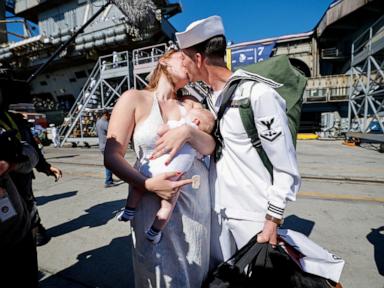
In the seconds before the first sailor steps off, the crowd holds its collective breath. Then the floodgates open. Uniformed men and women stream down the metal stairs, carrying sea bags, wearing expressionless masks of exhaustion that instantly dissolve the moment they spot a familiar face in the crowd.
A toddler drops a stuffed animal and runs blindly into khaki trousers. A husband lifts his wife off her feet, burying his face in her neck, holding on as if letting go would send him back out to sea. A mother drops to her knees to hug a son who has grown three inches since November.
These moments are not diplomatic milestones. They are the quiet, essential repair work of a nation that asks its military families to bear an extraordinary burden out of sight and out of mind.
The record books will record the USS Abraham Lincoln's deployment in terms of months at sea, strategic positioning, and operational readiness metrics. But history is written by people who lived through the silence between the satellite calls. It is written in the salt stains on flight deck jerseys, the worn pages of paperback books read until the bindings cracked, and the quiet determination of sailors who did their jobs when nobody was watching.
The ship is tied up now. The engines are cooling. The flight deck is silent, save for the gulls wheeling overhead in the bright coastal air. But out on the dark water, beyond the breakwater, the ocean remains deep, restless, and waiting for the next rotation.