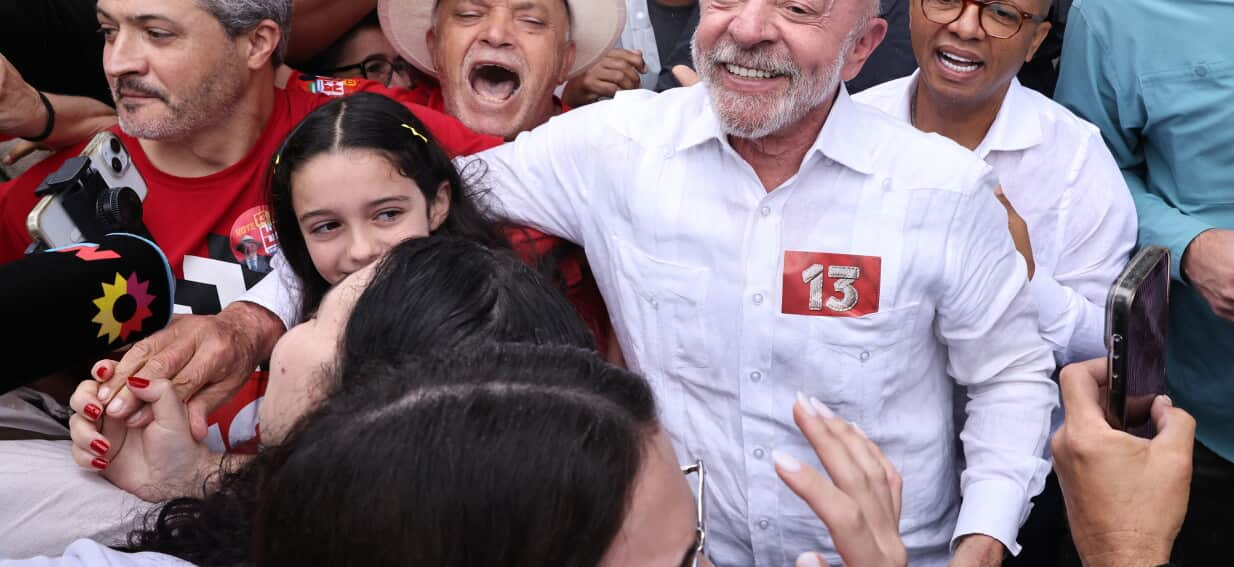
Luiz Inácio Lula da Silva has secured an unprecedented fourth presidential term in Brazil, defeating the right-wing movement anchored by former president Jair Bolsonaro and signaling a sharp geopolitical rebuke to Donald Trump's influence in Latin America. By winning the 2026 presidential election, the 81-year-old leftist leader became the first politician in Brazil's modern democratic history to occupy the Planalto Palace four times. The victory cements the Workers' Party's grip on South America's largest economy, though it comes with razor-thin margins, a deeply fractured congress, and immediate friction with Washington.
Most international headlines frame this race as a simple rematch of ideologies. That misses the actual mechanics on the ground. You cannot understand how a leader in his eighties overcame relentless inflation anxieties and conservative congressional gridlock without looking at how state welfare architecture, regional trade alliances, and external political interference collided at the ballot box.
The Anatomy of an Unlikely Reelection
Conventional political wisdom dictates that incumbents rarely survive four years of sluggish global growth and polarized legislative warfare. In Brazil, the odds were even steeper. Lula entered his third term in 2023 with a mandate to rebuild environmental protections and social safety nets, yet he spent much of his tenure fighting a conservative-dominated National Congress that held his budget hostage.
The opposition, rallying behind Bolsonaro’s political machine and emboldened by Trump's return to the White House in 2025, bet everything on economic fatigue and cultural backlash. They assumed middle-class voters in the industrial southeast would punish the administration for higher taxes and public spending.
They miscalculated the durability of targeted fiscal transfers.
While pundits in São Paulo debated macroeconomic deficits, Lula’s team focused relentlessly on the Bolsa Família cash-transfer program and real minimum-wage increases. For tens of millions of households in the impoverished Northeast, these policies are not abstract budget line items. They are the difference between food security and destitution. When election day arrived, that demographic firewall held firm, neutralizing conservative gains in the agricultural heartland.
The Trump Factor Backfires
Foreign policy rarely decides a Brazilian election. This cycle proved an exception.
Throughout 2025 and 2026, Trump’s administration aggressively courted the Brazilian right, framing South American politics as an existential battle against socialism. High-profile endorsements, tariff threats against BRICS nations, and vocal support for Bolsonaro’s legal battles were meant to energize conservative voters in Brazil.
Instead, it handed Lula a nationalist rallying cry.
Brazilians across the political spectrum harbor a deep, historical sensitivity to foreign meddling. By positioning himself as the defender of national sovereignty against American economic bullying, Lula successfully shifted the campaign narrative. Voters who were lukewarm on his domestic economic record suddenly saw him as the only figure capable of standing toe-to-toe with Washington without turning Brazil into a geopolitical vassal.
Trump’s rhetoric gave the Workers' Party an external adversary, uniting fractious left-wing factions that might otherwise have stayed home.
Economic Reality Behind the Campaign Slogans
Winning an election is one thing. Governing a country with structural fiscal bottlenecks is another entirely.
During the campaign, Lula’s surrogates pointed to falling unemployment rates and renewed foreign direct investment in green energy. Those numbers are real. Brazil’s vast hydroelectric grid, wind farms, and biofuel infrastructure have made it an indispensable supplier for global companies trying to decarbonize their supply chains.
Yet beneath those headline figures lies a precarious fiscal balancing act. To fund social programs without triggering a currency collapse, Finance Minister Fernando Haddad had to enforce a strict fiscal framework that capped spending growth relative to tax revenues. This satisfied bond markets in the short term, preventing a repeat of the sovereign debt crises that plagued Latin America in previous decades.
The cost, however, was borne by the domestic consumer. High interest rates maintained by the Central Bank to curb inflation kept credit expensive for small businesses and working families.
- Consumer debt remained stubbornly high throughout 2025 and 2026, limiting the purchasing power of the lower-middle class.
- Infrastructure bottlenecks in ports and railways continued to inflate the cost of transporting agricultural exports, eating into profit margins.
- Tax reform implementation created transitional confusion for service-sector companies, slowing private-sector hiring in major urban centers.
Lula won because voters trusted him more than his opponents to protect the poor during an economic squeeze, not because the economy was firing on all cylinders.
The Congressional Wall That Never Fell
If you want to know what Lula’s fourth term will actually look like, stop looking at the presidential palace and start looking at the legislature.
Brazil operates under a system known as coalition presidentialism. Because the country has dozens of political parties, no president ever wins an outright majority in Congress. To pass a single bill, the executive branch must negotiate continuously with a shifting bloc of transactional, center-right lawmakers known collectively as the Centrão.
Over the past decade, Congress has quietly stripped away presidential power by seizing control of mandatory budget earmarks. Billions of reais are now directed straight to local districts by lawmakers, bypassing ministerial oversight entirely.
Lula’s reelection did nothing to alter this balance of power. The conservative and agribusiness caucuses remain firmly entrenched in both the Chamber of Deputies and the Senate. Every major initiative—from environmental enforcement in the Amazon to corporate tax adjustments—will require grueling, expensive compromises.
A hypothetical example illustrates this trap clearly. Suppose the administration wants to pass a new bill funding public universities in the south. To get it onto the floor for a vote, the president's chief of staff might have to release millions in discretionary agricultural subsidies to lawmakers representing cattle ranchers in Mato Grosso—lawmakers who simultaneously oppose the administration's deforestation limits. Governing becomes an exercise in constant triage.
Geopolitics in a Fractured Hemisphere
Lula’s fourth term ensures that the diplomatic chill between Brasília and Washington will harden into a long-term freeze.
For decades, Brazil prided itself on pragmatic non-alignment, maintaining warm commercial ties with the United States, Europe, and China simultaneously. That diplomatic middle ground is vanishing. With Trump pushing aggressive bilateral trade demands and Lula championing a multipolar world order through BRICS, the two largest democracies in the Western Hemisphere are operating from fundamentally incompatible playbooks.
China is already Brazil’s largest trading partner by a wide margin, buying up massive quantities of soybeans, iron ore, and crude oil while investing heavily in Brazilian electric vehicle manufacturing and power transmission lines. Over the next four years, Brasília will almost certainly accelerate its integration into Beijing-backed trade and infrastructure networks to insulate itself from potential U.S. tariffs.
At the same time, Lula’s victory breathes new life into regional integration projects across South America. Left-leaning governments in neighboring countries, which had feared diplomatic isolation if the Brazilian right returned to power, now have a heavyweight regional anchor in Brasília to push back against Washington's hemispheric agenda.
What the Left Still Refuses to Confront
Beneath the celebrations in Brasília lies an uncomfortable truth that the Workers' Party can no longer ignore. The movement is entirely dependent on one octogenarian leader.
For more than forty years, Lula has been the sun around which the Brazilian left orbits. His personal biography—rising from a poor childhood in Pernambuco to lead metalworkers' strikes against a military dictatorship, surviving imprisonment, and returning to the presidency—gives him a visceral connection with working-class voters that no technocrat can replicate.
That singular dominance has become an organizational liability.
The party has failed to cultivate a younger generation of leaders with comparable national appeal. Meanwhile, the cultural terrain in Brazil has shifted dramatically beneath their feet. The rapid growth of evangelical Christianity across urban peripheries has created a deeply conservative social base that views the traditional left with suspicion, regardless of economic handouts.
Bolsonaro’s political brand may have suffered a major setback at the polls, but the conservative movement he galvanized is structural, well-funded, and deeply rooted in local municipal governments across the country. It is not going away simply because Lula won another four years.
Lula now faces the hardest task of his political life—not beating his rivals at the ballot box, but proving that his administration can deliver tangible economic mobility before age and succession politics finally catch up with the movement he built.