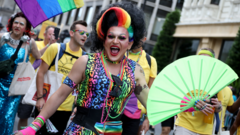
The operational viability of civic advocacy movements scales predictably with capital efficiency, legislative protections, and spatial infrastructure. When these variables degrade simultaneously, the baseline cost of achieving equivalent advocacy outcomes escalates exponentially. The current operational reality of Pride London exposes this systemic imbalance: despite drawing more than one million attendees and coordinating 35,000 marchers across 600 distinct organisations, the structural framework supporting the LGBTQIA+ ecosystem faces compounding capital, clinical, and spatial deficits.
To understand why large-scale civic mobilization requires targeted intervention, the underlying mechanics must be disaggregated into quantifiable operational risks. The assumption that high attendance correlates directly with structural stability ignores a severe breakdown across three core dependencies: infrastructure preservation, clinical delivery velocity, and security overhead.
The Spatial Decay Function: Infrastructure Contraction
The primary asset of any urban cultural ecosystem is physical space. Physical density drives network effects, accelerates resource distribution, and lowers the customer acquisition cost for grassroots organizing. In London, this physical foundation is in a state of rapid contraction.
Between 2006 and 2026, London lost 58% of its dedicated LGBTQIA+ venues. This structural attrition alters the economic mechanics of community advocacy in two ways:
- Network Fragmentation: The loss of localized hubs increases the physical distance between stakeholders, creating an operational bottleneck that prevents information velocity and resource sharing.
- Commercial Displacement: As dedicated non-profit and community spaces vanish, organizing efforts are forced into commercialized, transactional environments. This increases the baseline real estate cost for civic groups, shifting capital away from direct advocacy and into commercial rent.
The reduction in physical infrastructure undermines the long-term viability of small, specialized advocacy units. When physical spaces disappear, the financial burden of maintaining community networks scales linearly with real estate inflation, making grassroots operations unsustainable without systemic intervention.
Clinical Velocity Bottlenecks and Legislative Backlogs
The efficiency of a civic health framework is determined by its processing capacity relative to total demand. In the UK, this capacity has failed to scale with the demographic requirements of the population, creating severe delivery deficits.
[Systemic Demand] ---> [4-Year Clinical Processing Bottleneck] ---> [Advocacy Overhead Inflation]
NHS gender-affirming care waiting lists now exceed four years in multiple regions. This clinical delay operates as a systemic bottleneck, generating compounding downstream effects:
- Advocacy Overhead Inflation: When state-funded clinical infrastructure fails to deliver timely care, the financial and operational burden shifts heavily onto non-profit organizations. These groups must divert limited resources toward mental health triage and crisis management, starving long-term policy initiatives of essential funds.
- Legislative Stagnation Costs: The ongoing delay in codifying a comprehensive, trans-inclusive ban on conversion therapy—six years after the initial 2018 government pledge—creates sustained legal and psychological volatility. This absence of statutory protections increases the litigation and safety-compliance costs for organizations operating on the ground.
The Security Overhead Penalty
Civic execution requires a predictable security landscape. When external hostility rises, the cost of safety compliance escalates, acting as a direct tax on public assembly. Home Office figures for 2025 documented more than 18,000 reported hate crimes motivated by sexual orientation across the United Kingdom.
This environment imposes a real financial penalty on events like Pride London. The budget required for crowd management, defensive insurance, physical barriers, and private security details scales rapidly to mitigate these elevated risks. For smaller grassroots organizations within the 600 marching groups, this high security overhead acts as a barrier to entry, effectively pricing out under-funded advocacy segments from the public square.
Corporate Capital Allocation and the Instructionless Love Paradox
Large corporate sponsors provide significant cash flow for large-scale urban events. Brands like Lidl, Tesco, and Ikea deployed branded activations during the London procession, with corporate messaging emphasizing open-ended themes such as "Love doesn't require instructions."
While this corporate capital stabilizes the immediate balance sheet of the central parade, it introduces a structural misalignment regarding resource allocation:
The Marketing Capital Mismatch
Corporate expenditure is primarily directed toward high-visibility marketing activations rather than the long-term preservation of community infrastructure. This creates a stark paradox: millions of pounds flow into central London for a single afternoon of brand alignment, while the permanent venues that sustain the community throughout the remaining 364 days face persistent capital starvation and closure.
Advocacy Dilution
Broad corporate messaging lacks the policy-specific utility needed to drive legislative progress. While conceptually supportive, abstract themes do not address quantifiable deficits like the four-year clinical backlogs or uncodified legal protections. Consequently, the capital injection keeps the event operationally solvent but fails to yield long-term systemic progress.
Strategic Rebalancing of Cultural Assets
To offset spatial decay and clinical backlogs, corporate capital must be structurally diverted from transient marketing displays into permanent infrastructure investments. Relying on annual, single-day activations fails to secure long-term operational resilience. The primary strategic shift requires establishing corporate-endowed land trusts designed to acquire, subsidize, and protect physical venues from commercial real estate pressures.
Simultaneously, underwriting private, non-profit clinical alternatives can directly bypass the four-year state backlog. By converting symbolic corporate participation into localized, legally protected physical and clinical assets, the ecosystem can reduce its exposure to real estate inflation and state service failures, stabilizing the baseline infrastructure required for sustained civic advocacy.