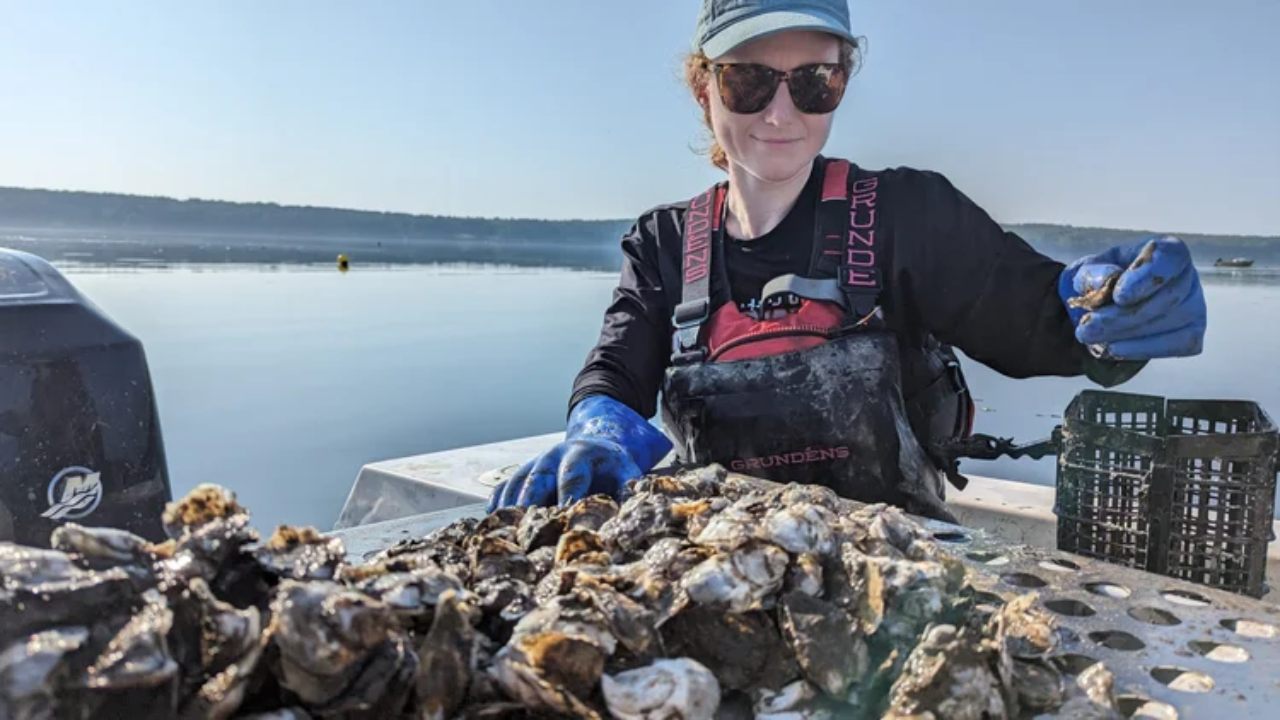
Shellfish aquaculture in cold northern waters is a battle of inches and ounces. Every single market-ready bivalve represents months of backbreaking labor, battling the North Atlantic tides, and manual sorting under freezing rain. A Maine oyster farm is currently testing a mechanical floating conveyor that cycles oyster baskets automatically through water and air, bypassing the traditional manual flip method that has defined the trade for generations.
This automation pilot tackles the single largest operational bottleneck in modern aquaculture: labor intensity. Traditional surface and floating bag methods require workers to haul gear by hand, flip bags to control biofouling, and sort growth irregularities one by one. The new floating conveyor mechanism uses wave action or small motorized drives to rotate cages systematically.
For decades, the standard operating procedure for off-bottom oyster farming has relied on brute force. Growers secure mesh bags to longlines or floating racks. To prevent algae, barnacles, and mussels from choking out the oysters, workers must regularly pull these bags onto a working vessel, flip them manually to dry out the fouling organisms in the sun, and toss them back into the brine.
It is grueling work. It wrecks lower backs, eats up scarce daylight hours, and creates a hard ceiling on how many animals a single crew can manage.
Enter the automated floating conveyor. By suspending the baskets on a continuous mechanical loop that interacts with the natural rise and fall of the tide or a low-draw motor, the system exposes the oysters to alternating cycles of submersion and air drying without requiring a human hand to touch every individual cage.
The Mechanics of Biofouling Control
Biofouling is the silent killer of profit margins in aquaculture. Unchecked marine growth blocks water flow through the mesh bags. Without adequate nutrient-rich water passing over them, oysters stop growing.
The biological logic behind the floating conveyor rests on desiccation. When marine organisms like tunicates, bryozoans, and green algae are hoisted out of the water into the drying air, they dehydrate and die.
Traditional farming achieves this through scheduled manual flips. Growers watch the weather, wait for a calm day, load the skiff, haul the gear up, flip it, wait a few days, and reverse the process. It is an administrative and physical nightmare.
The floating conveyor automates the cadence. By shifting the baskets through the air-water interface continuously or on a strict mechanical timer, the system starves biofouling agents of moisture before they can establish a thick colony.
[Traditional Method] -> Manual Haul -> Deck Sort -> Sun Dry -> Hand Flip -> Re-submerge
[Conveyor Method]  -> Mechanical Loop -> Automated Air/Water Cycle -> Continuous Operation
This mechanical predictability removes human error from the equation. If a crew falls behind on flipping due to bad weather or labor shortages, the fouling takes over, growth stalls, and mortality rates spike. An automated system keeps moving regardless of whether the deckhands are nursing sore muscles.
Labor Realities in the Modern Coastal Economy
Finding reliable labor along the coast of Maine has transformed from a seasonal challenge into an existential crisis. Waterfront housing costs have skyrocketed, young workers are migrating inland or toward tech sectors, and the physical demands of aquaculture deter casual applicants.
When an operation relies entirely on manual labor for husbandry tasks, its growth is strictly linear. Double the number of oysters, and you must double the number of hours worked or hire a second crew.
Mechanization breaks that linear trap. A floating conveyor allows an operation to scale its stock volume without a proportional explosion in payroll.
The economic calculus extends beyond direct wages. Worker compensation insurance claims for repetitive strain injuries and back trauma represent a massive overhead expense for aquaculture enterprises. Shifting the heavy lifting from human vertebrae to marine-grade polymers and stainless steel changes the risk profile of the entire business.
The Engineering Hurdles on the Open Water
Building a machine that works in a controlled factory is simple. Building a machine that survives the corrosive, dynamic, and violent environment of a Maine estuary is an entirely different discipline.
Saltwater is relentless. It pits metals, seizes bearings, and coats electrical contacts in conductive grime.
The prototype floating conveyors currently undergoing trials in Maine must withstand:
- Sub-zero winter temperatures and surface ice formation.
- Storm surges driven by nor'easters packing gale-force winds.
- Biofouling attacking the mechanical moving parts of the conveyor itself.
- Constant wave action that induces fatigue stress on joints and fasteners.
Engineers have had to lean heavily on high-density polyethylene and specialized marine alloys to prevent catastrophic structural failure. If a gear jams or a drive chain snaps in the middle of an icy November gale, repairing it safely requires waiting for a weather window that might not open for weeks.
Biological Impacts on the Bivalves
Machines do not possess intuition, which raises a critical question for aquaculturists: How do the oysters handle the ride?
Oysters are sessile filter feeders that close their shells tightly when disturbed. Subjecting them to constant mechanical agitation can induce chronic stress, forcing them to expend energy keeping their valves shut rather than feeding and growing.
Initial data from the Maine trials suggest a nuanced reality. Controlled, slow-speed rotation mimics the natural turbulence of a high-energy tidal zone. Oysters grown in dynamic water often develop deeper, stronger cups and harder shells because the muscle must work to stabilize the animal against movement.
However, too much vibration or aggressive handling can cause shell breakage at the bill, creating cosmetic flaws that reduce market value in the high-end raw bar trade.
The sweet spot lies in tuning the conveyor speed to match local hydrographic conditions. The goal is to replicate the beneficial exercise of natural wave action without triggering a defensive stress response.
Market Reception and the Premium Raw Bar Standard
The end consumer sitting in a Boston or New York bistro cares little about drive chains or polyethylene grades. They care about shell shape, meat fill, salinity, and cleanliness.
The raw bar market demands a pristine product. An oyster covered in residual mud, chipped at the edge, or fouled with barnacles will be rejected by wholesalers immediately, regardless of how sweet the meat tastes inside.
By automating the cleaning and rotation cycle, the floating conveyor consistently delivers a cleaner, more uniformly shaped shell. The constant motion prevents the oysters from clustering together into irregular clumps, a common issue in static bags where the animals fuse or grow sideways against their neighbors.
Uniformity translates directly to higher yield percentages at harvest. When 90 percent of your crop fits standard market grades rather than being oversized, undersized, or deformed, the revenue per acre multiplies dramatically.
Financial Viability and Capital Expenditure
Innovation requires capital, and capital is scarce in independent farming sectors.
Traditional oyster gear is cheap. A mesh bag and some line represent a minimal initial investment. Transitioning to a proprietary floating conveyor system involves significant upfront capital expenditure.
Small-scale growers operating on tight margins cannot easily absorb the cost of specialized mechanical infrastructure. For these operations to benefit, the technology must either drop significantly in price or prove that the labor savings and yield increases pay off the equipment within a few harvest cycles.
Larger corporate-backed aquaculture ventures, conversely, view these systems as essential investments for future scale. As consolidation reshapes coastal waters, the farms that survive will be those that successfully transition from artisanal craft to industrialized food production.
The Regulatory Labyrinth
Deploying new infrastructure in public tidal waters is never straightforward.
State regulators, commercial fishermen, waterfront property owners, and environmental advocates all scrutinize every new square foot of gear placed in a bay or estuary. A floating conveyor system alters the visual profile of a lease site compared to low-profile sub-surface cages.
Navigational safety is another flashpoint. If a mechanical line breaks loose or drifts into a channel used by lobstermen or recreational boaters, liability issues multiply instantly.
Permitting agencies move deliberately, often requiring extensive environmental impact monitoring before granting approval for permanent mechanical installations. This regulatory friction can stall innovation cycles for years, forcing developers to run prolonged small-scale tests under restricted experimental licenses.
The Future of Coastal Protein Production
The oceans are warming, acidification is altering water chemistry, and wild fisheries continue to face immense pressure. Sustainable aquaculture remains one of the few viable pathways to produce marine protein at scale without destroying marine ecosystems.
Yet, holding the line with 20th-century methods while labor costs rise and environmental conditions grow more volatile is a losing strategy.
The Maine floating conveyor trial is more than a localized engineering experiment. It represents a broader reckoning for an industry forced to choose between stagnation and industrialization.
The transition from hand-hauled mesh bags to automated water-and-air cycles marks a definitive turning point. The farms that adapt to mechanical husbandry will dictate the terms of coastal commerce for the next generation, while those clinging to pure tradition risk being priced out of the tide entirely.