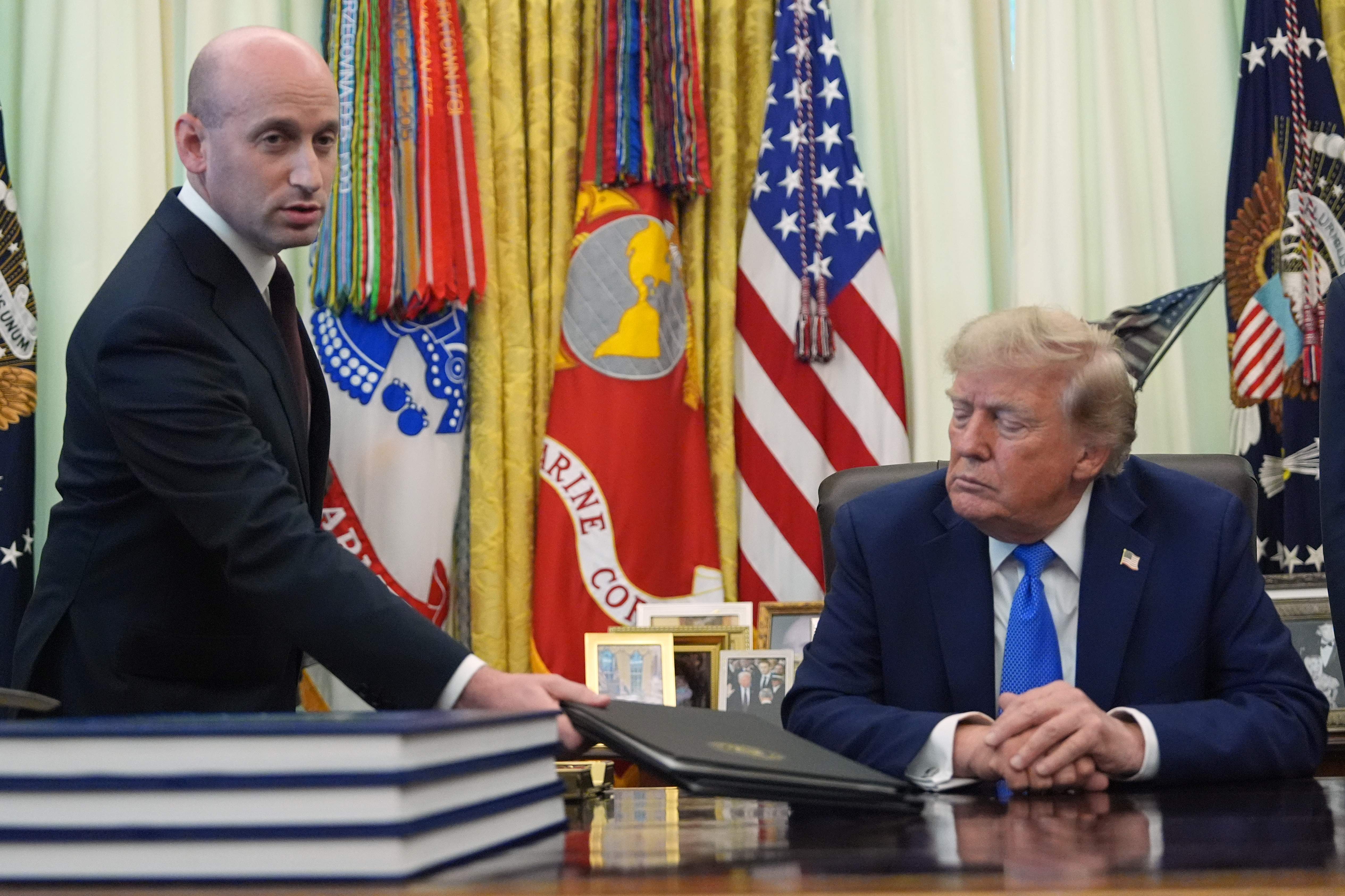
Every legacy newsroom in Washington is running the exact same script right now. They see Donald Trump elevating Stephen Miller to White House Chief of Staff after a bruising midterm election, and they immediately reach for their favorite lazy clichés. "Bunker mentality." "Doubling down." "Isolation."
They are completely missing the board. Discover more on a related subject: this related article.
When you analyze this move through the lens of actual executive power rather than cable news punditry, the consensus narrative falls apart. Putting an ideological architect into the Chief of Staff chair after losing the House isn't an act of denial. It is a cold, calculated recognition that legislative compromise is dead, and the only remaining currency in Washington is unilateral administrative action.
The "Pivot to the Center" Myth
To understand why the pundits are wrong, you first have to dismantle the biggest myth in American politics: the post-midterm pivot. Additional reporting by USA Today explores related views on the subject.
For decades, political consultants have sold the exact same playbook to bruised presidents. Lose Congress in year two? Fire the firebrands, hire a beltway institutionalist, reach across the aisle, and pass watered-down bipartisan bills to rebuild your approval rating before the next presidential cycle. It sounds reasonable. It looks great on Sunday morning talk shows. And in modern hyper-polarized Washington, it is completely useless.
Consider the structural reality of a divided government in the late 2020s. The opposition party did not win the midterms to hand the White House legislative victories. Their sole institutional incentive is oversight, subpoenas, and gridlock. If Trump had hired a traditional K-Street lobbyist or a moderate former governor to run the West Wing, that person would have spent the next two years begging a hostile Speaker of the House for floor votes that were never going to happen.
I have watched political operations burn tens of millions of dollars chasing "bipartisan consensus" that existed only in the minds of donor-class strategists. You cannot negotiate with an opposition whose primary electoral strategy depends on your total failure.
Trump didn't hire Miller to pass bills through Congress. He hired Miller because Congress is now irrelevant to his agenda.
Bureaucrat-in-Chief vs. Legislative Broker
The public misunderstands what a White House Chief of Staff actually does during the second half of a presidency. During the first two years, when a party holds a governing trifecta, the Chief of Staff acts as a legislative broker. Their job is to herd cats on Capitol Hill, manage committee chairs, and whip votes.
Once you lose the midterms, the job description mutates overnight. The Chief of Staff ceases to be a legislative broker and becomes the Bureaucrat-in-Chief.
This is where the mainstream media’s caricature of Stephen Miller blinds them to his actual operational utility. Yes, Miller is the public face of hardline immigration rhetoric. Yes, he is a polarizing figure who triggers instant outrage among progressive commentators. Neither of those things matters inside the Eisenhower Executive Office Building.
What matters is that Miller is one of the few people in Trump's orbit who actually knows how to read the Federal Register.
While other advisers spent the first term fighting turf wars over cable news bookings, Miller obsessed over the granular mechanics of the Administrative Procedure Act, executive orders, regulatory waivers, and agency rulemaking. He understands that the modern American presidency is not run through the halls of Congress; it is run through the sprawling regulatory apparatus of the executive branch.
When a president enters a lame-duck period with a hostile legislature, power retreats entirely into the agencies. You govern by executive action, by prosecutorial discretion, by tariff authority, and by regulatory reinterpretation. You don't need a smooth-talking Capitol Hill insider to run that machine. You need an ideological technocrat who knows where every lever in the federal bureaucracy is buried and isn't afraid to pull them until the courts physically stop him.
The Strategic Logic of Friction
Why are Washington insiders so horrified by this appointment? Because Miller rejects the foundational etiquette of the permanent bureaucracy.
In a standard administration, the Chief of Staff acts as a shock absorber between the President and the federal agencies. When the White House demands a radical policy shift, the traditional Chief of Staff listens to the Cabinet secretaries, absorbs the pushback from career civil servants, and waters down the directive until it is legally safe and institutionally palatable.
Miller does the exact opposite. He is an accelerant, not a shock absorber.
Imagine a scenario where the White House wants to overhaul a major federal entitlement or trade rule without a single vote from Congress. A traditional Chief of Staff forms an interagency working group, orders a six-month legal review, and watches the initiative die a quiet death in committee. An ideological Chief of Staff bypasses the working group, drafts the executive order directly with loyalists at the Office of Management and Budget, and forces the agencies to defend it in court.
Political scientist Richard Neustadt famously argued that presidential power is the "power to persuade." That definition is obsolete. In an era of total congressional paralysis, presidential power is the power to force friction. You create facts on the ground through unilateral executive action, daring the courts and the opposition to spend two years trying to undo what you accomplished in two weeks.
By elevating Miller, Trump is signaling to every Cabinet secretary that the era of cautious legalism is over. If an agency head drags their feet on implementation, they are no longer arguing with a mid-level policy adviser; they are defying the person who controls the President's schedule, paper flow, and personnel decisions.
What Critics Get Wrong About West Wing Chaos
Another common refrain from the pundit class is that Miller’s elevation guarantees West Wing chaos, staff turnover, and institutional dysfunction. They point to his abrasive management style and his history of clashing with more conventional Republicans.
This critique assumes that institutional harmony is a metric of success. It isn't.
History is full of harmonious, well-organized White Houses that accomplished nothing during their final two years. Conversely, some of the most consequential executive actions in American history emerged from turbulent, ideologically rigid West Wings.
Think about the structural reality of a second-term administration after a midterm loss. A-list corporate executives and establishment lawyers aren't lining up to take jobs in a bruised White House facing two years of congressional investigations. The talent pool naturally shrinks to true believers and ideological operators.
If your staff is inevitably going to consist of hardliners, putting a conventional moderate in charge of them is a recipe for sabotage and endless leaks. Look at the first Trump administration: when establishment figures like Reince Priebus or John Kelly tried to impose traditional order on a populist movement, the result was constant internal warfare and anonymous hit pieces in the Washington Post.
Putting Miller in charge aligns the management structure with the actual personnel. It eliminates the ideological civil war inside the West Wing. You may hate the policies that emerge from that building, and you may abhor the rhetoric, but the internal friction between the President's instincts and his Chief of Staff's execution drops to zero.
Answering the Wrong Question
If you look at search trends and political commentary right now, everyone is asking the same question: "How will Stephen Miller help Trump win back swing voters?"
That is the wrong question. It assumes the White House is still playing an electoral game.
Donald Trump cannot run for a third term. His personal political survival is no longer tied to suburban swing districts in Pennsylvania or Michigan. While GOP strategists on Capitol Hill are panicking about the next congressional map, the President's primary focus shifts toward legacy, executive dominance, and cementing ideological shifts into the federal apparatus before his clock runs out.
When a president is freed from the ballot box, the calculus of governance changes completely:
- Polls become secondary: Approval ratings matter when you need political capital to pressure hesitant senators. When you aren't passing legislation anyway, a 42% approval rating carries the exact same executive authority as a 58% approval rating.
- Base consolidation beats coalition building: Maintaining ironclad control over the party apparatus ensures that congressional Republicans cannot break ranks during oversight battles or potential impeachment inquiries. Miller's hardline orthodoxy keeps the GOP base locked in, which in turn keeps terrified Republican lawmakers in line.
- Speed replaces durability: Executive orders can be overturned by the next president, which traditionalists view as a fatal flaw. Hardliners view it differently: if you move fast enough and disrupt enough systems during your final 24 months, the sheer chaos of reversing your policies creates a permanent political deterrent for whoever comes next.
The Real Risk Nobody Is Talking About
Admitting the cold strategic logic of this move does not mean it is without massive, potentially fatal downsides. In fact, the actual vulnerability of the Miller appointment is the exact opposite of what the media claims.
The danger isn't that Miller will fail to execute the President's agenda. The danger is that he will execute it too aggressively, triggering a catastrophic collision with the federal judiciary and the bond markets.
Unilateral executive governance has hard limits. You can bypass Congress, and you can steamroll career bureaucrats, but you cannot bluff a federal judge or a Treasury auction.
- The Judicial Bottleneck: Miller’s preferred method of governance—maximalist executive orders pushed to the absolute edge of statutory authority—guarantees immediate nationwide injunctions. While this plays well to a base that loves seeing the administration "fight," it can leave major policy initiatives frozen in appellate courts until the President's term expires.
- The Market Reality Check: Unpredictable, unilateral shifts in trade, immigration, and regulatory policy create massive uncertainty for corporate capital allocation. When you remove the moderating voices from the room—the Wall Street veterans and traditional economists who usually talk a president back from the ledge—you risk triggering market shocks that no amount of populist messaging can spin away.
- The Oversight Meatgrinder: A Chief of Staff who treats Congress with open contempt invites relentless, scorched-earth investigations. With subpoena power firmly in the hands of the opposition, the White House legal counsel's office will spend the next two years drowning in document requests, contempt citations, and endless courtroom battles over executive privilege.
The Takeaway for Political Observers
Stop evaluating Washington through the nostalgic lens of the 1990s. The era of the "adult in the room" stepping in after a midterm defeat to guide a president back toward the political center is dead and buried.
By naming Stephen Miller Chief of Staff, Donald Trump isn't ignoring the midterm results. He is reacting to them with ruthless pragmatism. He recognizes that the legislative phase of his presidency is over, the administrative phase has begun, and you don't hire a diplomat to wage trench warfare.
You don't have to like the strategy to recognize what it is. The pundits calling this a bunker mentality are bringing a rulebook to a knife fight.