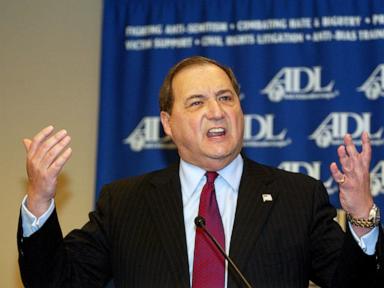
The Boy Beneath the Floorboards
In 1941, a Polish nurse named Bronisława Kurzyp did something that defied the logic of survival. She took a toddler from a Jewish family, renamed him Henryk Stanisław Kurpi, and raised him as a Catholic in the middle of a genocide. For four years, that child lived in a world of whispered rosaries and the terrifying thud of boots on cobblestones. He didn't know his name was Abraham Foxman. He didn't know that his parents were fighting for their lives in the Vilnius ghetto. He only knew the warmth of a woman who risked a firing squad every morning just to keep him fed.
When the war ended and his parents miraculously returned to claim him, the young boy didn't recognize them. He screamed. He fought. To him, these strangers were the threat, and the woman who had hidden him was his only mother. This wasn't just a family dispute; it was a custody battle fought in the shadow of the crematoria. It required a court order to return him to his biological parents.
That trauma—the jagged tear between safety and identity—didn't break Abe Foxman. It forged him. When news broke that Foxman died at the age of 86, the headlines focused on his decades leading the Anti-Defamation League (ADL). They listed his meetings with presidents and his fiery press releases. But to understand the man, you have to look at the boy who spent his most formative years learning that the world can turn on you in an instant, and that your life might depend entirely on the conscience of a stranger.
A Career Built on the Edge of a Precipice
For 50 years, Foxman walked the halls of power with the restless energy of someone who knew exactly how fragile civilization truly is. He took over the ADL in 1987, a time when many believed the ghosts of the mid-century had been laid to rest. The consensus was shifting toward a comfortable, post-racial future. Foxman never bought it. He lived with a permanent, internal siren that went off whenever he smelled the faintest whiff of old hatreds dressed in new clothes.
His office wasn't just a workspace; it was a command center. He monitored the world's vitriol with a forensic intensity. While others saw a fringe protest or a crude joke as an isolated incident, Foxman saw the blueprint for something much darker. He understood that hate doesn't start with a gas chamber. It starts with a slur. It starts with a dehumanizing cartoon. It starts when good people decide that "it’s not that serious."
He made it his business to make it serious.
Foxman was often criticized for being too loud, too sensitive, or too quick to demand an apology. Critics called him the "professional victim" of the American Jewish community. They argued that his constant vigilance actually fueled the flames he sought to extinguish. But Foxman wasn't interested in being polite. He was interested in survival. He knew that the distance between a "harmless" stereotype and a violent pogrom is much shorter than most people care to admit.
The Weight of the Phone Call
Imagine being the person who has to call a sitting president to tell them they’ve crossed a line. Imagine sitting across from world leaders—men like Pope John Paul II or Nelson Mandela—and Navigating the razor-thin line between diplomacy and moral demand. Foxman did this regularly. He wasn't a diplomat in the traditional sense; he was a witness.
When he spoke, he carried the weight of the six million who couldn't. This wasn't a metaphor for him. It was a physical burden. He often spoke about the "empty chairs" at his family table. Every decision he made, every public battle he picked with figures like Mel Gibson or Louis Farrakhan, was an attempt to fill those chairs with a sense of justice.
There is a specific kind of exhaustion that comes with being a professional sentinel. Foxman spent his days reading the worst things humans say about one another. He tracked the rise of internet hate long before Silicon Valley realized they had a problem. He saw the shift from skinheads in combat boots to trolls in business suits. Through it all, he remained a polarizing figure because he refused to prioritize "nuance" over the safety of his people. To Foxman, if you were flirting with antisemitism, you were flirting with his childhood nightmares.
The Complexity of the Human Shield
The reality of advocacy is rarely black and white. Foxman’s tenure was marked by moments that challenged even his most ardent supporters. He struggled with how to handle the Armenian Genocide recognition, fearing it would jeopardize the safety of Jews in Turkey. He faced backlash for his stance on the "Ground Zero Mosque." These weren't the actions of a man seeking universal popularity. They were the actions of a man playing a high-stakes game of geopolitical chess where the only goal was the protection of a vulnerable minority.
He was a man of contradictions. A survivor who cherished his Catholic savior but spent his life defending Jewish identity. A man who sat with the powerful but never forgot the feeling of being small and hidden. He understood that power is the only currency the world respects, so he made sure the Jewish community had as much of it as possible.
His retirement in 2015 didn't silence him. He watched the subsequent decade—the rise of overt white supremacy, the Pittsburgh synagogue shooting, the explosion of antisemitism on college campuses—with a grim "I told you so" energy. He didn't take pleasure in being right. He took it as a sign that the work would never be finished.
The Last Sentinel
Abe Foxman’s death marks the end of an era. We are losing the last generation of people who remember the world before the liberation of the camps. We are entering a period where the Holocaust is moving from "memory" to "history." Memory is visceral; it has a pulse. History is dry; it lives in textbooks.
Foxman was the pulse.
He was the human bridge between the horrors of the 1940s and the complexities of the 2020s. Without his loud, often abrasive, and always unapologetic voice, there is a vacuum. The stakes haven't changed, but the guardrails feel thinner.
Think back to that toddler in Poland, tucked away in a quiet house while the world burned. He survived because one woman decided that his life was worth the risk of her own. Abe Foxman spent the next 80 years trying to pay that debt back to the world. He worked to build a society where no child would ever have to hide beneath the floorboards again.
The sirens he spent his life sounding are still ringing. The difference now is that we have to be the ones to listen. We have to decide if we are going to be the bystander or the nurse who opens the door.
He is gone, but the smoke he smelled never really dissipated. It just changed shape.