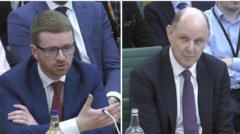
The core of the recent parliamentary inquiry into Peter Mandelson’s appointment as the UK’s Ambassador to the United States centers on a single, uncomfortable question: has the line between civil service expertise and political patronage finally vanished? MPs are not just scrutinizing a single job placement. They are interrogating a shift in how power is brokered in the post-Brexit era. While the government defends the move as a pragmatic choice for a "Special Relationship" facing a volatile second Trump administration, the testimony of former senior aides suggests a far more calculated dismantling of traditional diplomatic protocols.
The controversy stems from the decision to bypass the standard, competitive civil service application process in favor of a direct political appointment. Lord Mandelson, a veteran of the New Labour era and a figure synonymous with the professionalization of political "spin," represents a bridge to a specific type of globalist diplomacy. However, his return to the front lines of British influence has triggered a backlash from those who believe the Foreign, Commonwealth and Development Office (FCDO) is being sidelined by a small circle of Downing Street insiders.
The Death of the Career Diplomat
For decades, the path to a high-profile ambassadorship followed a predictable, meritocratic trajectory. You spent thirty years in the FCDO, learned the nuances of international law, and navigated the delicate egos of foreign ministers. You were, above all, a neutral servant of the Crown.
That model is under assault. The argument for Mandelson is that a career diplomat simply lacks the political "heft" required to deal with a White House that views traditional bureaucracy with suspicion. Proponents of the move argue that in an era of transactional politics, you need a deal-maker, not a note-taker.
But this logic carries a hidden cost. When the government signals that the highest honors are reserved for political allies, it guts the morale of the professional civil service. Why spend a lifetime mastering the intricacies of trade policy if the top job will always go to a former cabinet minister with a direct line to the Prime Minister? We are witnessing the "Americanization" of British diplomacy, where the spoils system replaces the merit system.
The Shadow of the 1990s
To understand why Mandelson’s name specifically causes such friction, one must look back at the origins of his political identity. He was the architect of a communications style that prioritized the "narrative" over the nuance. By placing him in Washington, the current administration is not just sending a diplomat; they are sending a strategist.
The questioning of former aides revealed a persistent concern that this appointment was less about American relations and more about internal British power dynamics. Mandelson remains a divisive figure within the Labour Party itself. His presence in Washington provides him with a massive platform to influence UK economic policy from afar, particularly regarding European alignment and trade. Critics argue that he will be running a "parallel Foreign Office," one that answers to a specific faction of the party rather than the collective interests of the government.
The Trump Factor and the Necessity of Influence
The government’s primary defense is rooted in the unique challenge of the current American political climate. The consensus in Downing Street is that the incoming U.S. administration prizes personal relationships and "big name" recognition over formal diplomatic channels.
In this context, Mandelson is viewed as a heavy hitter who can bypass mid-level staffers and gain direct access to the Oval Office. He has spent years cultivating a global network of donors, CEOs, and political leaders. To his supporters, he is the only person with the stature to prevent the UK from being sidelined during the inevitable trade disputes and tariff negotiations that lie ahead.
However, this "Great Man" theory of diplomacy is risky. If the relationship depends entirely on the personal charisma of one individual, it becomes fragile. If Mandelson falls out of favor with the White House—or if his past business dealings become a distraction—the UK’s primary diplomatic channel is effectively severed. A career diplomat provides a baseline of stability that a political appointee cannot guarantee.
Conflict of Interest and the Business of Diplomacy
Perhaps the most grueling line of questioning during the recent committee hearings focused on Mandelson’s private sector ties. After leaving government, he built a lucrative career in strategic consulting. His firm, Global Counsel, has represented a vast array of international interests.
This creates a minefield of potential conflicts. The public is asked to believe that a man who has spent the last decade advising private corporations can suddenly switch off those interests and represent only the British taxpayer. The "cooling off" periods mandated by the Advisory Committee on Business Appointments (ACOBA) are often seen as toothless, a series of boxes to be checked rather than a rigorous ethical screen.
When a former aide was asked if Mandelson’s private clients would benefit from his move to Washington, the answer was a masterclass in bureaucratic evasion. They focused on the "process" of the appointment rather than the "outcome" of the influence. This is where the public’s trust breaks down. People do not care if the paperwork was filed correctly; they care if their representative is being paid by two different masters.
The Institutional Sidelining of the FCDO
Beyond the individual, there is the institutional damage to consider. The FCDO has already been reeling from budget cuts and a forced merger with the Department for International Development. By choosing an outsider for the most important diplomatic post in the world, the government has essentially told its own department that they aren't up to the task.
The testimony suggested that the Permanent Secretary of the Foreign Office was consulted only after the decision had largely been made. This "sofa government" approach—where major decisions are hammered out by a few people in a room without formal minutes or departmental oversight—is exactly what led to the failures of the early 2000s. It removes the friction of expert dissent, which is often the only thing that prevents a government from making a catastrophic mistake.
The Role of the Senior Aide
The aides being questioned are often the "gatekeepers" of these decisions. They are the ones who translate a Prime Minister’s vague desire for a "big name" into a formal job offer. Their testimony revealed a culture of extreme loyalty, where the primary objective is to deliver what the boss wants, regardless of the long-term institutional consequences.
One aide admitted that the search for candidates was "narrow." In plain English, this means there was no search. There was a list of one. This lack of competition is not just an administrative failure; it is a failure of governance. Without a competitive process, there is no way to prove that Mandelson was truly the best person for the job. We are left with the government’s word, which, in the current political climate, is a currency in steep decline.
The Trade Reality
While the headlines focus on the personality of Peter Mandelson, the underlying reality is trade. The UK is desperate for a comprehensive free trade agreement with the United States, something that has remained elusive since the Brexit referendum.
Mandelson’s background as a former EU Trade Commissioner is a double-edged sword. On one hand, he knows how the machinery of trade works better than almost anyone. On the other, his pro-European history makes him a suspicious figure to the "America First" wing of the Republican Party. There is a real danger that his appointment will be seen as a signal that the UK is looking to hedge its bets between Washington and Brussels, potentially alienating the very people he is supposed to be wooing.
The hearings touched on the specific brief Mandelson has been given. It appears he will have an unprecedented level of autonomy, reporting directly to the Prime Minister on certain key files. This bypasses the traditional hierarchy and creates a "super-ambassador" role that has no real precedent in British history.
The Public Perception Gap
There is a vast gulf between how this appointment is viewed in the "Westminster Bubble" and how it is perceived by the average voter. Inside the bubble, it’s seen as a shrewd move, a way to put a sophisticated operator in a difficult spot. Outside, it looks like "jobs for the boys."
The perception of cronyism is a poison in the body politic. When people see a former politician who has already had multiple careers in government and the private sector being handed one of the most prestigious jobs in the land, it reinforces the belief that the system is rigged. The government’s defense—that he is uniquely qualified—falls flat when the qualification process was designed to ensure he was the only one who could win.
The Future of Diplomatic Oversight
What does this mean for the future of the British state? If the Mandelson appointment stands without a serious overhaul of how such roles are filled, we have entered a new era of "un-civil" service. The tradition of the neutral, permanent official is being traded for a model of temporary, political appointees who serve at the whim of the executive.
This might be efficient in the short term. It might even lead to a few more "wins" in Washington. But it erodes the foundation of a stable democracy. A professional civil service is the "memory" of the state. It provides continuity when governments change. By politicizing the top tier of the diplomatic corps, we are ensuring that every change of government will be followed by a purge of ambassadors and a chaotic reshuffling of foreign policy.
The MPs’ questioning of the former aide was a rare moment of accountability, but it was likely too little, too late. The machinery of the appointment is already in motion. The focus now shifts to how Mandelson will actually perform. Will he be the bridge-builder the government claims, or will his tenure be defined by the same controversies that have followed him throughout his career?
The answer matters because the stakes in Washington have never been higher. With the global order shifting and trade wars looming, the UK cannot afford a diplomatic mission that is more concerned with political optics than national interest. We have traded a system of checks and balances for a system of personal influence. Now, we wait to see if the gamble pays off.
The true test will not be the social functions or the high-level meetings. It will be the first time the UK’s interests directly clash with those of the U.S. administration. In that moment, we will find out if our ambassador is representing the British people, the Prime Minister, or his own storied legacy.
Stop pretending that the "process" was followed. It wasn't. Admit that this is a political play and judge it on those terms. The era of the neutral diplomat is over; the era of the political fixer has begun.