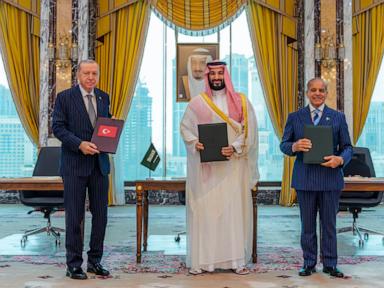
Ink on paper dries quickly. Borders, however, take generations to bleed.
If you stand on the dusty ridge outside Ankara at dawn, the air tastes of ancient dust and cold stone. Look south, toward the jagged folds of the Zagros Mountains, and you are looking across an invisible line that has defined survival for centuries. Down in the capitals, diplomats polish their cuff links and speak in quiet, measured cadences. They talk about defense pacts, strategic alignments, and regional stability. They make it sound like geometry.
It is not geometry. It is breath.
To understand what happens when Turkey, Saudi Arabia, and Pakistan begin drawing lines together, you have to look past the official communiqués. You have to listen to the silence that follows a denial.
"This is not about Tehran," the official statement insists. The words bounce off marble walls in foreign ministries, carefully calibrated to soothe raw nerves three time zones away.
Nobody believes it entirely. And yet, everyone must pretend they do.
Consider what happens when a map is redrawn in the dark.
For decades, the security architecture of the Middle East and South Asia resembled a rigid house of cards. Pull out a single card, and the whole structure threatens to tumble. You had the traditional heavyweights, the historical rivals, the sectarian fault lines that politicians exploited like open wounds. Every alliance was transactional, brittle, and defensive.
Then the ground shifted.
When Turkish officials stepped forward to clarify that their deepening defense cooperation with Riyadh and Islamabad carried no hostile intent toward Iran, the diplomatic corps rushed to decode the subtext. Why the preemptive reassurance? Because in a neighborhood where suspicion is the default currency, a new friendship automatically looks like a knife being sharpened in the shadows.
Let us step into a hypothetical room in Islamabad, inside a secure briefing room where the hum of the air conditioner is the only sound louder than the ticking clock. A mid-level strategist—let's call him Tariq—stare down at a satellite map of the Arabian Sea. His fingers trace the maritime choke points where oil tankers crawl like beetles.
Tariq is not thinking about grand ideological crusades. He is thinking about logistics, foreign reserves, and the sheer, exhausting cost of standing alone in a fractured world.
"We are not building a wall," Tariq murmurs to an empty room, echoing the talking points whispered down from ministerial desks. But then he adds what he cannot say to the press: "We are simply making sure we have a roof when the storm hits."
That storm has many names. Economic instability, shifting American footprints, and the eternal, exhausting shadow of Tehran’s nuclear ambitions and regional proxy networks. Iran watches every military exercise between Ankara and Riyadh with a wary eye. To Tehran, a security compact forged between Sunni powerhouses looks remarkably like a cordon.
So why the denial? Why the frantic diplomatic dance to assure the mullahs in Iran that this club has no velvet rope keeping them out, but no welcome mat either?
Fear. Pragmatism. And a weary recognition that nobody in the region can afford another hot war.
Turkey walks a tightrope that would snap under a lesser weight. Ankara wants economic leverage, defense manufacturing exports, and diplomatic centrality. It wants to play the elder statesman of the Turkic and broader Islamic world. But Turkey shares a long, porous border with Iran. Trade matters. Gas pipelines matter. Open hostility with Tehran is a luxury Ankara's inflation-battered economy cannot sustain.
Meanwhile, Saudi Arabia is racing against its own calendar. Crown Prince Mohammed bin Salman’s Vision 2030 cannot succeed under the roar of artillery fire. Riyadh needs foreign investment, tourism, and quiet skies. The historic detente with Iran, brokered in Beijing, was supposed to buy breathing room. Yet, trust in a region built on sand is notoriously fragile. Saudi Arabia wants insurance. Pakistan, possessing the ultimate deterrent and a battle-hardened military, provides that insurance policy.
It is a delicate choreography of deterrence.
Imagine two neighbors living on either side of a crumbling fence. They have shouted across it for decades, occasionally throwing stones. One day, they both start buying heavy locks for their front doors from the same hardware store down the street. When the local neighborhood watch asks if they are preparing for a fight, they smile and say, "Oh, we are just upgrading our security. It's not about anyone in particular."
Everyone knows the locks are meant to keep out a specific burglar. But naming the burglar invites a confrontation nobody wants to host on their front lawn.
This is the psychological reality behind the diplomatic boilerplate. The defense pacts are real. Joint military drills are real. Technology transfers, drone sales, and intelligence-sharing frameworks are being inked in quiet boardrooms from Rawalpindi to Riyadh.
The stakes are invisible until they break the surface.
When a Pakistani JF-17 thunder fighter trains with Saudi pilots, or when Turkish defense contractors sign multi-billion-dollar agreements in the Gulf, they are shifting the center of gravity in the Muslim world. They are creating a third way. For years, nations in this arc had to choose: align with Western capitals and accept their moral lectures and conditional aid, or fall into the orbit of regional revisionists.
Now, they are looking inward. They are pooling their own blood, iron, and capital.
And that brings us back to the silence from Tehran.
Iran's leadership is calculating. They see the writing on the wall. A cohesive bloc stretching from the Bosphorus to the Indus Valley creates a formidable counterweight to Iranian ambitions across the Levant and the Gulf. Yet, Tehran cannot afford to overreact. Cornered, isolated by sanctions, and grappling with domestic discontent, Iran must accept the diplomatic fictions. They must nod along when Ankara says, "This is not about you."
Because the alternative is worse. The alternative is acknowledging that the map has changed forever, and that the new lines were drawn without their permission.
History is rarely made in grand declarations. It is forged in the quiet compromises of men who are terrified of tomorrow.
When the sun sets over the ridge in Ankara, the shadow of the mountains stretches long and dark across the plains. Down below, the lights of the city flicker on, one by one. The diplomats sleep, or try to. The treaties are signed. The ink dries.
And somewhere in the dark, the map holds its breath.