Inside a fluorescent-lit conference room in Brussels, a stack of paper rests on a mahogany table. It is heavy. It measures thousands of pages, divided into thirty-five separate chapters covering everything from food safety regulations to the precise chemistry of industrial diesel. To a casual observer, these documents are the absolute peak of bureaucratic monotony. They are dry. They are exhausting.
But three hundred miles away, in a small apartment overlooking the dark, swirling waters of the Dniester River in Moldova, a woman named Elena sits by her window and looks toward a horizon she cannot quite see. Elena is real, even if her name is a composite of a dozen conversations held along this border. She is thirty-four. She teaches high school history. For her, those dry pages in Brussels are not bureaucratic trivia. They are a lifeline. They are the difference between a future where her classroom has reliable heating and a future where her country is swallowed by the grey, unresolved shadows of a forgotten conflict.
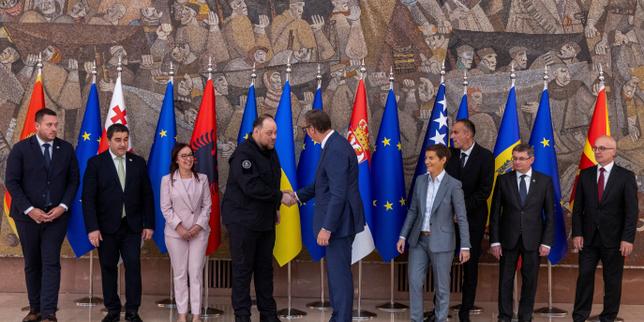
On Tuesday, July 14, 2026, the gears of the European Union ground forward with a speed they have not shown in a generation. In what diplomats in Brussels quietly dubbed "Super Tuesday," the EU held a series of intense intergovernmental conferences to accelerate membership negotiations with four distinct nations: Montenegro, Albania, Moldova, and Ukraine.
For years, the expansion of the European project was treated like a slow, academic exercise. It was a chore to be postponed. Western European capitals, wary of absorbing poorer neighbors, dragging their feet, spoke endlessly of "absorption capacity" and "procedural rigor."
Then, the world caught fire.
The sheer scale of the changes happening right now across the continent has shattered those old hesitations. This is the story of what happens when a continent realizes that its borders are not just lines on a map, but walls built to keep out the cold.
The Weight of the Chapters
To understand the scale of what happened this Tuesday, we have to look at how the machinery of Brussels actually works. The process of joining the European Union is a grind. It is divided into thirty-five thematic clusters called chapters. Every single chapter requires a candidate country to rewrite its national laws to match the strict legal codes of the bloc. It is a massive, exhausting overhaul of a nation's legal, economic, and social structure.
For Montenegro, a tiny, sun-drenched Adriatic nation of just over six hundred thousand people, this grind has been the background noise of daily life for more than a decade. They are the frontrunners. On Tuesday, Montenegrin negotiators moved to provisionally close several key negotiating tracks.
Think about what that means. In Podgorica, the capital, a young environmental inspector named Danilo spent his afternoon reviewing water quality standards. He did not do this because of some sudden burst of local bureaucratic enthusiasm. He did it because Chapter 27 demands it. If Montenegro wants to join, its rivers must be as clean as those in Sweden. Danilo is tired. He has been working twelve-hour days for months, translating complex European directives into local laws.
"We are rebuilding our house while living in it," Danilo says. He laughs, but his eyes are bloodshot. "Every time we think we have finished a room, the inspectors in Brussels tell us the foundation needs another coat of plaster. But we keep working. What else is there? The alternative is to let the house fall apart."
Montenegro’s goal is incredibly ambitious: complete negotiations by the end of this year and achieve full membership by 2028. It is a sprint to the finish line of a marathon that has lasted fourteen years.
The Long Journey of the Balkans
Just south of Montenegro lies Albania. For decades, Albania was a closed vault, locked away under one of the most paranoid, isolationist communist dictatorships the world has ever seen. When the regime fell in the early 1990s, the country was left bankrupt and disoriented.
On Tuesday, Albania sat at the same table in Brussels, provisionally closing chapters on science, research, and education.
Imagine telling an Albanian citizen in 1990 that their grandchildren would be negotiating the terms of joint scientific research grants with Paris and Berlin. They would have laughed. Or they would have had you arrested.
The progress is real, but the scars are deep. In Tirana, a software engineer named Arben describes the feeling of waiting at the gate.
"We have been told we are European our entire lives," Arben says, pouring a small glass of raki. "But for a long time, it felt like we were the poor relatives waiting on the porch. We could hear the music inside, but the door was locked. Now, they are finally turning the key."
The door is opening because the geopolitics of the continent have shifted beneath our feet. For years, countries like France argued that the EU needed to fix its own internal decision-making before letting anyone else in. It was a polite way of saying "not yet." But when Russian tanks rolled across the Ukrainian border, those polite delays became a luxury Europe could no longer afford.
Under the Shadow of the Howitzers
Nowhere is the human cost of this geopolitical shift more obvious than in Ukraine.
While diplomats in Brussels discussed trade policies and development cooperation on Tuesday, air raid sirens were sounding in Kharkiv. Ukraine opened its second major cluster of negotiations, focusing on foreign relations, security, and defense.
It is a surreal spectacle. A nation fighting a war of national survival is simultaneously rewriting its civil service laws and agricultural subsidies to satisfy inspectors thousands of miles away.
Consider Maryna, an attorney working for the Ukrainian ministry of justice. She does not work from a sleek office building. She works from a basement in Kyiv, illuminated by a single LED lantern connected to a car battery when the power grid goes dark. Her desk is covered in files on European antitrust regulations.
"Sometimes the irony is almost too much to bear," Maryna says, her voice flat with fatigue. "We are drafting laws on fair market competition while our cities are being hit by glide bombs. But we do not stop. Because these laws are our armor. If we lose the legal war to become a modern, transparent European state, then we have already lost the war on the battlefield, even if we hold the line."
Ukraine has turned its country into a military powerhouse. Its rapidly evolving drone technologies and battle-tested logistics have rewritten the rules of modern warfare. But security is not just about weapons. It is about belonging to an ecosystem. For Ukraine, the EU is that ecosystem. It is the promise that when the dust settles, they will not be left alone in the cold buffer zone between East and West.
The Quiet Panic of Moldova
Then there is Moldova. Small, landlocked, and deeply vulnerable, Moldova is often overlooked in the grand narratives of European power. But its stakes are perhaps the most fragile.
Moldova opened its second negotiating cluster alongside Ukraine on Tuesday. This happened despite continuous, relentless attempts by foreign intelligence services to destabilize the country, flood its social media with disinformation, and buy votes in its local elections.
To live in Chisinau, the capital, is to live with a constant, low-grade fever of anxiety.
"You look at the map, and you realize how thin the thread is," says Stefan, a journalist who covers the border regions. "We are a country of less than three million people. We have a breakaway region, Transnistria, occupied by Russian troops. Every day, we wake up and check the news to see if the thread has snapped."
For Stefan and his neighbors, the EU’s €1.9 billion Growth Plan for Moldova is not just an economic stimulus. It is a physical anchor. It is the weight that keeps their small boat from being swept away in the storm.
The Invisible Opponents
The road to Brussels is not a straight line. It is a maze filled with traps, and many of them are self-inflicted.
For years, the loudest voice blocking this expansion belonged to Hungary’s nationalist government, which used its veto power to extract concessions and stall Ukraine’s progress. It was a masterclass in transactional politics. But political tides turn. A shift in the European political landscape has weakened that resistance, allowing the backlog of candidate countries to finally start moving.
Yet, the biggest obstacle is not a single politician in Budapest or a cynical diplomat in Paris. It is the quiet, creeping cynicism within the candidate countries themselves.
Decades of waiting have left deep scars. In North Macedonia, which was forced to change its very name to appease Greece only to see its negotiations blocked by Bulgaria, the skepticism is thick enough to choke on.
"We did everything they asked," says Ilir, a schoolteacher from Skopje. "We changed our flag. We changed our name. We rewrote our history books. And still, they kept us in the waiting room. Now they say they are accelerating things. Forgive us if we do not throw a party just yet."
This is the vulnerability at the heart of the European dream. It is a promise that has been broken so many times that when it is finally kept, people are too tired to celebrate.
The Blueprint of a New Europe
The officials in Brussels are not blind to this fatigue. They know that if they wait too long, these nations will look elsewhere for partners. China is waiting with cheap infrastructure loans. Russia is waiting with energy deals and security promises that come with invisible handcuffs.
European Commissioner for Enlargement Marta Kos has noted that the accession treaties being drafted right now will serve as a blueprint for a whole new generation of European integration. These treaties will include stronger safeguards against new members backsliding on democracy and the rule of law once they are safely inside the club.
It is a difficult balance to strike. How do you welcome countries that have been battered by war and corruption without diluting the values that make the Union worth joining in the first place?
There are no easy answers. The process is confusing, scary, and filled with historic risks. But as the sun sets over the European quarter in Brussels, and the diplomats pack up their heavy leather briefcases, the map of the continent looks slightly different than it did twenty-four hours ago.
It is a map being drawn in the dark, by people who are tired of living in the shadows of empires.
Back in Moldova, Elena turns off her desk lamp. Her eyes are tired from grading papers, but she looks out the window one last time before going to bed. The Dniester River is black under the starlight, a silent border between two worlds. She knows that tomorrow she will stand in front of her classroom and teach her students about the fall of Rome, the rise of modern nations, and the fragile, beautiful idea of a united Europe. She knows they will ask her if it is real.
She wants, more than anything, to be able to tell them yes.

