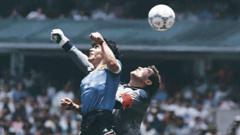
You think you know the story of June 22, 1986. Diego Maradona jumps against England goalkeeper Peter Shilton at the Azteca Stadium in Mexico City. He uses his left fist to punch the ball into the net. He spins away celebrating, fooling the referee, and later calls it a little with the head of Maradona and a little with the hand of God. It's the ultimate heist in football history.
But the story everyone focuses on leaves out the actual mechanics of how that goal was allowed to stand. Most people think Tunisian referee Ali Bin Nasser just choked under pressure. They assume he was incompetent. The truth is much more complicated. It involves strict FIFA directives, a bitter miscommunication between two officials from different continents, and a tactical masterclass by a referee that actually birthed the Goal of the Century just four minutes later.
If you look past the standard narrative, you find a completely different match than the one highlighted on historical reels.
The Anatomy of a Blown Call
Fifty-one minutes into a tense, scoreless World Cup quarterfinal, English midfielder Steve Hodge sliced a high, looping ball back toward his own penalty box. Maradona didn't hesitate. He surged forward, tracking the dropping ball. Shilton, who had an eight-inch height advantage over the diminutive Argentine, sprinted off his line to punch it clear.
They met in mid-air. Maradona reached out his left arm and flicked his fist. The ball trickled into the empty net.
Shilton went ballistic. English defenders Terry Fenwick and Glenn Hoddle chased the referee, waving their arms, miming a handball. But Bin Nasser didn't look at the English players. He looked directly at his Bulgarian linesman, Bogdan Dochev.
"I was waiting for Dochev to give me a signal of what happened exactly," Bin Nasser recounted years later. "But he didn't raise his flag."
FIFA had issued strict instructions to tournament referees before the World Cup. If an assistant official had a clearer view of an incident than the head referee, the head referee was obliged to defer to their positioning. From where Bin Nasser stood, the backs of both Shilton and Maradona shielded the point of contact. Dochev, standing on the touchline, had a parallel look at the play.
Bin Nasser saw Dochev walking back toward the center circle, the universal signal that a goal was valid. Following the protocol mandated by his superiors, the Tunisian blew his whistle and pointed to the spot. Argentina was up 1-0.
Two Men and One Moment
What happened next created a decades-long cold war between the two officials. Dochev later claimed FIFA rules prevented assistant referees from discussing decisions on the pitch with the head official, asserting that whatever Bin Nasser decided was final. He spent the rest of his life frustrated by the fallout, even saying the moment ruined his life.
Bin Nasser took a completely different path. He never apologized because, by the letter of the instructions he was given, he did his job.
The contrast between how people processed that afternoon is stark. In 2015, Maradona traveled to Tunisia to visit Bin Nasser at his home. They shared coffee. Maradona handed him a signed Argentine jersey inscribed to his "eternal friend." Dochev never received an apology and died in 2017 with deep bitterness toward the entire event.
How Bin Nasser Birthed the Goal of the Century
Everyone forgets that if Bin Nasser had been a poor referee, the greatest goal in football history wouldn't exist. Just four minutes after the handball, Maradona took the ball in his own half and began his legendary 60-yard dash, weaving through five English defenders before slotting it past Shilton.
Watch that play closely. England's players weren't passive. They tried to hack Maradona down three separate times in midfield. They lunged at his ankles. They grabbed at his jersey.
A lesser official blows the whistle early to control the game. Had Bin Nasser called a foul on any of those initial challenges, the play dies in midfield. Instead, the referee sprinted behind Maradona, shouting "advantage" through the chaos, letting the play breathe until the ball hit the back of the net.
It took immense refereeing restraint to let that sequence happen, especially in the furnace of a match that carried immense political tension following the Falklands War just four years prior.
The Lessons for Modern Football
If you think modern technology solved the issues present in 1986, you aren't paying attention. The human error that defined the Hand of God has merely mutated into bureaucratic confusion inside the Video Assistant Referee (VAR) booths of modern stadiums.
The lesson of 1986 isn't that referees need more eyes on the pitch. It's that over-indexing on rigid protocols and communication hierarchies can paralyze decision-making. Bin Nasser trusted Dochev because the rulebook told him to. Dochev stayed silent because he thought the rulebook required it.
To understand football history, you must look at the whole picture. Stop viewing the 1986 quarterfinal as a simple act of cheating. Analyze it as a breakdown in institutional communication, saved only by a brilliant application of the advantage rule minutes later. Go watch the full 90 minutes of that match online rather than the standard two-minute highlight reel. Pay attention to the positioning of the officials when Hodge loops that ball backward. You'll see exactly how easily a historic moment can hide in plain sight.
Tunisian referee recalls Maradona's Hand of God goal
This news segment offers direct insight into Ali Bin Nasser's perspective and his later meeting with Maradona, showing how the referee processed the most controversial decision of his career.