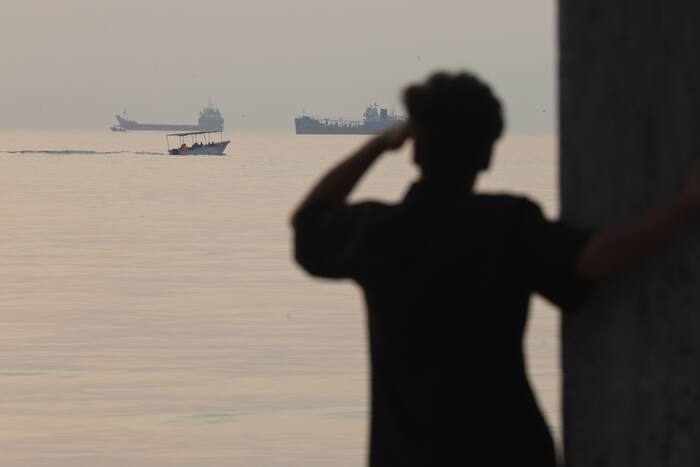
Kinetic strikes on commercial shipping off the coast of Qatar represent a structural shift in regional risk transfer rather than an isolated tactical event. When projectiles impact a tanker inside the Persian Gulf—specifically near the maritime approaches of the world’s premier liquefied natural gas (LNG) exporter—the immediate physical damage is secondary to the cascading disruption of global energy logistics, maritime insurance underwriting, and sovereign deterrence models. Standard news reporting treats these incidents as disconnected bulletins: a vessel is struck, diplomatic statements are issued, and regional proxies trade fire elsewhere in the theater. That fragmented framing obscures the underlying operational reality. Maritime interdiction in the Gulf operates as a unified economic weapon designed to impose asymmetric costs on global supply chains without triggering full-scale conventional warfare.
To understand the mechanics of a tanker strike off Qatar, analysts must separate the kinetic event from its financial and geopolitical transmission channels. The Persian Gulf is not merely a body of water; it is a high-density logistical bottleneck governed by narrow bathymetry, overlapping Exclusive Economic Zones (EEZs), and rigid marine insurance structures. Meanwhile, you can read similar stories here: Why Historic Firsts Succeed Only When Candidates Stop Running on Identity.
The Anatomy of Gulf Maritime Interdiction
Commercial vessels operating near Qatar navigate one of the most heavily surveilled yet legally complex maritime environments on earth. Unlike the open ocean, where evasive routing can mitigate localized threats, the geography of the Persian Gulf forces tankers into predictable transit corridors.
Bathymetric and Navigational Constraints
Deep-draft vessels, particularly Very Large Crude Carriers (VLCCs) and Q-Flex or Q-Max LNG carriers, require specific water depths to maintain safe under-keel clearance. These drafts restrict vessels to established Traffic Separation Schemes (TSS). Adversaries utilizing unmanned aerial vehicles (UAVs), uncrewed surface vessels (USVs), or coastal anti-ship cruise missiles do not need wide-area maritime domain awareness to locate targets; the geography dictates exactly where high-value hulls must pass. To see the bigger picture, check out the detailed article by NBC News.The Attribution-Deterrence Gap
Modern asymmetric maritime strikes rely on deniable or semi-deniable launch platforms. When projectiles strike a vessel in international waters or contested transit zones, the time required to conduct forensic debris analysis, verify radar tracks, and establish legal attribution creates a strategic buffer. During this window, the aggressor achieves immediate economic disruption while the targeted state or coalition faces high political thresholds for retaliatory escalation.Collateral Proximity to Energy Infrastructure
Qatar’s North Field and the Ras Laffan industrial complex sit directly adjacent to these transit lanes. Even when a strike targets a third-party commercial tanker rather than Qatari-flagged assets, the geographic proximity forces immediate operational pauses, heightened security postures, and defensive posturing across the entire southern Gulf energy infrastructure.
Known Facts Versus Operational Hypotheses
Rigorous intelligence analysis requires a strict boundary between verified physical events and strategic inference.
- Verified Operational Realities: Commercial tankers in the Gulf operate under continuous Automatic Identification System (AIS) tracking unless deliberately spoofing or darkening their transponders. Projectile impacts on commercial hulls follow predictable physical signatures—typically above-the-waterline penetrations aimed at accommodation blocks, bridge structures, or non-volatile hull sections rather than catastrophic hull-splitting detonations below the waterline. Maritime security agencies, including the United Kingdom Maritime Trade Operations (UKMTO) and regional naval task forces, rapidly confirm vessel status, crew safety, and localized coordinates.
- Analytical Hypotheses: The strategic intent behind targeting a specific vessel is rarely confirmed in real time. Analysts infer intent by cross-referencing the vessel’s beneficial ownership, flag state, charterer, and recent port calls against ongoing regional friction points. A strike off Qatar may represent a deliberate expansion of the geographic threat envelope to signal that no sector of the Gulf is insulated, or it may reflect opportunistic targeting of a specific commercial affiliation regardless of its geographic coordinates at the moment of impact.
The Cost Function of Asymmetric Naval Warfare
The fundamental economic logic driving maritime harassment in the Middle East is an extreme asymmetry in marginal costs. An attacker can deploy a one-way attack drone or a short-range ballistic projectile for a fraction of the capital required to defend against it or repair the resulting damage.
Consider the defense expenditure equation. Naval task forces operating in the Gulf rely on sophisticated area-air-defense destroyers and frigates. Intercepting an incoming projectile requires surface-to-air missiles whose unit costs run into the millions of dollars. Even a successful kinetic interception represents a net financial drain on the defender if repeated over an extended campaign. Conversely, if a projectile penetrates defenses and strikes a commercial hull, the cost shifts instantly from military budgets to private capital markets.
This cost transfer manifests across four distinct operational variables:
- Hull and Machinery (H&M) Repairs: Even non-catastrophic structural damage forces a vessel out of service, requiring dry-docking, specialized marine engineering, and weeks of lost charter revenue.
- War Risk Insurance Premiums: Marine underwriters at Lloyd’s of London and global equivalents price risk dynamically. Within hours of a confirmed strike near Qatar, the Joint War Committee (JWC) evaluates whether to expand Listed Areas. War risk premiums—calculated as a percentage of the vessel's hull value per transit—can spike exponentially, adding hundreds of thousands of dollars to a single voyage.
- Charter Party Disputes and Force Majeure: Maritime law relies on strict contractual allocations of risk. When a transit zone becomes active, shipowners invoke war-risk clauses to refuse orders into the Gulf or demand additional compensation, triggering legal friction with charterers and commodity traders.
- Bunker Fuel and Rerouting Penalties: While vessels inside the Gulf cannot easily reroute around the Strait of Hormuz without abandoning their cargo, global fleet operators adjust by holding vessels outside the Gulf of Oman, incurring demurrage charges and disrupting downstream refinery and regasification schedules in Europe and Asia.
The Broader Mideast Theater as an Integrated System
News aggregators frequently bundle a Persian Gulf tanker strike with disparate regional developments—ground skirmishes in the Levant, diplomatic deadlocks in regional capitals, or aerial interceptions over the Red Sea—under the generic banner of "other Mideast news." Treating these events as separate silos misses their systemic synchronization.
Regional actors operate across multiple maritime and terrestrial theaters as a single interconnected pressure valve. When kinetic intensity escalates on a terrestrial front, maritime pressure in the Red Sea or the Persian Gulf frequently adjusts in tandem to stretch coalition naval assets and complicate diplomatic mediation.
The strategic linkage between the Red Sea and the Persian Gulf is particularly acute for global energy flows. Disruptions in the Bab el-Mandeb Strait force tankers transiting between the Middle East and Europe to divert around the Cape of Good Hope, adding ten to fourteen days of transit time and absorbing global tanker capacity. When simultaneous threats emerge inside the Persian Gulf—threatening the Strait of Hormuz and the waters off Qatar—the global maritime system loses its primary redundancy. The market is no longer dealing with a detour; it is confronting a potential constriction at the source of supply.
The Diplomatic Paradox of Qatar
Strikes occurring in proximity to Qatar introduce a unique geopolitical complication. Doha occupies a dual role in the regional architecture: it hosts major Western military infrastructure at Al Udeid Air Base while simultaneously maintaining open diplomatic channels with state and non-state actors across the ideological spectrum, frequently serving as the primary mediator in regional ceasefires and hostage negotiations.
Kinetic activity off Qatar’s coast tests the limits of this neutrality. For Doha, maintaining uninterrupted LNG exports is an existential economic requirement; roughly a fifth of global LNG trade originates from Qatari terminals. Any sustained threat to shipping lanes off Ras Laffan directly threatens Qatari sovereign revenue and undermines its reputation as a reliable, insulated energy supplier. The third limitation of asymmetric maritime pressure is that over-extension in the southern Gulf risks alienating the exact diplomatic intermediaries needed to negotiate favorable outcomes in other regional theaters.
Structural Vulnerabilities in Modern Commercial Shipping
Commercial tankers are engineered for hydrodynamic efficiency and cargo capacity, not survivability in a contested battlespace. Understanding why these vessels remain vulnerable despite heightened regional alerts requires examining their physical and operational architecture.
Low Freeboard and Slow Transit Speeds
Laden tankers sit low in the water and cruise at predictable speeds between 12 and 15 knots. They lack the maneuverability to evade terminal-guidance munitions or high-speed surface drones once within the inner engagement zone.Passive Defense Limitations
International maritime law and port-state regulations strictly govern the presence of armed security personnel and defensive weaponry aboard commercial vessels. While privately contracted armed security personnel (PCASP) have proven effective against small-arms piracy in the Indian Ocean, small arms offer zero utility against stand-off aerial munitions, ballistic trajectories, or explosive-laden USVs.Electronic Vulnerability
Modern bridge navigation relies heavily on Global Navigation Satellite Systems (GNSS). Regional electronic warfare capabilities—specifically GPS jamming and spoofing—routinely degrade navigational accuracy in the Gulf. When a vessel’s electronic positioning is compromised near shallow shoals or congested oil platforms, the risk of grounding or collision rises sharply, creating a secondary hazard even in the absence of direct projectile impacts.
Operational Limitations of Naval Deterrence
A common analytical error is assuming that deploying additional naval surface combatants to the Persian Gulf can fully eliminate the threat to commercial shipping. Naval escorts operate under strict physical and mathematical constraints.
A single destroyer cannot provide continuous point-defense coverage for dozens of commercial vessels dispersed across hundreds of nautical miles of coastline. Convoy systems—where naval vessels escort groups of tankers through high-risk zones—dramatically reduce the efficiency of global shipping. Convoys force faster vessels to match the speed of the slowest hull, create massive congestion at assembly points outside the Strait of Hormuz, and overwhelm port terminal berthing schedules upon arrival.
Naval forces can punish launch infrastructure and degrade adversary command-and-control nodes, yet they cannot achieve a 100 percent interception rate against low-cost, distributed munitions launched from concealed coastal positions. Deterrence in the maritime domain is therefore a function of acceptable risk thresholds rather than absolute physical immunity.
Strategic Allocation for Maritime and Energy Operators
For energy traders, fleet managers, and sovereign risk analysts, reacting to individual headlines after a projectile strikes a hull is a losing strategy. Capital protection requires pre-positioning operational protocols before war-risk premiums reprice the market.
- Audit Beneficial Ownership Exposure: Threat actors routinely target vessels based on corporate registry trails, historical port calls, or minority equity stakes linked to adversary nations. Fleet operators must conduct deep-tier forensic audits of their charterers, insurers, and financing entities to assess whether specific hulls carry elevated targeting profiles.
- Structure Dynamic Charter Clauses: Commodity buyers and shipowners must replace static force majeure language with granular war-risk triggers. Contracts should pre-define exact freight rate adjustments, diversion protocols, and insurance cost-sharing mechanisms tied to specific Joint War Committee geographical designations.
- Diversify Spot Versus Term Freight: Over-reliance on the spot tanker market leaves energy importers exposed to violent freight spikes immediately following a Gulf incident. Locking in time-charter tonnage with pre-negotiated war-risk pass-through caps insulates supply chains from sudden liquidity crunches in the freight market.
- Implement Multi-Sensor Navigation Redundancy: Bridge teams operating in the Persian Gulf must treat GNSS data as compromised by default. Operational protocols must mandate continuous cross-checking via terrestrial radar ranges, visual bearings, and inertial navigation systems to prevent electronic warfare from forcing vessels into hazardous waters or unauthorized territorial seas.
The trajectory of maritime security in the Persian Gulf points toward persistent, low-intensity attrition rather than a clean resolution. Commercial shipping has permanently entered the calculus of regional statecraft as a primary financial lever. Operators who price this reality into their baseline logistical models will absorb future shocks; those treating each strike as an anomaly will remain perpetually exposed to asymmetric market dislocations.


