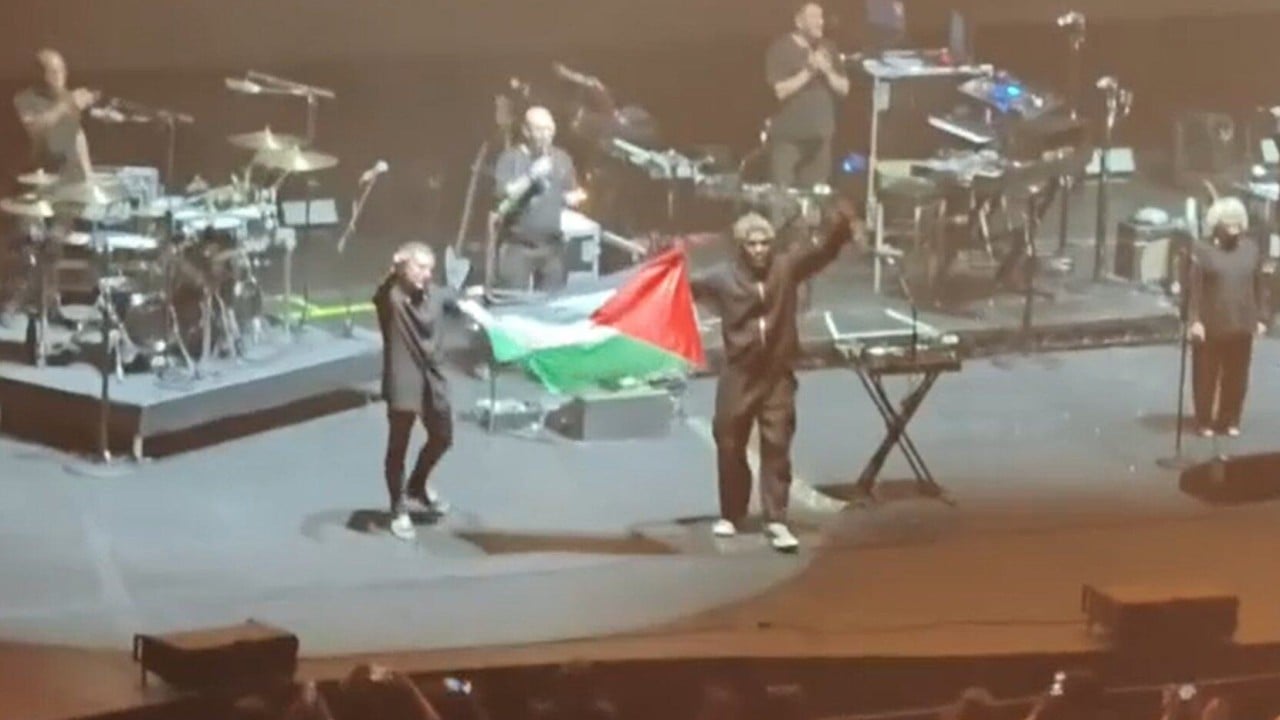
Singapore authorities and the Infocomm Media Development Authority are officially investigating British trip-hop pioneers Massive Attack following a concert at The Star Performing Arts Centre where band members raised a Palestinian flag and voiced support for Gaza. For a sovereign state built on hyper-regulated public order, strict maintenance of racial harmony, and rigid controls over foreign political expression, the incident represents a high-stakes stress test of local laws against international touring standards.
The confrontation highlights an intensifying clash between global artists utilizing performance spaces to project political stances and host nations determined to enforce strict neutrality laws.
The Anatomy of a Foreign Emblem Violation
Under Singaporean statutes, public expression is subject to severe guardrails designed to prevent external conflicts from fracturing domestic social cohesion. The core legal mechanism triggering the current inquiry is the Foreign National Emblems (Control of Display) Act 1949, which prohibits displaying any foreign flag or national emblem in public without a specific government permit.
When founding members Robert Del Naja and Grant Marshall hoisted the Palestinian flag at the close of their performance, they crossed a bright line established decades ago. Singapore maintains a meticulous stance on foreign policy matters, particularly regarding conflicts in the Middle East. The Ministry of Home Affairs previously issued explicit advisories emphasizing that domestic law strictly penalizes importing external geopolitical flashpoints into local public spheres.
Penalties for violating the Foreign National Emblems Act include financial fines or imprisonment. Beyond criminal statutes, the Infocomm Media Development Authority regulates public entertainment licenses. Promoters and artists agree to explicit regulatory stipulations before stepping on stage. Breaching these stipulations can jeopardize future event approvals for local organizers, forcing international booking agencies to weigh artistic statements against commercial viability in Southeast Asian markets.
The Operational Reality of Touring Under Surveillance
Touring acts entering the Southeast Asian circuit frequently miscalculate the strict legal parameters governing public speech. Western musicians often operate within a cultural ecosystem where political protest on stage is treated as standard artistic license. In contrast, jurisdictions like Singapore view public order as a collective security necessity rather than a secondary administrative hurdle.
During the concert, Massive Attack embedded stark multimedia projections addressing multiple international crises, ranging from the war in Ukraine to conflicts in Sudan, alongside critiques of global surveillance infrastructure. This multimedia approach mirrors the band's long-standing activist identity. Yet, translating an anti-establishment stance rooted in Bristol directly onto a tightly monitored stage in Queenstown creates immediate regulatory friction.
Local promoters find themselves caught in the middle of this friction. Lushington Entertainments, the local organizer for the tour, announced full cooperation with authorities. Promoters carry the operational burden of ensuring compliance, meaning foreign acts pushing political boundaries inadvertently threaten the business models of local partners who navigate these bureaucratic waters daily.
Balancing Geopolitical Neutrality and Global Culture
Singapore’s hardline stance stems from its unique demographic vulnerability. As a multi-ethnic society with significant Chinese, Malay, and Indian populations, the government enforces strict boundaries on religious and political discourse to prevent external identity politics from igniting domestic friction.
The public reaction within the city-state has been sharply divided. Digital forums lit up immediately following the event, with discussions ranging from staunch defense of free speech to fierce demands for legal accountability and deportation of the artists. This polarization illustrates why authorities act swiftly whenever foreign entities attempt to bypass local regulatory frameworks. Left unchecked, foreign stages risk turning into proxy battlegrounds for overseas grievances.
As investigations proceed, the outcome will likely reinforce a clear message to international touring acts. Artistic expression inside the sovereign borders of Singapore remains strictly tethered to local legal boundaries, and geopolitical messaging on stage carries real-world consequences.

/GettyImages-157526585-93425538070d4422ad42d22af28c0758.jpg)
