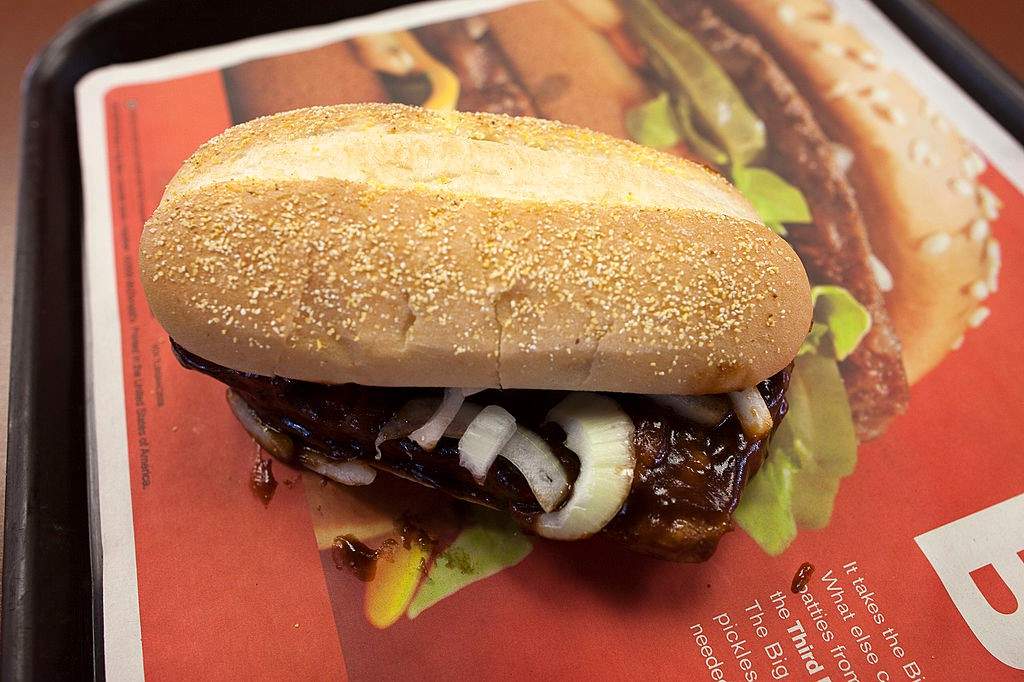
Every few years, like clockwork, the internet collectively rediscovers what restructured meat is and acts like it uncovered a cartel operation.
Right now, the viral outrage machine is churning over a class action lawsuit against McDonald’s regarding the McRib. The plaintiffs claim the sandwich is deceptive because it is shaped to look like a rack of ribs with bones, yet it contains zero actual rib meat. Instead, it is made from restructured pork shoulder, water, salt, dextrose, and preservatives.
Mainstream coverage frames this as a classic David-versus-Goliath consumer protection victory. A judge lets the lawsuit move forward, headlines scream about "deceptive meat," and pundits nod solemnly about corporate transparency.
That framing is completely lazy.
If you think this lawsuit is going to force McDonald’s to put bone-in St. Louis style ribs on a sesame seed bun, you fundamentally misunderstand food science, tort law, and how billion-dollar quick-service restaurants manage risk. The "deceptive meat" narrative is a distraction. The real story is how plaintiffs' attorneys weaponize food engineering terminology against consumers who don't read ingredient panels, and why McDonald’s actually benefits from the free press.
The Anatomy of Restructured Meat (And Why You Actually Want It)
Let’s kill the biggest myth immediately. "Restructured meat" is not pink slime, it is not synthetic lab-grown paste, and it is certainly not fake.
In food science, restructuring is a mechanical process developed in the 1970s—largely funded by the U.S. Army Natick Soldier Research, Development and Engineering Center—to solve a massive supply chain problem. Soldiers needed high-protein, portion-controlled meat rations that were tender, easy to chew, and wouldn't spoil in transit. Whole-muscle cuts were too expensive and inconsistent.
Dr. Roger Mandigo, a meat science professor at the University of Nebraska-Lincoln, pioneered the exact process McDonald’s eventually commercialized for the McRib in 1981.
Here is the actual chemistry of how it works:
- Comminution: Tougher, flavorful cuts of meat—specifically pork shoulder (Boston butt)—are flaked or ground into smaller particles.
- Protein Extraction: The meat is tumbled with salt and sodium tripolyphosphate. This isn't done to "trick" you. Salt and phosphate alter the ionic strength of the meat, extracting myofibrillar proteins (specifically myosin) to the surface of the meat particles.
- Binding and Forming: When those sticky, myosin-coated particles are pressed into a mold and heated, the proteins denature and cross-link. They bind together into a single, cohesive muscle-like structure.
Without restructuring, eating a pork sandwich with real rib bones in the front seat of a Honda Civic while driving 65 miles per hour would be a hazard. You would choke on bone fragments or ruin your shirt.
I’ve spent years watching food startups blow millions of dollars trying to replace functional ingredients like sodium tripolyphosphate with "clean label" alternatives like citrus fiber or mushroom extract, only to end up with a product that tastes like wet cardboard and falls apart in the fryer. Food engineering exists for a reason. Calling a molded pork shoulder patty "fraud" because it has decorative ridges on top is like suing Nabisco because Goldfish crackers don't contain actual marine life.
The "Reasonable Consumer" Standard Is Broken
To understand why this lawsuit survived a motion to dismiss, you have to look at the legal machinery behind modern food litigation.
Plaintiffs' firms in California, New York, and Illinois have turned food labeling lawsuits into an automated assembly line. Between 2010 and 2023, federal class action filings targeting food and beverage companies exploded by over 400 percent. These firms don't care about culinary accuracy. They care about clearing one specific hurdle: surviving the motion to dismiss.
Under state consumer protection laws—like California’s Unfair Competition Law or Illinois’s Consumer Fraud and Deceptive Business Practices Act—a plaintiff only needs to show that a "reasonable consumer" could be misled by the packaging or product design.
Notice the word could. Not would. Not was.
At the pleading stage, a federal judge isn't allowed to weigh evidence or decide if the plaintiff is being ridiculous. The judge has to accept the plaintiff's allegations as true and ask: Is it plausible that someone saw a rib-shaped sandwich called the "McRib" and genuinely believed it was harvested from the rib cage of a pig?
Because "plausibility" is a remarkably low bar, judges routinely punt these cases into discovery. And the moment a case enters discovery, the economics flip entirely in favor of the plaintiffs' lawyers.
The Economics of Nuance vs. Nuisance
Imagine a scenario where you are the General Counsel for a global fast-food chain. A plaintiffs' firm files a class action claiming your seasonal sandwich is deceptive.
You have two choices:
- Option A: Fight it on the merits. Hire an army of food scientists, linguistic experts, and consumer survey specialists. Spend three years and $4 million to $7 million in legal fees proving to a jury that nobody actually thinks a $5 drive-thru sandwich contains artisanal baby back ribs.
- Option B: Settle out of court for $1.5 million. The plaintiffs' attorneys pocket $500,000 in fees, the named plaintiffs get $5,000 each, and the rest of the class gets a voucher for a free medium fry that 94 percent of people will never redeem.
This is the dirty secret of consumer class actions. They rarely prove deception. They exploit the cost of defense. The headlines scream that a judge "validated" the claims of fake meat, when in reality, a judge simply declined to throw out a complaint before discovery began.
Answering the Questions You Should Actually Be Asking
When these lawsuits hit the news cycle, consumers start typing frantic questions into search engines. Most of those questions are built on flawed premises. Let’s dismantle them.
"Is the McRib actually made of real pork?"
Yes. It is 100 percent USDA-inspected pork. Specifically, it uses pork shoulder, which is the exact same cut pitmasters use for pulled pork. The notion that it contains mystery meat, hooves, or snouts is an urban legend rooted in classist assumptions about fast food. Pork shoulder is actually more expensive per pound than the trimmings used in standard commercial hot dogs or breakfast sausages.
"Does the McRib contain any rib meat at all?"
Sometimes, marginally, yes—though not in the way you think. In commercial pork processing, "pork trim" from the shoulder and loin areas can legally include small amounts of intercostal meat (the meat between the ribs) depending on the specific trim specification (like 80/20 lean-to-fat pork trim). However, it is not a slab of ribs. The ridges on the patty are purely aesthetic, stamped by a Formax forming machine to give the barbecue sauce a place to pool so it doesn't slide off the bun.
"Why is the McRib only available for a limited time?"
Everyone loves the theory that McDonald’s brings the McRib back only when global pork prices hit rock bottom. Commodity traders have even tried to chart pork belly futures against McRib release dates.
The correlation is weak at best. McDonald’s buys pork on massive, long-term forward contracts—they aren't shopping the spot market like a local butcher. The real reason for the limited-time offer (LTO) is operational friction and scarcity marketing.
The McRib requires a dedicated barbecue sauce vat on the prep line, which slows down kitchen throughput. Worse, because the patty is glazed in sauce, it cross-contaminates standard grills if not managed carefully. Running it year-round destroys kitchen speed—the single metric franchisees care about most. Making it scarce turns a logistical headache into a cultural event.
The Streisand Effect on Steroids
If you think McDonald’s corporate communications team is panicking over a "deceptive meat" lawsuit, look at their marketing playbook over the last decade.
McDonald’s has already survived the "pink slime" (lean finely textured beef) panic of 2012. They survived Super Size Me. They survived decades of urban legends about worm meat in hamburgers and rubber chicken nuggets.
Every single time an exposé or a lawsuit attacks the manufacturing process of a McDonald’s staple, the company doesn't hide. They lean into it. In 2014, they launched their "Our Food. Your Questions." campaign, literally taking cameras inside their processing plants to show the exact vats of liquid chicken and restructured pork patties that horrified foodies.
Why? Because transparency kills mystique, and fast-food consumers aren't buying nutrition—they are buying predictability and nostalgia.
When a lawsuit accuses the McRib of not having bones, it triggers millions of dollars in earned media. Late-night hosts make jokes about it. TikTok creators film themselves dissecting the patty. Radio DJs debate whether the ridges look like real ribs.
And what happens next? People get a sudden, inexplicable craving for tangy barbecue sauce, slivered onions, and dill pickles on a hoagie roll.
The Downside of the Industry’s Defense
To be completely fair, Big Food isn't entirely innocent here. While the "fake meat" angle is absurd, the industry has spent forty years blurring the lines between culinary craft and industrial manufacturing.
When a brand names a product the "McRib," molds it to mimic skeletal anatomy, and slathers it in smoky sauce, they are intentionally triggering a sensory association with traditional barbecue. They want the consumer's brain to register "hearty pit-smoked ribs" without the company having to pay for the raw materials or deal with the liability of bones.
Linguistic framing matters. If McDonald’s called it the "McPork Shoulder Patty," sales would crater by 60 percent overnight. The entire value proposition of ultra-processed food relies on mimicking the visual and textural cues of whole foods at a fraction of the cost.
Plaintiffs' attorneys know this. Even when their legal theories are paper-thin, they are tapping into a very real consumer fatigue over hyper-engineered food products that pretend to be something they aren't.
How to Actually Read a Fast-Food Menu Without Getting Played
If you want to stop falling for both corporate marketing spin and sensationalist legal headlines, change how you evaluate commercial food. Stop looking at the shape of the patty and start looking at the supply chain constraints.
- Follow the physics of the drive-thru. Any menu item designed to be eaten with one hand in a moving vehicle has been heavily engineered for structural integrity. Real bone-in ribs, authentic flaky pastries, and fresh heirloom tomatoes fail the drive-thru test. If it doesn't drip, crumble, or require a napkin, it was built in a lab to hold moisture.
- Read the allergen and ingredient matrix, not the product name. Every major chain publishes full ingredient decks online. If a product name uses a culinary descriptor (like "rib," "steak," or "artisan") without a USDA standard of identity attached to it, assume it is a marketing term. For example, "beef patty" has a strict USDA definition. "Rib-shaped patty" does not.
- Ignore motion-to-dismiss headlines. When you read that a lawsuit "moves forward," translate that in your head to: A judge decided the plaintiff spelled the defendant's name correctly and cited a real statute. Wait for summary judgment or a class certification ruling before assuming a company actually broke the law.
The McRib isn't a culinary lie. It is an engineering triumph designed to deliver maximum salt, sugar, fat, and nostalgia at 120 seconds per car. The lawyers suing over the lack of rib bones know this. McDonald’s knows this. The only people getting played are the ones who think a courtroom is going to change what goes into a $5 sandwich.