Geopolitical assessments frequently collapse under the weight of unverified assertions, where strategic claims outpace empirical telemetry. Recent intelligence evaluations regarding Middle Eastern conflicts and domestic environmental engineering projects demonstrate a persistent analytical failure: the substitution of narrative for measurement. Disentangling strategic posturing from physical reality requires deploying structured verification frameworks, examining satellite telemetry over state communiques, and quantifying ecological interventions through material science rather than political optics.
The Verification Gap in Modern Conflict Analysis
Traditional defense reporting often relies on unverified operational claims, creating severe feedback loops in strategic forecasting. When assessing regional escalations, such as assertions surrounding US-Iran military flashpoints, intelligence analysts face an information environment polluted by deliberate obfuscation and reactive media amplification.
The mechanism of error usually stems from three distinct failures:
- Source Homogeneity: Relying on single-origin military press releases without cross-referencing independent multispectral satellite data.
- Temporal Latency: Accepting delayed ground reports as real-time tactical indicators.
- Attribution Ambiguity: Failing to separate electronic warfare signatures from kinetic deployment events.
To resolve these discrepancies, analysts must transition from qualitative reception to quantitative remote sensing. Commercial synthetic aperture radar and high-resolution optical imagery provide an objective baseline that neutralizes propaganda. When state actors claim kinetic degradation of specific logistical nodes, pixel-level verification of thermal signatures and structural integrity acts as the primary truth metric. The cost of ignoring this step is systemic misallocation of defense capital and flawed risk modeling by foreign policy stakeholders.
The Mechanics of Arid Zone Remediation
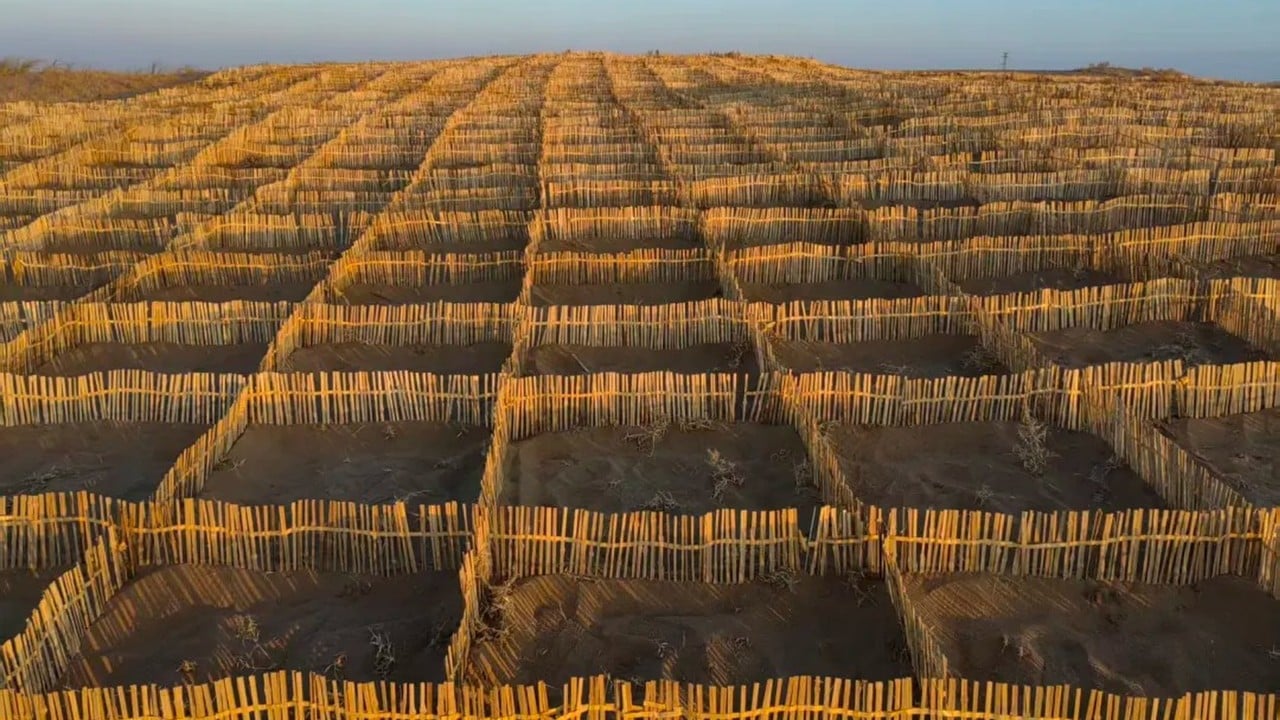
Shifting from military telemetry to environmental engineering, state-backed ecology projects face a similar deficit of rigorous measurement. The introduction of alternative botanical barriers, such as utilizing bamboo species for desertification control in northern territories, highlights the friction between traditional afforestation and material-based agronomy.
Evaluating the viability of these ecological interventions demands a strict cost-benefit function based on hydrological impact and soil mechanics:
$$E = \frac{R_v \cdot C_s}{W_u}$$
Where $E$ represents ecological efficiency, $R_v$ is root-system volumetric density, $C_s$ denotes carbon sequestration rate per hectare, and $W_u$ measures cumulative water consumption per plant lifecycle.
Standard poplar or shrub plantations historically favored for arid-zone stabilization often fail because their high water-uptake coefficients deplete local aquifers faster than precipitation can replenish them. Bamboo variants proposed in recent trials present a structural modification to this equation. Their dense, interlocking rhizome networks form a subterranean tensile mesh that resists wind-driven soil erosion while exhibiting high elasticity under hyper-arid stress conditions.
However, deploying non-native flora in fragile desert ecosystems introduces structural vulnerabilities. If the transpiration rate exceeds the localized water table recharge capacity, the intervention transitions from a remediation asset to a hydrological liability. Practitioners must calculate the exact hydraulic gradient of the target zone before approving large-scale translocation.
Operationalizing Empirical Oversight
Bridging the gap between raw data collection and actionable strategy requires stripping away political rhetoric to examine core operational variables. Whether evaluating contested military zones through satellite arrays or measuring biomass survival rates in arid restructuring zones, decision-makers must enforce strict evidentiary thresholds.
The analytical sequence demands an uncompromising sequence of verification:
- Isolate the primary physical or digital artifact from secondary commentary.
- Test the claim against historical baseline telemetry or botanical yield records.
- Calculate the structural resource cost required to sustain the observed phenomenon.
- Publish findings with explicit error margins rather than absolute declarations.
Adopting this methodology prevents systemic policy errors caused by accepting superficial media narratives. Rigorous intelligence and environmental management depend entirely on treating data as a physical constraint rather than a negotiable variable.

/GettyImages-157526585-93425538070d4422ad42d22af28c0758.jpg)