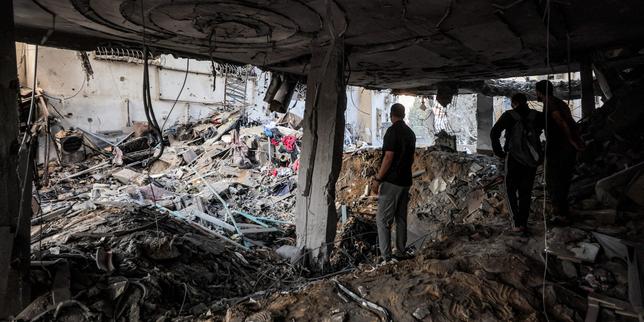
The mechanics of urban warfare are defined by structural vulnerability, population density, and the ballistic profiles of high-yield munitions. When precision-guided ordnance strikes multi-story residential architecture, the kinetic energy dissipation and subsequent structural collapse dictate a casualty distribution heavily skewed toward non-combatants, particularly women and children who occupy domestic spaces during daylight and nocturnal hours.
Recent civil defense reports from Gaza City detail a single strike resulting in five fatalities, four of whom were women, highlighting a persistent operational pattern in contemporary high-density conflicts. Understanding this pattern requires moving past narrative summaries to examine the intersection of structural density, targeting protocols, and reporting methodologies.
The Architecture of Structural Vulnerability
Gaza represents one of the most densely populated urban landmasses globally, creating an environment where structural architecture doubles as civilian shelter. The physics of reinforced concrete apartment blocks dictate that an aerial strike breaching upper floors causes progressive collapse, where each descending floor compounds the kinetic impact.
- Spatial Compression: Average living spaces house multiple family units, maximizing the human density per square meter of target area.
- Temporal Occupancy: Domestic targets experience peak occupancy rates outside typical working hours, raising the probability of multi-casualty outcomes per individual munitions payload.
- Blast Containment: Narrow urban corridors channel shockwaves laterally, increasing secondary fragmentation injuries among adjacent structures that lack structural hardening.
Casualty Documentation Protocols and Institutional Reliability
Quantifying urban warfare casualties involves distinct verification nodes, each carrying specific structural limitations. The data pipeline relies on municipal civil defense teams, hospital intake ledgers, and international monitoring agencies.
The primary verification mechanisms operate under severe infrastructure constraints:
- First-Responder Extraction: Civil defense units log fatalities recovered directly from structural rubble. This phase often underestimates total figures due to unrecovered bodies trapped beneath collapsed floors.
- Medical Facility Intake: Hospitals document deceased individuals upon arrival, categorizing by age and sex where identifiable. Mutilation from high-explosive ordnance frequently complicates rapid identification.
- Longitudinal Aggregation: International organizations cross-reference local health ministry figures against historical baselines, consistently noting a high statistical correlation during prolonged hostilities.
The presence of a disproportionate demographic ratio among the deceased—such as four women in a five-fatality incident—reflects standard urban demographics during active phases where adult males may be mobile or engaged in exterior survival logistics, leaving women, the elderly, and children concentrated within residential perimeters.
Strategic Implications of Post-Ceasefire Volatility
Low-intensity conflict environments governed by fragile or fractured cessation agreements exhibit distinct escalation dynamics. When formal truces experience repeated violations, military operations frequently transition from wide-area maneuvers to targeted tactical strikes against specific urban coordinates.
This operational shift changes the risk matrix for the civilian population. Rather than broad displacement waves, the primary threat vector becomes intermittent, high-precision munitions directed at urban housing infrastructure. The strategic outcome is a continuous attrition rate that impedes civil recovery, prevents structural rebuilding, and maintains perpetual displacement cycles among non-combatants. The calculus of modern urban engagement dictates that as long as high-yield ordnance is deployed within dense residential sectors, civilian demographic concentration metrics will directly mirror casualty distribution outcomes.