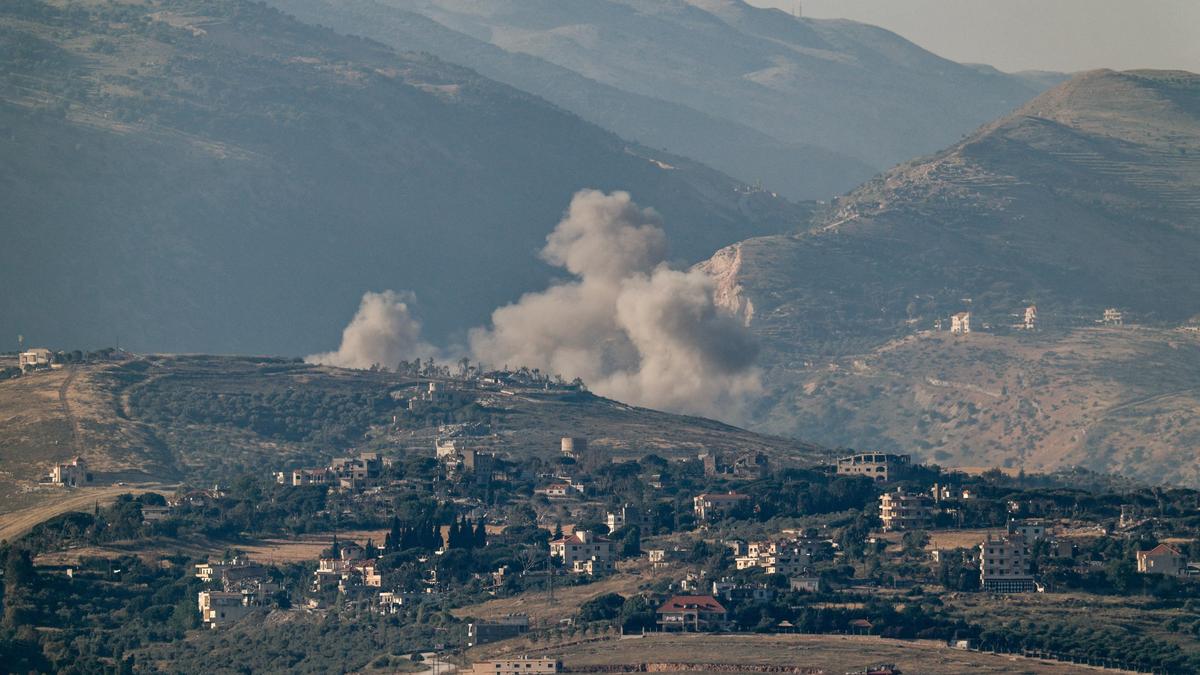
The diplomatic intervention proposed by United States Secretary of State Marco Rubio to establish a "gradual de-escalation" corridor between Israel and Hezbollah exposes a structural flaw in modern asymmetric conflict management: treating a strategic war of attrition as a series of disconnected, transactional tactical violations. The American blueprint relies on a linear, reciprocal sequence where Hezbollah halts all cross-border kinetic operations against Israel, and Israel simultaneously ceases operational escalation within metropolitan Beirut. This framework assumes that localizing the geography of violence will create the diplomatic insulation necessary to salvage a crumbling security architecture.
This model collapses under empirical scrutiny. The failure of the April 2026 ceasefire—which unraveled within six weeks, culminating in the Israeli military's seizure of Beaufort Castle and the strategic Litani ridge lines—demonstrates that temporary pauses do not alter the underlying structural incentives of either combatant. By decoupling the immediate operational friction from the long-term strategic imperatives of both Jerusalem and Beirut, the American de-escalation framework targets the symptoms of cross-border escalation while accelerating the breakdown of state sovereignty in the Levant. If you found value in this piece, you might want to look at: this related article.
The Asymmetric Equilibrium: The Cost-Incentive Disconnect
The foundational vulnerability of the American proposal lies in its miscalculation of the strategic utility of violence for both actors. The framework models the conflict as a symmetrical zero-sum game, assuming both sides place an identical value on geographic constraints. It introduces a two-variable equation:
- The Hezbollah Variable: Cessation of all cross-border rocket, missile, and unmanned aerial vehicle (UAV) salvos targeting northern and central Israel.
- The Israeli Variable: Cessation of high-yield airstrikes targeting Hezbollah's command-and-control, intelligence, and logistical nodes within the Beirut municipal perimeter.
This equation contains a profound conceptual error. For Hezbollah, a non-state armed actor structurally integrated into Lebanon’s political fabric, the tactical pause is not a step toward disarmament; it is a critical operational buffer. A cessation of hostilities allows the organization to absorb battlefield losses, reconstitute decentralized command elements, and restock low-altitude drone and precision-guided munition portfolios via Syrian supply corridors. Hezbollah’s political apparatus, managed via parliamentary proxies such as Speaker Nabih Berri, exploits this dynamic by shifting the diplomatic burden onto Israel, asserting that the state actor must "stop shooting first." This strategy transforms the diplomatic framework into a shield for tactical re-armament. For another angle on this story, check out the latest update from NPR.
Conversely, Israel's strategic calculus operates on an entirely different timeline. The displacement of over 60,000 Israeli citizens from northern communities creates an unsustainable internal political and economic liability. For the Israeli defense establishment, the baseline status quo prior to 2024—defined by the toothless enforcement of United Nations Security Council Resolution (UNSCR) 1701—is fundamentally dead.
The kinetic goal of the Israeli military is no longer deterrence, but the permanent modification of the border topography. The seizure of Beaufort Castle and the adjacent high ground confirms that Israel is executing a doctrine of geographic denial. Because Israel measures security through the physical eradication of launch sites and infrastructure south of the Litani River, a proposal that demands a halt to forward operations in exchange for a temporary pause in Hezbollah rocket fire presents an unacceptably asymmetric cost function. Israel is asked to sacrifice permanent geographic gains to achieve a temporary, highly reversible pause in asymmetric fire.
The Tripartite Breakdown and Institutional Emptiness
The structural failure of the current de-escalation architecture is compounded by the institutional emptiness of the Lebanese state. The United States continues to execute its diplomatic engagements through a dual-track fiction: negotiating formally with Lebanese President Joseph Aoun while relying on Speaker Nabih Berri to guarantee the compliance of an autonomous militia.
This diplomatic model ignores the absolute decoupling of the formal Lebanese state from the military realities on the ground. The structural elements tasked with monitoring the border zone are fundamentally incapable of altering the security landscape:
- The Lebanese Armed Forces (LAF) Bottleneck: While international frameworks frequently propose deploying 5,000 to 10,000 LAF troops to southern Lebanon to enforce an exclusive state monopoly on violence, the LAF lacks the domestic political mandate, heavy armor, and air defense capabilities required to forcibly disarm or displace Hezbollah's Radwan units.
- The Monitoring Mechanism Deficit: The five-country monitoring panel, alongside the United Nations Interim Force in Lebanon (UNIFIL), operates without real enforcement mechanisms. When tactical violations occur, the mechanism acts as an archival ledger rather than a deterrent system.
- The Sovereignty Paradox: The Lebanese cabinet’s theoretical commitments to dismantle unauthorized military infrastructure north of the Blue Line remain unenforceable. Because Hezbollah retains a domestic veto over Lebanese security policy through its allied political blocs, the formal state apparatus cannot execute the commitments made by its diplomats in Washington or Beirut.
When the United States proposes an immediate step-down framework, it places the implementation burden on a state structure that is an institutional hollow shell. The result is an inevitable cycle: a diplomatic declaration is signed, Hezbollah uses the operational pause to fortify decentralized positions, Israel detects the re-armament via aerial reconnaissance, and preemptive or retaliatory strikes shatter the agreement.
Strategic Forecast: The Inevitability of Border Reshaping
The diplomatic framework introduced by the United States will fail to achieve a durable cessation of hostilities because it refuses to address the fundamental security dilemma of the Blue Line. A gradual de-escalation plan that leaves Hezbollah’s launch infrastructure intact while demanding Israeli operational restraint does not offer an exit ramp; it merely resets the timer for a more destructive escalatory cycle.
The conflict will not be resolved through regional diplomatic trades or incremental geographic restrictions. The current momentum points toward a definitive strategic outcome: the enforcement of a de facto security buffer zone via continuous, unilateral ground operations. Israel’s military movements indicate that its strategic baseline is the absolute physical exclusion of hostile anti-tank guided missile (ATGM) systems and short-range rockets from direct line-of-sight targeting of northern Israeli civilian infrastructure.
Unless an international or state actor emerges with the raw military power and political will to physically displace non-state militias north of the Litani River and seal the Lebanese-Syrian frontier against smuggling, the conflict will follow its current kinetic trajectory. The United States proposal, detached from these structural imperatives, will remain a diplomatic artifact—ignored by a non-state actor leveraging tactical pauses for organizational survival, and bypassed by a state actor determined to re-engineer its border security by direct military force.
The primary strategic choice for international policymakers is no longer choosing between an unworkable diplomatic compromise and a wider war. The real choice is acknowledging that the previous security architecture of southern Lebanon is permanently shattered, and preparing for the economic and geopolitical consequences of a prolonged, physically enforced partition of the southern Lebanese border zone.