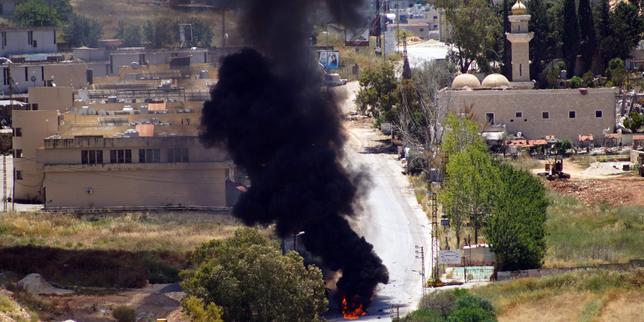
The execution of cross-border kinetic operations along the Israel-Lebanon axis operates not on spontaneous political impulse, but on a highly calculated framework of deterrence thresholds, structural asymmetries, and logistical constraints. While standard news coverage treats ongoing bombardments in various localities as an uncoordinated sequence of flashpoints, an analytical deconstruction reveals a rigid operational logic. The current conflict is governed by a precise interplay between targeted degradation strategies and the geographical distribution of non-state military infrastructure.
To understand the trajectory of these military engagements, one must move past the localized reporting of strikes and analyze the conflict through three distinct operational vectors: the asymmetry of information, the attrition cost function, and the geography of escalation.
The Tri-Border Deterrence Framework
The kinetic interactions between the Israel Defense Forces (IDF) and Hezbollah are structurally bound by a three-part framework that defines when, where, and how hard a state actor strikes a non-state actor embedded within a civilian population.
[Intelligence Dominance] ──> [Target Attrition Efficiency] ──> [Proportional Threshold Management]
1. Intelligence Dominance and Target Generation
The velocity of a bombardment campaign depends entirely on the capacity to generate actionable targets faster than the adversary can reconstitute or conceal assets. State military doctrine relies on a continuous loop of signals intelligence (SIGINT), human intelligence (HUMINT), and geospatial intelligence (GEOINT). When an escalation cycle accelerates, the primary bottleneck is not ammunition availability, but the validation rate of target profiles.
A non-state actor's primary defense mechanism is structural opacity—hiding military infrastructure within high-density urban environments or subterranean networks. Consequently, the geographic distribution of strikes across various Lebanese localities indicates a systematically mapped network rather than reactive firing. Each targeted structure represents a pre-computed intersection of high-value asset probability and acceptable collateral thresholds.
2. The Attrition Cost Function
Every missile deployed and every defensive interceptor launched possesses a distinct economic and strategic cost function. For the state actor, the calculation balances the direct cost of precision-guided munitions (PGMs) against the asset value degraded on the ground (e.g., rocket storage facilities, command nodes, or launch platforms).
For the non-state actor, the cost function is measured in strategic depth and inventory depletion. Because non-state actors rely on external supply chains that are difficult to replenish during an active blockade, the loss of a single major munitions depot has an exponential impact on their long-term sustainability. The state’s bombardment strategy is designed to accelerate this depletion rate past the point of viable replacement, forcing the adversary into a defensive posture where tactical flexibility is lost.
3. Proportional Threshold Management
Kinetic operations are bounded by implicit communication. Both actors operate under a shared, albeit fluid, understanding of red lines. Up until a full-scale regional escalation occurs, strikes are calibrated based on geographic zones and target profiles.
- Zone A (The Border Interface): High-frequency, low-latency tactical strikes targeting immediate firing positions.
- Zone B (Operational Depth): Medium-frequency strikes aimed at logistical supply lines, cutting off the front lines from reinforcement.
- Zone C (Strategic Core): Low-frequency, high-impact strikes targeting high-level leadership and command-and-control centers.
When bombardment extends deep into various localities outside the immediate border zone, it signals a deliberate decision to reset the deterrence equilibrium by demonstrating a willingness to absorb the escalatory response that such deep strikes inevitably trigger.
The Geography of Embedded Infrastructure
A critical failure of conventional conflict reporting is the omission of spatial mechanics. Bombardments are not distributed randomly across a map; they track the physical topography and urban planning of the region.
+------------------------+---------------------------------------+---------------------------------------+
| Operational Zone       | Infrastructure Type                   | Target Validation Protocol           |
+------------------------+---------------------------------------+---------------------------------------+
| Southern Border Ridge  | Concealed firing positions, ATGMs     | Real-time counter-battery, thermal     |
| Litani Basin           | Medium-range rocket arrays, bunkers   | Synthetic Aperture Radar (SAR) mapping|
| Beqaa Valley / Urban   | Strategic supply depots, command centers| High-altitude recon, deep penetration |
+------------------------+---------------------------------------+---------------------------------------+
The southern border ridge features rugged terrain that offers natural defilade for short-range rocket systems and anti-tank guided missiles (ATGMs). Striking these positions requires real-time counter-battery radar linked to automated drone or artillery response systems. The latency between an adversary's launch and the state's counter-strike must be compressed to under 120 seconds to be effective.
Further north, the Litani River basin and the Beqaa Valley present a different structural challenge. Here, military assets are integrated into agricultural and urban zones. The state’s targeting mechanism shifts from real-time reactive firing to deliberate, intelligence-driven interdiction. The objective changes from protecting immediate border communities to neutralizing the adversary’s capacity to launch sustained, synchronized salvos that could overwhelm domestic air defense networks like the Iron Dome or David's Sling.
This spatial distribution creates an operational paradox. To achieve complete degradation of the non-state actor's capabilities, the state must expand its targeting envelope into civilian-adjacent areas. This expansion inherently increases the probability of civilian casualties, which the non-state actor leverages within the international informational theater to degrade the state's strategic legitimacy.
Logistics as the Ultimate Constraint
No kinetic campaign can be sustained indefinitely without robust logistics. The frequency of air strikes is tightly bound to maintenance cycles, pilot fatigue, and the consumption rate of specialized ordnance.
A modern air force requires hundreds of maintenance hours for every hour of combat flight time. Precision munitions require specialized component logistics, including guidance chips and specific explosive yields. If a state actor anticipates a prolonged multi-front conflict, it must ration its premium deep-penetration ordnance, opting instead for standard gravity bombs equipped with guidance conversion kits (such as JDAMs) where appropriate.
The non-state actor faces an even more severe logistical bottleneck. Deprived of air superiority, their internal movement of weapons, fuel, and personnel must occur via subterranean tunnels or disguised civilian transport. A sustained bombardment campaign that targets bridges, transit junctions, and fuel storage facilities effectively fractures the non-state actor’s territory into isolated pockets. Once internal connectivity is broken, the adversary's ability to mount a coordinated defense or launch a concentrated counter-offensive decays linearly.
This degradation of internal logistics leads to a measurable drop in operational cadence. The frequency of rocket launches from the non-state actor drops, the coordination between different geographic sectors fractures, and their response times to state maneuvers slow down significantly.
Strategic Forecast and Operational Imperatives
The current kinetic posture indicates that the conflict has transitioned past a simple border skirmish into a systematic degradation campaign. The state actor will not cease operations upon achieving a temporary lull in incoming fire; the stated objective requires a structural reorganization of the security architecture along the border.
The primary operational indicator to watch over the coming weeks is the shifting ratio between reactive strikes (counter-battery) and proactive interdiction (deep logistics strikes). A sustained increase in proactive interdiction signals preparation for either a localized ground incursion to establish a buffer zone or an attempt to force a diplomatic realignment through sheer material exhaustion of the adversary.
The non-state actor will likely respond by attempting to saturate the state’s air defenses through high-volume, low-sophistication rocket barrages mixed with low-altitude loitering munitions. This tactic is designed to find a flaw in the defensive grid, score a high-casualty strike within a major population center, and re-establish a psychological equilibrium.
The conflict will not be resolved by tactical containment. The state actor must either accept the political and material costs of a protracted war of attrition designed to permanently hollow out the non-state actor's infrastructure, or it must leverage its current kinetic dominance to force an international diplomatic settlement that enforces a verifiable demilitarized zone up to the strategic depth of the Litani River. Anything short of these structural changes guarantees a return to the status quo ante bellum, merely delaying the next kinetic escalation cycle.