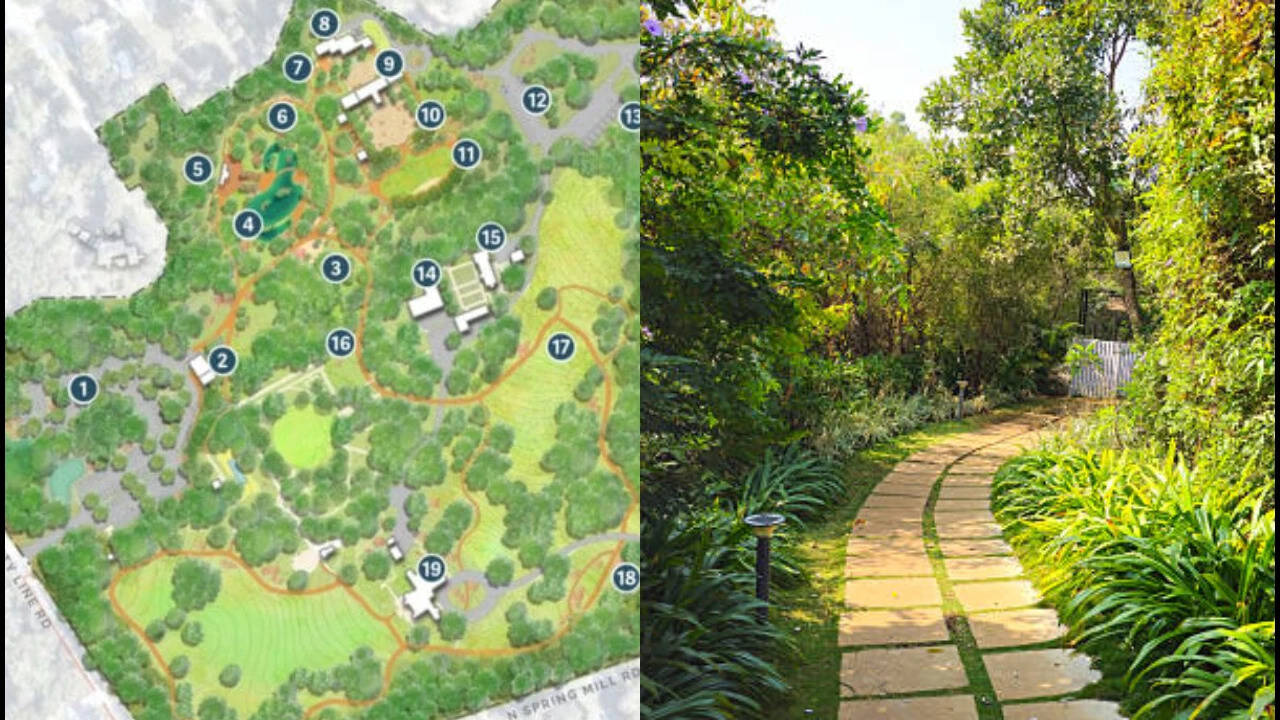
Land conservation assets face an inherent structural vulnerability: the tension between municipal infrastructure demands and private philanthropic intent. When the Lower Merion School District targeted the 13-acre Oakwell property via eminent domain in 2018 for athletic development, it exposed the fragility of localized green spaces. The subsequent resolution—culminating in the transfer of 10 acres to Natural Lands to expand the adjacent Stoneleigh public garden to 52 acres—provides a case study in land-use economics, legislative defense mechanisms, and asset reunification. Understanding this trajectory requires examining the economic, legal, and operational mechanics that transformed a threatened suburban estate into a permanent public utility.
The Economic Arbitrage of Urban Land Encumbrances
The foundational asset, Stoneleigh, originated as a 65-acre Pennsylvania estate before enduring a century of subdivision. When the Haas family gifted the core 42 acres to Natural Lands in 2016, they relied on a pre-existing conservation easement established in 1996. An easement strips development rights from a property title, depressing its commercial market valuation while preserving its ecological and historical utility.
The economic dynamics governing the adjacent Oakwell parcel operated under a different set of financial incentives. Acquired by the school district for approximately $12.9 million, Oakwell represented a high-cost municipal acquisition intended to solve a spatial deficit for school athletics. The subsequent friction between civic utility and historical preservation created a fiscal and political stalemate. The resolution—splitting the parcel to allocate 10 acres to Natural Lands and 3 acres to the Wyncote Foundation for mansion restoration—demonstrates a multi-party asset reallocation strategy.
The transaction value reflects a compromise between municipal capital recovery and non-profit endowment capabilities. By deploying philanthropic capital alongside foundation backing, conservation entities can neutralize municipal eminent-domain strategies when public sentiment assigns a higher net present value to ecological preservation than to localized scholastic infrastructure.
Legislative Backstops and Eminent Domain Vulnerability
Eminent domain statutes grant state and local governments sweeping authority to condemn private property for public use, provided just compensation is paid. Conservation easements introduce a legal friction into this mechanism, but they do not offer absolute immunity.
The vulnerability of Stoneleigh became clear during the 2018 confrontation when local authorities attempted to seize portions of the perimeter. The systemic defense deployed by preservationists relied on rapid legislative intervention rather than purely judicial remedies. The passage of Pennsylvania House Bill 2468, codified as Act 45, fundamentally altered the legal risk matrix for conserved land. By requiring Orphans Court approval before any entity can condemn a property protected by a conservation easement, the statute raised the legal threshold for municipal seizure.
This creates a replicable structural framework for land defense across other jurisdictions:
- Codified Intent: Securing baseline protection via permanent conservation easements tied to land trusts.
- Statutory Firewalls: Lobbying for state-level oversight acts that mandate judicial review for eminent domain actions on ecologically or historically designated tracts.
- Public Coalition Leverage: Mobilizing surrounding residential demographics to shift the political cost function for elected school boards or municipal councils pursuing condemnation.
Horticultural Integration and Operational Scaling
Expanding a natural garden from 42 to 52 acres is not a linear exercise in property management. The newly acquired Oakwell acreage was separated from Stoneleigh for roughly a century, during which distinct vegetative successions, micro-climates, and architectural modifications took root.
Integrating these zones requires a multi-year master planning phase focused on ecological restoration rather than immediate public access. The operational challenges of scale involve several distinct variables:
- Pathfinding and Flow: Reconnecting pedestrian corridors that mirror the original Olmsted Brothers design logic without disrupting established native plant communities.
- Carrying Capacity: Managing visitor density, parking constraints, and municipal spillover. With a primary parking infrastructure limited to baseline capacities, increased event programming requires off-site transit coordination or structural expansion of access points.
- Capital Expenditure Allocation: Balancing the horticultural maintenance of mature tree canopies against the capital costs of historic mansion preservation handled by secondary foundations.
The operational transition from a private estate to an accessible 52-acre public utility proves that historical landscapes can be successfully recaptured if capital deployment matches the long-term ecological timeline. Future preservation efforts facing municipal encroachment must prioritize statutory legislative shielding early in their lifecycle to prevent capital misallocation and secure permanent land integrity.