The security architecture of the Persian Gulf is currently experiencing a stress test focused on the vulnerability of isolated maritime assets. Recent reports regarding an attempted infiltration of a strategic island belonging to a Gulf state by Iranian-linked elements are not isolated tactical incidents; they represent a calculated application of "gray zone" warfare designed to test the response threshold of regional coalitions and their Western partners. To understand this friction, one must look past the immediate diplomatic protest and examine the logistical, geographical, and psychological variables that make small island territories the primary friction points in modern maritime geopolitics.
The Triad of Insular Vulnerability
The strategic value of a small island is rarely found in its landmass. Instead, its utility is a function of three overlapping factors:
- Projected Sovereignty: An island serves as a physical anchor for an Exclusive Economic Zone (EEZ), extending a state's legal right to extract subsea resources and regulate transit.
- Surveillance Persistence: These locations provide fixed platforms for radar, SIGINT (Signals Intelligence), and automated maritime domain awareness sensors that cannot be easily replicated by mobile naval patrols.
- Denial Logic: Even if a state does not actively use an island, its occupation prevents an adversary from establishing a "chokehold" proximity to vital shipping lanes, specifically the Strait of Hormuz.
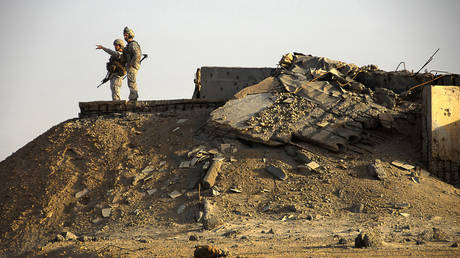
The recent accusation of infiltration suggests a shift from conventional naval posturing toward sub-conventional, non-attributed operations. By utilizing small, fast-moving craft or civilian-flagged vessels to land personnel or equipment, an aggressor avoids the immediate escalation triggers associated with a formal naval incursion.
The Cost Function of Asymmetric Incursion
From an analytical perspective, an infiltration attempt is a low-cost, high-leverage gambit. The "attacker" incurs minimal financial or political risk, while the "defender" faces an exponential increase in operational costs to harden every possible landing site.
The Asymmetry of Detection
Maintaining a 24/7 security perimeter around uninhabited or sparsely populated islands requires a significant allocation of high-end assets. A defender must deploy:
- Persistent Aerial Overlook: UAVs or manned patrols.
- Satellite Bathymetry and Imagery: To detect new structures or changes in terrain.
- Rapid Response Teams: Coastal guard units capable of intercepting fast-moving targets.
Conversely, the infiltrator only needs a single successful breach to create a fait accompli—a situation where removal requires force, which then risks a broader regional conflict. This creates a bottleneck in the defender’s decision-making process: do they ignore a "minor" presence and risk incremental annexation, or do they escalate and risk a full-scale war?
The Proxy Layer and Plausible Deniability
A recurring mechanism in Persian Gulf tensions is the use of non-state actors or paramilitary wings, such as the IRGC (Islamic Revolutionary Guard Corps). By delegating operations to these units, a state can maintain a layer of "strategic ambiguity." This complicates the legal framework for a response. International law provides clear protocols for state-on-state aggression, but "unidentified armed individuals" on a desert island fall into a legal gray zone that can paralyze diplomatic reactions.
The effectiveness of this strategy depends on the speed of the information cycle. If a Gulf state can produce immediate, high-resolution evidence of state-sponsored infiltration, they can collapse the deniability window. If the evidence is grainy or delayed, the aggressor wins the narrative war, framing the incident as a misunderstanding or a localized dispute among fishermen or smugglers.
Geographic Determinism and the "Salience" Factor
Strategic islands in the Persian Gulf, such as Greater and Lesser Tunbs or Abu Musa, are not merely rocks in the water; they are sensors in a network. The recent incident follows a historical pattern where territorial claims are used as leverage in broader negotiations, such as nuclear talks or oil production quotas.
The geography of the Gulf dictates that any vessel entering or exiting must pass within a narrow corridor. Controlling an island near this corridor provides a "tactical overwatch" capability. If an adversary can successfully place electronic jamming equipment or anti-ship missile batteries on such a point, they effectively hold the global energy supply chain hostage without firing a single shot from their mainland.
Structural Failures in Current Maritime Security
The reported infiltration highlights a gap in the "Integrated Air and Missile Defense" (IAMD) frameworks often discussed by Gulf Cooperation Council (GCC) members. While these states have invested heavily in intercepting high-altitude threats, their "littoral awareness"—the ability to track small, low-signature surface threats—remains uneven.
This gap exists because of a focus on prestige assets (frigates, destroyers, fighter jets) at the expense of distributed sensor networks. A "thick" defense would require thousands of low-cost sensors, acoustic arrays, and automated AI-driven thermal cameras distributed across the archipelago. The lack of this infrastructure creates the "shadow zones" that infiltrators exploit.
Logistics of an Infiltration Attempt
A successful island infiltration typically follows a four-phase operational model:
- Reconnaissance: Long-term observation of patrol patterns via dhows (traditional boats) or electronic surveillance to identify "blind spots" in the coastal radar.
- Insertion: Use of low-profile vessels during high-sea states or low-visibility conditions to ferry a small team or automated monitoring equipment.
- Establishment: The quick setup of temporary shelters or communication relays, often camouflaged to avoid detection by standard satellite passes.
- Verification of Response: Observing how long it takes for the sovereign power to notice the intrusion, which provides data on their reaction times for future, more significant operations.
The Strategic Play: Countering Encroachment
To move beyond a reactive stance, the targeted state must shift its strategy from "Point Defense" to "Proactive Deterrence." This involves three specific shifts in doctrine:
Automated Denial Systems
Relying on human patrols to guard thousands of miles of coastline is a losing mathematical proposition. The integration of "Smart Sea-Borders"—unmanned surface vessels (USVs) paired with persistent tethered drones—creates a continuous "tripwire" effect. These systems should be programmed to transmit data autonomously to a centralized command, removing the delay inherent in human reporting chains.
Legal and Diplomatic Forensics
The defense must be as much about data as it is about ammunition. Every island, no matter how small, should be equipped with "Black Box" sensor suites—hardened, buried devices that record audio, video, and electromagnetic signatures. In the event of an infiltration, the state can immediately release a data-backed indictment to the UN Security Council, stripping away the aggressor’s deniability before they can formulate a counter-narrative.
Kinetic Proportionality
There is a need for a pre-defined "Escalation Ladder." If an infiltration is detected, the response should not be a binary choice between "nothing" and "war." Developing specialized littoral recovery units designed to evict intruders using non-lethal or low-lethality means allows a state to reassert control without providing the adversary an excuse for a larger military strike.
The recurring friction over these islands is a reminder that in the Persian Gulf, sovereignty is not a static state; it is a constant, resource-intensive performance. The failure to secure a single strategic island does not just lose a piece of land; it signals a vulnerability in the entire regional security matrix. The immediate priority for Gulf states is the hardening of these "maritime outposts" into intelligent nodes capable of self-reporting and autonomous data capture. Any delay in this transition provides a permanent invitation for further "gray zone" testing.