The boarding of a non-compliant, dark-registered oil tanker by elite maritime forces in high-traffic international shipping lanes is not a mere law enforcement action; it is a complex kinetic intervention executed at the intersection of international maritime law, asymmetric naval warfare, and global energy economics. When sovereign states deploy specialized assets like the Royal Marines to board vessels operating within the "shadow fleet"—ships utilizing flag-of-convenience registration, obscured ownership structures, and deactivated Automatic Identification Systems (AIS)—they are responding to a deliberate disruption of the global maritime regulatory framework. To understand the strategic implications of these operations, one must analyze the precise operational mechanics, the legal parameters of state jurisdiction in international straits, and the economic friction points that govern shadow fleet operations.
The Operational Architecture of Maritime Interdiction
A maritime interdiction operation (MIO) against a non-compliant commercial vessel involves a highly structured progression of force, moving from electronic detection to physical control. The objective is to neutralize the vessel’s command structure before the crew can destroy evidence, scuttle the ship, or alter its course into sovereign waters where jurisdiction becomes contested.
The operational sequence relies on three distinct functional phases:
- Persistent Domain Awareness: Long-range radar, satellite imagery, and synthetic aperture radar (SAR) track vessels that have intentionally disabled their AIS transponders (going "dark"). By cross-referencing satellite overflights with known shipping schedules, maritime trade commands isolate anomalous signatures.
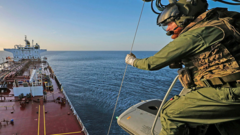
- Helicopter Visit, Board, Search, and Seizure (HVBSS): The insertion phase utilizes fast-rope techniques from rotary-wing aircraft to place an armed boarding team directly onto the vessel's superstructure. This method bypasses the vulnerabilities of a surface approach via rigid-hulled inflatable boats (RHIBs), which are susceptible to defensive maneuvers by the target vessel, such as high-speed banking or the deployment of physical barriers.
- Control and Securing of the Bridge and Engine Room: The boarding team must simultaneously secure the navigation bridge and the main engine control room. This splits the crew’s ability to resist and prevents the engineering staff from disabling the propulsion systems or initiating an intentional environmental spill as a deterrent.
The primary operational constraint during these maneuvers is the physical mass of the target vessel. A fully laden crude oil tanker can displace upwards of 100,000 deadweight tonnage (DWT). At standard transit speeds, its kinetic energy makes any physical obstruction impossible. The boarding team must assume total operational control of the vessel's steering gear and propulsion mechanisms within minutes of touchdown to mitigate the risk of grounding or collision in congested waters like the English Channel.
Legal Friction and Jurisdictional Thresholds
Interdicting a foreign-flagged merchant vessel in international waters or exclusive economic zones (EEZs) requires navigating a dense framework of international law, primarily governed by the United Nations Convention on the Law of the Sea (UNCLOS). Under normal transit conditions, the principle of freedom of navigation protects merchant vessels from interference by foreign warships. However, the shadow fleet operates systematically within the gray zones of these legal definitions.
To lawfully execute an involuntary boarding, an interdicting state must establish specific legal triggers:
- The Right of Visit (UNCLOS Article 110): A warship may board a foreign merchant ship if there is reasonable ground for suspecting the vessel is engaged in piracy, the slave trade, unauthorized broadcasting, or is flying a fraudulent flag or refusing to show its flag.
- Flag State Consent: If a vessel is suspected of violating international sanctions, the interdicting state must request authorization from the nation under whose flag the vessel is registered. The shadow fleet exploits this by utilizing flags from nations with minimal regulatory oversight or slow bureaucratic response times, creating a temporal window to evade enforcement.
- Coastal State Jurisdiction in Territorial Waters: If the operation occurs within the 12-nautical-mile territorial sea limit, the coastal state possesses broader enforcement powers related to fiscal, immigration, sanitary, and customs laws, alongside urgent environmental protection mandates.
The legal vulnerability of the shadow fleet stems from its structural reliance on compromised documentation. When a vessel falsifies its registration or operates under a revoked flag ("stateless status"), it forfeits its protections under UNCLOS Article 92, rendering it subject to the jurisdiction of any state that encounters it on the high seas.
The Cost Function of Shadow Fleet Transits
The existence of the shadow fleet is driven by economic arbitrage: bypassing international price caps, sanctions, and environmental compliance costs. However, the operational model introduces severe structural inefficiencies that increase the total cost function of transporting energy products.
Total Shadow Transit Cost = Base Operational Expenses + Insurance Risk Premium + Document Obscuration Costs + Interdiction Probability Loss
The standard maritime logistics model relies on high-liquidity, low-risk insurance provided by the International Group of P&I Clubs, covering approximately 90% of global ocean-going tonnage. Shadow fleet vessels are barred from these networks, forcing them to rely on undercapitalized, state-backed, or non-traditional insurers. This alters the economic profile of a voyage in several ways.
The absence of top-tier hull and machinery insurance requires operators to self-insure against mechanical failure, detention, or seizure. The capital tied up in risk mitigation reduces the net margins of the cargo transport. Furthermore, the reliance on older, depreciated hulls—often over 15 years of age, nearing the end of their design life—increases the probability of catastrophic mechanical failure.
To obfuscate the origin and destination of the cargo, these vessels engage in ship-to-ship (STS) transfers in deep-water anchorage zones. An STS transfer introduces significant variable costs: chartering secondary lightering vessels, paying specialized mooring masters, and accounting for volumetric product loss through evaporation or spillage during the transfer process. The temporal delays inherent in executing these maneuvers in suboptimal weather conditions further degrade the economic efficiency of the supply chain.
Strategic Implications for Global Maritime Choke Points
The escalation of boarding operations in high-density maritime corridors signals a shift in how coastal states police strategic choke points. The English Channel, the Strait of Malacca, and the Bab-el-Mandeb are no longer treated merely as commercial transit lanes, but as active regulatory enforcement zones.
As coastal states increase the frequency of physical inspections, shadow fleet operators are forced to re-route vessels around broader geographical features, such as the Cape of Good Hope. This geographic displacement increases voyage duration by 10 to 14 days, directly driving up bunker fuel consumption and tightening the global supply of available tanker tonnage.
The increased operational friction creates a bifurcated maritime shipping market. The compliant fleet operates with low overhead and predictable transit times, while the shadow fleet functions within an increasingly volatile risk environment, where the probability of asset seizure or prolonged port detention must be priced into every barrel of oil delivered. Coastal nations are leveraging this economic pressure, using elite military units not to halt all illicit trade, but to make the cost of defiance economically unsustainable for commercial operators.