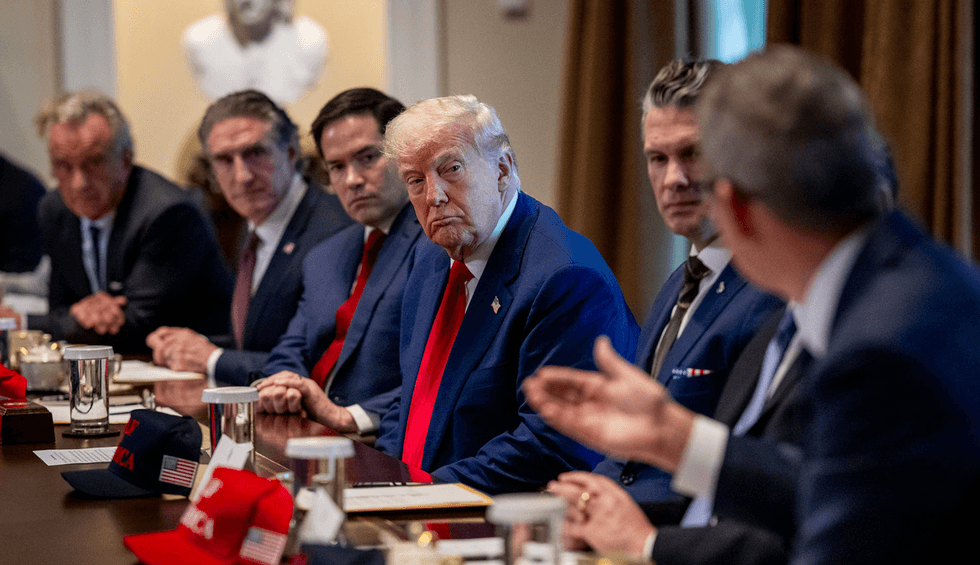
Political loyalty in a second-term presidential administration operates as a depreciating asset whose liquidation value peaks immediately after a catastrophic midterm defeat. When an incumbent party loses control of both chambers of Congress, including traditional electoral strongholds, the internal incentive structure of the executive branch flips overnight. Senior officials no longer optimize for proximity to executive authority; they optimize for survivability ahead of the next presidential primary and protection against incoming legislative oversight. The reported preparation of Secretary of State Marco Rubio to exit the administration and attribute electoral losses to President Donald Trump illustrates a predictable principal-agent breakdown rather than an isolated interpersonal dispute.
The Principal-Agent Breakdown in Lame-Duck Cabinets
In organizational economics, a principal-agent problem emerges when an executive (the principal) delegates authority to a senior lieutenant (the agent) whose personal risk-reward calculus diverges from the executive's survival strategy. During the first two years of a presidential term, alignment remains high because the principal controls appointments, policy direction, and the party's electoral machinery. Following a midterm wave that hands the House of Representatives and the Senate to the opposition, that alignment collapses through three structural shifts. For an alternative view, read: this related article.
- The Asymmetry of Lame-Duck Horizon: A term-limited president faces zero future electoral accountability, allowing them to double down on unpopular foreign entanglements or polarizing domestic policies without bearing personal ballot-box costs. Conversely, a Cabinet official harboring presidential ambitions for the subsequent cycle—such as Rubio positioning himself for 2028—must face the electorate in less than twenty-four months. Remaining inside the administration forces the agent to absorb 100 percent of the reputational liability for decisions over which they hold diminishing operational control.
- The Oversight Liability Multiplier: When the opposition captures the House, committee gavel power transfers immediately. For senior figures across the State Department, Defense Department, and Justice Department, remaining in office converts them from policy executors into primary subpoena targets. Stepping down before the new Congress convenes reduces institutional exposure, limits the scope of ongoing operational testimony, and eliminates the risk of formal impeachment proceedings aimed at sitting Cabinet members.
- The Succession Market Signal: In any presidential succession race, early differentiation determines fundraising velocity and elite endorsement consolidation. With Vice President JD Vance already attempting to separate his political brand from the administration's unpopular conflict in Iran, a Cabinet rival cannot afford to remain tethered to the White House messaging apparatus. Exit becomes the prerequisite for credible differentiation.
Deconstructing the Blame-Attribution Matrix
Standard political reporting treats post-election finger-pointing as emotional fallout. In practice, blame attribution is a disciplined reputation-laundering exercise designed to reallocate responsibility across three distinct centers of power: the Oval Office, the Cabinet, and the Vice Presidency.
- Executive Overreach vs. Departmental Execution: Allies of departing officials frame electoral defeat as the direct consequence of top-down White House mandates—specifically foreign military intervention and resulting energy price shocks—while portraying the Cabinet official as a restrained institutionalist who maintained a lower operational profile during key negotiations.
- The Vice-Presidential Trap: A sitting Vice President cannot resign without triggering a constitutional crisis of confidence within their own party, leaving them structurally bound to the administration's record even as they issue critical post-mortems. A Secretary of State faces no such institutional lock-in. Resignation grants immediate freedom of movement to critique executive strategy from the outside while retaining the foreign-policy credentials accrued in office.
- The Scapegoat Counter-Offensive: While departing officials attempt to anchor blame to the President's unilateral decisions, the West Wing simultaneously prepares a counter-narrative that redirects failure toward Cabinet execution or staff management, targeting figures such as Defense Secretary Pete Hegseth or outgoing chief of staff personnel. Whichever faction establishes the dominant causal narrative
Political Scapegoating and Executive Defection in the Modern Republican Party
news Further analysis on this trend has been provided by The Washington Post.
Executive turnover inside political administrations rarely occurs in a vacuum, and when anonymous party insiders leak impending resignations tied to leadership friction, they are executing a calculated signaling strategy. The mechanics behind a senior Republican official preparing to exit and publicly attribute that departure to Donald Trump illustrate a recurring structural failure in centralized political organizations: the collision between institutional risk management and charismatic authority. Understanding this dynamic requires separating the tactical noise of Washington gossip from the underlying incentive structures that govern political survival, reputation preservation, and post-administration career viability.
The Anatomy of the Pre-Emptive Leak
Political leaks are instruments of leverage, not accidental disclosures. When Republican insiders float the narrative that an unnamed official is on the verge of quitting and intends to blame Trump, the leak serves three distinct operational functions before a resignation letter is ever signed.
First, it establishes narrative primacy. In high-turnover environments, the principal executive typically controls the firing mechanism and the subsequent framing, often labeling departing staffers as incompetent or disloyal. By pre-emptively leaking an impending voluntary exit alongside a specific grievance, the official's allies invert the power dynamic. They transform a potential dismissal into a principled resignation, stripping the executive of the element of surprise.
Second, the leak acts as a trial balloon to gauge coalition support. Anonymous sourcing allows the departing official to test how party donors, media ecosystems, and institutional allies react to a direct critique of the party leader. If the reaction yields support from traditional conservative institutions or corporate boards, the official gains confidence to execute a public break. If the backlash from the party base is overwhelming, the absence of a confirmed name allows the official to quietly exit without a public confrontation, preserving future employability within the movement.
Third, it transfers reputational liability. Senior officials operate under a continuous risk-reward calculation. When policy outcomes deteriorate, legal exposure increases, or strategic directives contradict established institutional norms, the cost of remaining in the role exceeds the value of proximity to power. Attributing the exit directly to Trump is an effort to ring-fence the official's personal brand from the administration's liabilities.
Centralized Authority Versus Institutional Autonomy
The core friction driving these departures stems from an organizational mismatch between traditional administrative governance and populist executive leadership. Standard political operations rely on delegated authority, where cabinet members, agency heads, and senior advisors possess defined operational autonomy within broad policy guardrails. Under this model, loyalty is institutional; officials serve the office, the party platform, and the legal framework, absorbing operational friction to protect the principal from daily tactical errors.
Conversely, a hyper-centralized leadership model treats institutional autonomy as a threat. Decision-making is concentrated at the top, and loyalty is defined strictly in personal terms. This creates a structural bottleneck with predictable consequences for senior personnel:
- Asymmetric Accountability: Officials are held responsible for executing directives they did not formulate, while strategic credit flows upward and operational blame flows downward.
- Policy Whiplash: Rapid shifts in executive priorities force agency leaders to repeatedly abandon long-term implementation plans, eroding their credibility with career staff, legislative committees, and external stakeholders.
- Erosion of Gatekeeping: When senior advisors are bypassed in favor of informal outside networks, formal titles lose functional authority. An official who cannot control their own organizational chart becomes a figurehead bearing full legal and political risk without corresponding decision-making power.
When an official reaches the breaking point under these conditions, the decision to quit is rarely triggered by a single ideological disagreement. Instead, it is the culmination of cumulative operational paralysis. The official concludes that staying in the role guarantees reputational destruction, whereas a loud exit offers a chance at rehabilitation outside the immediate orbit of the administration.
The Cost Function of Public Attribution
Quitting quietly is the default mode for exhausted political appointees; quitting loudly and naming the principal executive as the cause is a high-stakes maneuver governed by a strict economic and political cost function. To understand why an official would choose confrontation over a quiet departure, we must examine the post-exit marketplace.
A former senior Republican official faces two primary career tracks after leaving government:
- The Populist Ecosystem: Media commentary, aligned PACs, lobbying firms catering to Trump-friendly industries, and future appointments within the same political orbit. Entering this market requires unbroken loyalty. Publicly blaming Trump permanently forecloses this track, triggering immediate ostracization and potential primary challenges if the official seeks elected office.
- The Institutional-Corporate Ecosystem: Fortune 500 boards, traditional think tanks, white-shoe law firms, academia, and legacy media networks. Entry into this market requires demonstrable independence from populist controversies. For an official tainted by association with an administration's most polarizing actions, a quiet exit is insufficient to clear corporate compliance and reputational vetting.
Publicly blaming Trump functions as a costly signal—a concept in game theory where an action is credible precisely because it inflicts irreversible damage on the actor in one domain to prove sincerity in another. By burning bridges with the party's dominant figure, the departing official signals to institutional gatekeepers that they are willing to absorb base-level hostility in exchange for re-entry into mainstream governance and corporate circles.
Principal-Agent Failure in Party Politics
This dynamic is a textbook manifestation of the principal-agent problem in organizational economics, inverted for political reality. In standard principal-agent theory, the principal (the leader) struggles to ensure the agent (the official) acts in the principal's best interest rather than their own. In modern GOP internal politics, the agent often attempts to enforce institutional norms that the principal actively rejects.
The insiders leaking this story are operating as secondary agents. Often, these sources are not the departing official themselves, but mid-level staffers, congressional aides, or rival faction members within the party apparatus. Their incentives diverge from both the principal and the departing official:
- Factional Sabotage: Rival advisors leak an impending resignation to accelerate the official's removal, painting them as weak or treacherous before they can execute their own exit timeline.
- Legislative Insulation: Congressional Republicans frequently use executive branch turmoil to signal to moderate constituents that internal checks still exist, without having to cast risky floor votes against the party leader.
- Media Currency: Insiders trade high-value narrative scoops to political reporters in exchange for favorable coverage of their own portfolios or protection from scrutiny.
Because the primary reference lacks named sources, specific policy triggers, or a confirmed timeline, the story exists entirely in the realm of pre-decisional signaling. The factual baseline is limited to the existence of internal friction and the strategic use of anonymous press outreach. Treating an unverified leak as a definitive operational reality ignores the reality that many threatened resignations are resolved through quiet side-deals, title changes, or delayed exits after the news cycle shifts.
Limitations of the Public Break Strategy
While blaming the top executive appears decisive in theory, historical precedent from recent Republican administrations demonstrates severe limitations to this strategy. First, the news cycle compresses the impact of individual resignations. Unless a departure is accompanied by a major legislative defeat, a criminal indictment, or a coordinated wave of simultaneous exits, a single official's grievance is absorbed and neutralized within 48 hours.
Second, asymmetrical media reach favors the principal. Trump commands a direct communication apparatus capable of defining the departing official to millions of voters instantly. A former cabinet secretary or senior advisor relying on traditional press interviews or op-eds cannot match that volume, often resulting in the official becoming politically irrelevant to the Republican base while remaining suspect to Democratic-leaning institutions.
Third, timing dictates efficacy. An exit staged too early is dismissed as a failure to adapt to the administration's pace; an exit staged too late is viewed as opportunistic rat-fleeing once the political costs have already been incurred. Most officials miscalculate this window, waiting until their institutional leverage has completely evaporated before making their move.
Tactical Execution for Political Operatives and Observers
When evaluating or managing executive departures within a centralized political movement, decision-makers must bypass surface-level press narratives and execute a disciplined verification and positioning protocol.
For political analysts and institutional stakeholders assessing the credibility of anonymous resignation leaks, apply a three-step filter before adjusting strategic forecasts:
- Verify Structural Isolation: Check whether the rumored official has been excluded from recent high-level meetings, budget allocations, or legislative negotiations. Real departures are preceded by operational marginalization weeks before a press leak occurs.
- Track Secondary Movers: Watch the deputies and chief of staff attached to the official. Senior principals rarely depart without first securing soft landings for their immediate loyalists; sudden LinkedIn updates or quiet inquiries to K Street firms by mid-level staffers are reliable leading indicators.
- Assess Policy Chokepoints: Identify imminent deadlines—such as statutory certification dates, budget submissions, or regulatory rollouts—that force a binary choice between legal compliance and executive demands. True principled resignations cluster around non-negotiable procedural deadlines rather than abstract ideological disputes.
For senior officials contemplating an exit under conditions of severe leadership friction, avoid the half-measure of anonymous threats. Leaking an intent to blame the principal before resigning alerts the executive's enforcement apparatus, allowing them to pre-emptively fire the official and strip away the narrative value of a voluntary departure. Execute the departure silently, secure formal legal and compliance sign-offs prior to submission, and release a concise, factual statement of resignation simultaneously with delivery to the executive office—controlling the timestamp, the text, and the institutional record before counter-messaging can mobilize.


