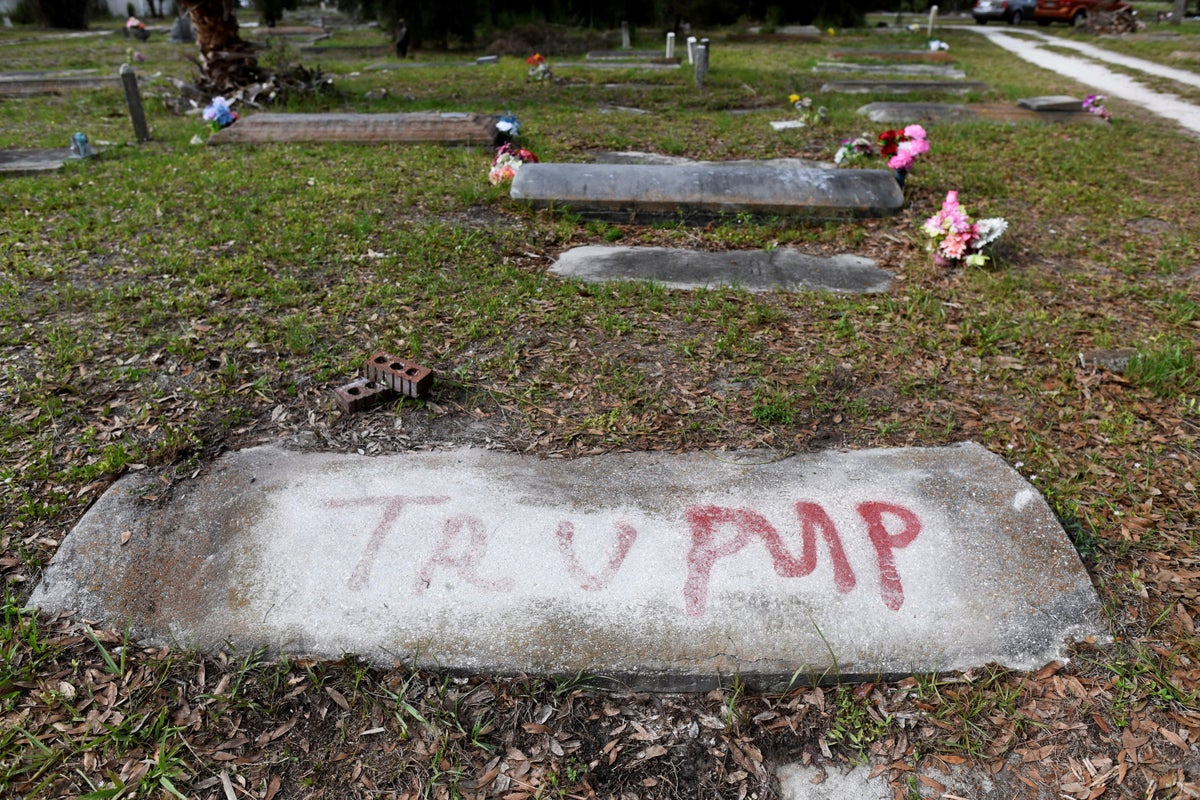
The desecration of the Silver Creek Cemetery—a historic African American burial ground in Bourbon, Missouri—represents a confluence of two distinct socio-political phenomena: the weaponization of historical heritage sites and the deployment of high-contrast political messaging within marginalized spaces. On May 11, 2026, authorities confirmed that 17 headstones were defaced with the name of a political figure in bright red spray paint. This act transcends simple property damage; it functions as a deliberate disruption of cultural continuity. By analyzing the incident through the lens of psychological warfare and symbolic erasure, we can quantify the impact beyond the physical cost of restoration.
The Architecture of Symbolic Erasure
Vandalism in a historic context operates on three primary layers of impact. When a site is targeted based on its racial or historical identity, the intent shifts from random delinquency to a structured attempt at "erasure."
- The Temporal Layer: Historic cemeteries serve as the physical ledger of a community’s existence. By defacing graves that date back over a century, the perpetrator attempts to sever the link between the present community and its ancestral legitimacy.
- The Political Layer: The choice of a specific political name serves as a "claim of dominance." It signals that the current political climate is being forcibly inserted into a space that is traditionally viewed as a sanctuary or a neutral zone of mourning.
- The Psychological Layer: The use of red spray paint—a high-visibility, aggressive color—creates a visual shock. This choice ensures that the desecration is impossible to ignore, forcing the community into a reactive state of trauma and defense.
Resource Allocation and Restoration Bottlenecks
The restoration of 17 headstones is not merely a labor-intensive task; it is a technical challenge dictated by the material science of historical masonry. Most headstones in 19th and early 20th-century Black cemeteries were crafted from porous materials such as limestone, marble, or sandstone.
The application of modern spray paint creates a chemical bond that is difficult to break without destroying the underlying substrate. Standard pressure washing is often contraindicated because it can cause spalling or surface loss on fragile stones. The restoration process follows a specific hierarchy of intervention:
- Chemical Neutralization: Technicians must identify the specific binder in the spray paint (likely an acrylic or alkyd resin) and apply a solvent that dissolves the pigment without migrating it deeper into the stone’s pores.
- Poultice Application: For deep-seated staining, a "poultice"—a paste made of absorbent material and chemicals—is applied to the stone. As the paste dries, it draws the dissolved paint out through capillary action.
- Mechanical Cleaning: If chemicals fail, microscopic abrasive techniques are used, though these carry the highest risk of removing the original inscriptions.
The bottleneck here is the availability of certified conservators. Because these cemeteries are often managed by non-profit boards or family descendants with limited budgets, the "cost of recovery" includes both the direct restoration fees and the opportunity cost of diverted preservation funds.
The Security Vacuum in Rural Heritage Sites
The Silver Creek incident highlights a systemic vulnerability in rural historical preservation. Most small-scale cemeteries lack a "Security-in-Depth" (SiD) strategy, leaving them as "soft targets" for ideological vandalism.
The failure points are usually categorized as follows:
Lack of Perimeter Definition
Many historic Black cemeteries were established on the outskirts of towns or on land that was marginalized at the time of purchase. Over decades, these sites have been surrounded by woods or private property, lacking clear fencing or lighting. This absence of a "psychological boundary" makes unauthorized entry trivial.
Surveillance Deficits
The cost of installing and maintaining a remote camera system (CCTV) with night-vision capabilities and cellular backhaul is often prohibitive for small cemetery associations. Without real-time monitoring, perpetrators can operate with a high degree of confidence that they will not be caught in the act.
Community Isolation
When a cemetery is physically isolated from daily foot traffic, the "window of opportunity" for a vandal expands from minutes to days. The delay between the act of vandalism and its discovery allows the physical evidence to degrade (e.g., paint curing in the sun) and the trail of the perpetrator to grow cold.
Legal Classifications and Sentencing Disparities
The legal response to this event depends on the classification of the act. While "vandalism" is the colloquial term, the specific statutes triggered in Missouri and under federal law provide a more rigorous framework for prosecution.
- Institutional Vandalism: Under Missouri Revised Statutes § 574.085, the defacement of a place of worship or a cemetery is a Class E felony if the damage exceeds a specific monetary threshold. The historic nature of the stones can escalate the valuation of the damage due to the specialty labor required for repair.
- Hate Crime Enhancement: If it can be proven that the site was targeted specifically because it is a Black cemetery, the act may be prosecuted as a hate crime. This adds a layer of "motive-based sentencing," which recognizes that the harm extends to the entire demographic group represented by the site.
- Federal Civil Rights Violations: The Department of Justice can intervene if the act is seen as an attempt to intimidate or interfere with the free exercise of cultural or religious rights.
The Socio-Economic Impact of Desecration
Beyond the emotional toll, the desecration of 17 graves creates a negative economic feedback loop for the surrounding area.
- Decline in Heritage Tourism: Many historic Black cemeteries are sites of interest for genealogists and historians. Persistent vandalism reduces the "safety rating" of the site, leading to a decrease in visitors and the associated revenue for local businesses.
- Increased Insurance Premiums: As vandalism incidents rise, the cost of insuring historic sites increases. Many small associations are forced to drop coverage, leaving the site even more vulnerable to future incidents.
- Property Value Stagnation: Areas surrounding neglected or defaced landmarks often experience slower growth in property values, as the vandalism is viewed as a proxy for the lack of effective local law enforcement and community cohesion.
Strategic Hardening of Historical Assets
To prevent the recurrence of such events, cemetery associations and local governments must move beyond reactive repairs and toward a model of "Asset Hardening." This involves a multi-pronged approach to site management.
Phase 1: Environmental Design (CPTED)
Implementing Crime Prevention Through Environmental Design (CPTED) principles is the most cost-effective first step. This includes clearing brush to improve "natural surveillance" (lines of sight from the road) and installing solar-powered motion-activated lighting.
Phase 2: Digital Preservation
Every headstone should be 3D-scanned or high-resolution photographed. In the event of total destruction or unrecoverable vandalism, these digital records allow for the creation of exact replicas, ensuring the historical data is never truly lost.
Phase 3: Legal Aggression
Local prosecutors must be lobbied to pursue the maximum possible charges for "Institutional Vandalism." When these acts are treated as mere misdemeanors, the "cost of the crime" remains low enough to be ignored by bad actors. Treating them as felonies raises the stakes and serves as a deterrent.
The events at Silver Creek Cemetery are a signal of a broader trend where historical memory is the battlefield. The strategy for the future must be a transition from "passive observation" to "active protection." This requires a shift in how these sites are funded, monitored, and legally defended. The survival of the historical record depends on the ability to make the cost of its destruction—both legal and social—prohibitively high.