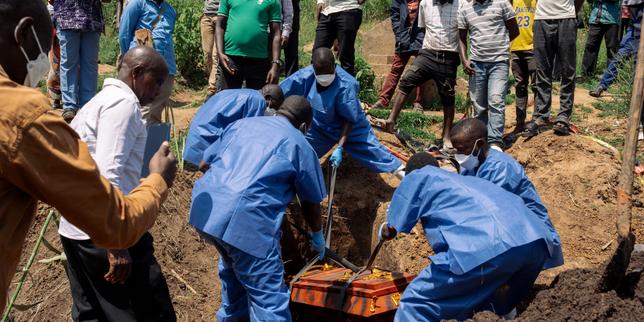
The headlines are predictable, alarmist, and fundamentally wrong. Every time an Ebola outbreak surfaces in the Democratic Republic of Congo, mainstream reporting follows a copy-paste script. They paint a picture of an unstoppable wildfire, screaming that the virus is "spreading at a record pace" and "out of control."
This lazy narrative sells papers, but it fundamentally misinterprets the data.
When you look at the actual epidemiological mechanics on the ground, a surging case count doesn't mean the virus is winning. Often, it means our surveillance systems are finally working. The standard panic-inducing reporting conflates an increase in detected cases with an increase in actual transmission speed.
By treating Ebola as an unpredictable, explosive monster rather than a localized, manageable crisis of infrastructure, international commentators do more harm than good. They trigger panic, misallocate resources, and ignore the hard-won expertise of local Congolese health workers who actually know how to choke out the virus.
The Mirage of the Record Pace
Let’s dismantle the premise that Ebola spreads like wildfire. It doesn't.
Epidemiologists measure transmission potential using the basic reproduction number, or $R_0$. For Ebola, the $R_0$ typically hovers between 1.5 and 2.0 in an unmitigated environment. Compare that to measles, which boasts an $R_0$ of 12 to 18, or airborne respiratory viruses that can sweep through a city in days. Ebola requires direct contact with bodily fluids of a symptomatic or deceased person. It is structurally incapable of moving at a "record pace" across a vast geographic area unless human beings actively transport it via modern transit corridors.
So why do the numbers appear to skyrocket suddenly during an outbreak?
- The Surveillance Catch-Up Effect: In the early weeks of an outbreak in remote regions like North Kivu or Équateur province, cases occur in isolation. When the World Health Organization (WHO) and the Congolese Ministry of Health deploy mobile labs, they begin retroactive contact tracing. The sudden spike of 50 new cases in a week isn't 50 people getting infected simultaneously; it is the statistical formalization of cases that happened weeks ago.
- The Trust Deficit Drop: Early on, communities hide the sick out of fear of forced isolation. When response teams pivot to community-led models, people stop hiding their relatives. A surge in admissions at an Ebola Treatment Center (ETC) often signals rising community trust, not an accelerating epidemic.
Reporting a data backlog as a "record-breaking expansion" is bad science. It penalizes transparency and rewards media hysteria.
Stop Treating the DRC Like an Incompetent Victim
The underlying subtext of Western reporting on the DRC is paternalistic. The implication is always that local authorities are overwhelmed and waiting for a foreign savior.
The reality? The DRC has managed more than a dozen distinct Ebola outbreaks since the virus was discovered near the Ebola River in 1976. The country houses the most experienced Ebola fighters on the planet. Scientists at the Institut National de Recherche Biomédicale (INRB) in Kinshasa, led for decades by pioneers like Dr. Jean-Jacques Muyembe, understand the social dynamics of containment better than any airborne expert flying in from Geneva or Atlanta.
During the massive 2018–2020 Kivu outbreak, the challenge wasn't a lack of medical knowledge; it was active conflict. You cannot run contact tracing when response teams are dodging gunfire from armed militia groups. Yet, the narrative consistently framed the struggle as a failure of medical containment rather than a complex geopolitical crisis.
When the international community treats an outbreak strictly as a biological emergency rather than an operational and security challenge, they fund the wrong things. They buy more hazmat suits instead of investing in secure logistics, local language communicators, and basic road infrastructure.
The Vaccine Obsession and the Forgotten Fundamentals
Ever since the Ervebo vaccine received regulatory approval, the global health apparatus has treated ring vaccination as a silver bullet. The logic seems simple: find a case, vaccinate the ring of contacts, and the outbreak dies.
I have watched public health agencies pour millions into cold-chain logistics to keep vaccines at $-60^\circ\text{C}$ in equatorial jungles while the local clinic down the road lacks clean running water, basic gloves, or disposable syringes.
Vaccines are an incredible asset, but they do not replace the boring, unglamorous work of classic infection prevention and control (IPC).
[Traditional Approach] -> Focus on Foreign Experts & Specialized ETCs -> High Cost, Local Distrust
[Resilient Approach]   -> Focus on Local Clinic Upgrades & Basic IPC  -> Low Cost, Permanent Protection
If a local triage clinic doesn't have the resources to change gloves between patients or properly sterilize equipment, that clinic becomes a super-spreader hub. No amount of high-tech vaccination campaigns can outrun a healthcare facility that lacks fundamental sanitary infrastructure. We must stop prioritizing flashy medical interventions over the structural fortification of existing healthcare systems.
Dismantling the Premise: What People Get Wrong
Public forums and search engines are filled with variations of the same terrified question: Is Ebola going to mutate and become airborne?
The short answer is no. Viruses rarely alter their fundamental mode of transmission. For Ebola to become airborne, it would require a complete restructuring of its viral architecture, changing how it binds to host receptors. In the history of modern virology, we have not seen a severe filovirus make that kind of evolutionary leap.
The question itself reveals how poorly the public understands the threat. The danger of Ebola isn't that it will mutate into influenza; the danger is that our global supply chains and health policies are so fragile that a perfectly containable hemorrhagic fever can still paralyze a region because nobody wanted to fund the local nurse's salary or secure a reliable supply of clean needles.
The Cost of the Contrarian Reality
Taking this perspective comes with an uncomfortable admission. If we stop sensationalizing Ebola, funding dries up.
The global health funding apparatus runs on adrenaline. NGOs and international agencies use terrifying headlines to shake loose budgets from donor nations. If the article says "Ebola is tough, but local teams have a solid handle on it provided we pay for their fuel and gloves," the donor country moves its money elsewhere.
By demanding panic to justify funding, we perpetuate a cycle of crisis and neglect. We underfund the DRC’s health system for five years, watch a predictable outbreak happen, scream that it is out of control, fly in millions of dollars of emergency aid, wrap up the outbreak, and then pull out all the funding until the next crisis.
It is an expensive, inefficient, and deeply cynical way to manage global health.
Stop reading the breathless dispatches about an epidemic spiraling out of control. The virus isn't changing its strategy; the media is just running its standard playbook. It’s time to defund the panic and fund the infrastructure.