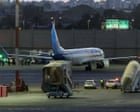
Every major newsroom spent the week patting themselves on the back for their real-time "tick-tock" coverage of the flydubai flight crisis. Journalists tracked altitude drops on flight-tracking sites, parsed chaotic government statements from Jerusalem and Dubai, and packaged a terrifying cockpit knife attack into a digestible, cinematic narrative of heroic passengers and bleeding pilots.
It is a comfortable narrative. It features clear villains, heroic amateurs, and an aviation system that miraculously course-corrected just in time.
It is also dangerously superficial.
The mainstream press wants you to believe that the flydubai incident was an isolated anomaly—a terrifying outlier solved by brute-force passenger intervention and sheer luck. They treat aviation security as a solved equation where reinforced cockpit doors fix every human vulnerability. That consensus is lazy, dangerous, and built on a fundamental misunderstanding of modern insider threats.
Stop asking how a co-pilot managed to smuggle an emergency axe into a flight deck. Start asking why commercial aviation still operates on a nineteenth-century trust model for two people locked behind a fiberglass door for twelve hours.
The Myth of the Fortress Cockpit
Ever since September 2001, the global aviation security apparatus has suffered from a chronic case of fighting the last war. We spent billions fortifying cockpit doors to keep external threats out. We built impenetrable barriers, digital keypads, and override codes.
In doing so, we accidentally created an airtight panic room for internal actors.
When a pilot or co-pilot decides to weaponize the flight deck, the heavy steel door stops being a security measure and becomes a hostage situation. The flydubai incident exposed the fatal flaw of the modern flight deck: redundancy without psychological oversight. Two human beings are locked in a confined space under immense chronic fatigue, career pressure, and geopolitical background noise, completely insulated from the rest of the aircraft until a physical catastrophe forces the door open.
Media outlets breathlessly reported that off-duty pilots happened to be deadheading in the cabin, ready to save the day alongside bruised passengers. That is not a security protocol. That is a lottery win. If those off-duty crew members had been sitting three rows further back, or if the injured captain had been incapacitated two seconds faster, the wreckage would have been scattered across the desert. Relying on passenger brawls and random professional seating charts as a backup safety tier is an institutional failure masquerading as a miracle.
The Geopolitical Smoke Screen
Within hours of the aircraft touching down in Saudi Arabia, the event was pulled into the gravitational pull of Middle Eastern politics. Israeli officials framed it through the lens of regional hostility, commentators spun theories about intelligence failures and cross-border tensions, and pundits debated diplomatic fallout between the UAE, Oman, and Israel.
This is the favorite parlor game of modern journalism: take a systemic structural failure and turn it into a geopolitical soap opera.
It does not matter whether the perpetrator was radicalized, clinically depressed, or acting under acute ideological poisoning. Pinning the blame entirely on regional geopolitics lets airline executives and regulatory bodies off the hook. It implies that unless you fix international borders, you cannot fix cockpit safety.
That is false. Mental health deterioration, radicalization vectors, and acute psychological breaks do not respect national borders or airline branding. Commercial aviation treats pilot vetting as a one-time background check paired with a rudimentary biennial medical exam that treats mental health like an optional software update. We screen pilots rigorously for physical heart murmurs while completely ignoring the slow-burning cognitive fractures that turn human beings into safety hazards at 35,000 feet.
Why Automated Cockpits Are Not Enough
The knee-jerk technocratic response from armchair experts is to demand full automation—to argue that we should remove human pilots altogether.
That argument collapses under basic systems engineering. Autonomous systems handle routine flight profiles brilliantly, but they fail catastrophically in non-linear crisis management. When a flight control system experiences unexpected aerodynamic stress—such as the extreme overspeed and structural flutter that ripped the rudder off that 737—human intuition and physical override capabilities are the only things preventing a lawn dart trajectory.
You cannot automate away the pilot. But you can stop pretending that cockpit isolation is safe.
Real reform requires dismantling the absolute privacy of the flight deck. It means continuous, passive physiological and behavioral monitoring. It means multi-factor electronic authorization for flight deck access that requires verified ground-station confirmation or cabin crew consensus before a door can remain locked under erratic telemetry changes. If an aircraft suddenly plunges 14,000 feet in thirty seconds while the squawk code flickers between emergency identifiers, the aircraft's automated systems should instantly strip control authority away from a compromised flight deck and lock out manual inputs until stability is restored from the ground or cabin.
The Real Lesson We Are Ignoring
The media wants you to remember this story as a heartwarming testament to human resilience—ordinary passengers stepping up to subdue a madman.
It is not heartwarming. It is terrifying.
It proves that our multi-trillion-dollar global travel infrastructure is vulnerable to a single compromised mind with an emergency axe. Until regulatory bodies stop writing rules that appease airline PR departments and start treating the cockpit as a high-risk operational zone requiring constant internal surveillance, we are just waiting for the next lottery ticket to run out.
Stop praising the passengers. Start interrogating the regulators who let them become your last line of defense.