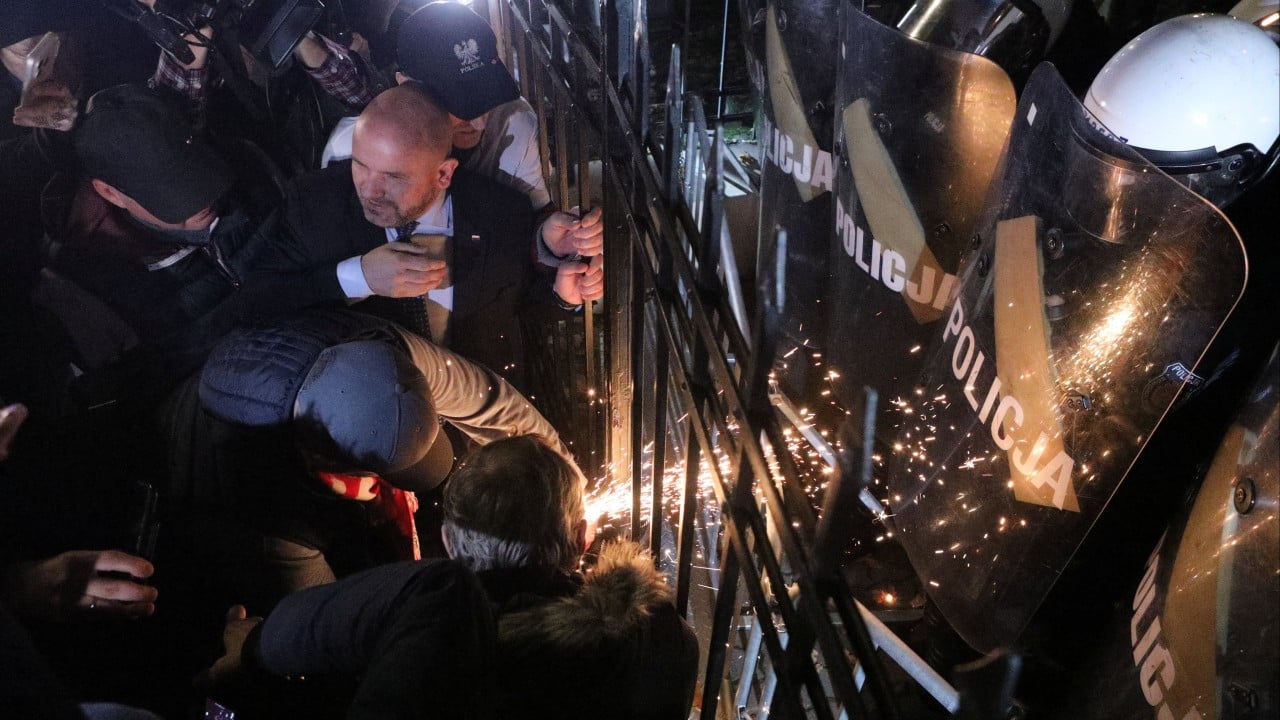
Look at the headline. "Moment riot cops hammer protesters with batons as clashes break out in Italy & fires lit near Colosseum."
It is a masterclass in visual sensationalism. It gives you smoke, shields, sparks, and a famous ancient monument in the background. What it does not give you is an actual understanding of what is happening on the ground in Italy, how European crowd control operates, or why these flashpoints occur with predictable regularity.
Mainstream coverage treats every street clash in Rome as a sudden, chaotic breakdown of civilization. Journalists zoom in on a five-second clip of a baton swing or a burning trash bin near the Colosseum and frame it as an apocalyptic binary: either brutal state repression against innocent citizens, or a lawless mob tearing down Western heritage.
Both narratives are lazy. They ignore decades of criminological research, public order doctrine, and the specific political history of Italian street demonstrations.
The Spectacle Trap in Modern Conflict Reporting
When news outlets lead with the "moment" of impact, they reverse cause and effect. A baton charge is rarely the beginning of an event; it is the final, visible failure of a containment strategy that began hours or days earlier.
Media coverage of civil unrest typically relies on episodic framing rather than thematic framing. Political scientist Shanto Iyengar documented this dynamic decades ago, showing that when news focuses on isolated, dramatic incidents rather than broader structural context, audiences are far more likely to blame individual actors—either "bad cops" or "violent agitators"—while missing the systemic mechanics driving the confrontation.
In Rome, the geography itself creates a recurring trap for reporters. The historic center is compact. Piazza Venezia, Via dei Fori Imperiali, and the area surrounding the Colosseum are not obscure backstreets; they are the primary civic arteries of the Italian capital. Almost any major march routing through central Rome will pass within sight of the Colosseum. When flares are lit or dumpsters are set on fire along a standard protest route, cameras naturally frame the flames against two-thousand-year-old travertine stone. It makes for an unforgettable thumbnail. It does not mean the Colosseum was under siege.
How Italian Public Order Doctrine Actually Functions
To understand why clashes happen in Italy—and why they look the way they do—you have to look at how Italian law enforcement is structured and trained.
Italy maintains a dual-force national policing model alongside specialized public order units. On the streets during high-risk demonstrations, you are typically looking at the Reparti Mobili of the Polizia di Stato (State Police) and the Battaglioni Mobili of the Arma dei Carabinieri.
Unlike municipal police departments in countries like the United States, where patrol officers are often pulled off routine traffic duty and handed riot gear with minimal specialized training, Italy's mobile units are dedicated public order formations. Their doctrine is rooted in spatial control, containment, and deterrence rather than mass arrest.
Here is the counter-intuitive reality that sensational headlines obscure:
- Containment over dispersal: In many Anglo-American policing models, the goal during unrest is to clear the street and arrest as many participants as possible. In the Italian model, police lines frequently hold fixed geographic chokepoints to prevent a march from entering sensitive institutional zones—such as Palazzo Chigi, Montecitorio, or foreign embassies.
- The buffer zone dynamic: Police units establish static cordons. When a fringe group within a larger, peaceful demonstration attempts to breach that cordon, the resulting clash is localized at the barrier. To an untrained observer watching a ten-second video clip, it looks like an unprovoked melee. In operational terms, it is a kinetic push-and-pull over a specific line on a map.
- The role of the Questura: Every major demonstration in Italy is preceded by negotiations between organizers and the Questura (the provincial police headquarters) to establish an authorized route. Trouble typically erupts when a splinter faction deviates from the agreed route or attempts to force a blockade, or when intelligence assessments lead authorities to suddenly restrict a previously open square.
None of this means police tactics are above scrutiny. Human rights organizations, Italian legal scholars, and parliamentary oversight committees have repeatedly debated proportionality, the use of baton charges (cariche di alleggerimento), and the need for identification numbers on riot helmets—a long-standing political controversy in Italy.
However, reducing a complex doctrinal interaction to "cops hammer protesters" strips away the very details needed to evaluate whether a specific use of force was a proportionate defense of a perimeter or an excessive escalation.
The Anatomy of a Flashpoint
If you study street demonstrations across Southern Europe, you quickly realize that a crowd is never a single, monolithic entity. Treating thousands of demonstrators as one unified actor is the second major error in conventional reporting.
Sociologists and crowd psychologists—most notably Clifford Stott and Stephen Reicher, whose Elaborated Social Identity Model (ESIM) transformed European public order policing—have demonstrated that crowds are composed of distinct subgroups with competing goals.
In a typical major protest in Rome, whether over labor laws, university reforms, housing, or foreign policy, you generally see three distinct layers:
- The Main Body: Trade unions, student associations, families, and civic groups marching peacefully along the permitted route to register political dissent.
- The Tactical Fringe: Smaller, organized groups—often wearing black clothing, helmets, or face coverings—who arrive prepared for physical confrontation with police lines, carrying fireworks, smoke bombs, or blunt objects.
- The Opportunistic Edge: Individuals caught in the middle who react emotionally when tear gas is deployed or when a police line surges forward.
When police respond to projectiles thrown by the tactical fringe with a broad baton charge or tear gas, they risk triggering what Stott and Reicher call "indiscriminate" enforcement. That is the exact moment when peaceful demonstrators begin to view the police as an illegitimate aggressor, uniting previously divided subgroups against the police line.
Conversely, when journalists fail to distinguish between the thousands marching peacefully two hundred meters back and the fifty individuals throwing firecrackers at a police van near the Colosseum, they smear an entire political movement with the actions of its most militant fraction.
What People Actually Get Wrong About Protest Violence in Italy
When footage of burning bins and riot shields goes viral, public debate immediately splits into predictable questions. Most of those questions are built on faulty assumptions.
Are protests in Italy becoming more violent than ever?
No. Anyone who knows modern Italian history recognizes that current street clashes, while serious, pale in comparison to the political violence of the 1970s—the Anni di Piombo (Years of Lead)—or even the massive, sustained clashes surrounding the 2001 G8 summit in Genoa.
Genoa 2001 was a watershed moment for Italian policing. The death of demonstrator Carlo Giuliani and the subsequent court convictions of senior police officials over the raid on the Diaz school forced a generational overhaul in Italian public order management. Since then, the Ministry of the Interior has placed far greater emphasis on pre-event mediation, intelligence gathering, and strict containment corridors to avoid the kind of catastrophic breakdown seen in 2001.
Why do protesters light fires in the street?
To international viewers unfamiliar with European protest culture, burning dumpsters look like random arson. In practice, they serve specific tactical functions during a street confrontation:
- Visual screening: Thick black smoke from burning plastic bins obscures the sightlines of police spotters, cameras, and water cannon operators.
- Physical barricades: Dragging heavy metal or plastic municipal waste containers into the roadway slows down armored police vehicles and creates a temporary buffer between advancing riot squads and retreating demonstrators.
- Symbolic escalation: Flames guarantee media coverage. Without smoke and fire, a peaceful march of twenty thousand people might receive thirty seconds on the evening news; with a burning bin near a landmark, it leads international digital front pages.
Do baton charges actually restore order?
Sometimes, in the immediate physical sense, a carica di alleggerimento (a "lightening charge" intended to push a crowd back and create space) relieves pressure on a static police shield wall that is being pelted with objects.
Strategically, however, heavy baton strikes carry a massive cost. Every video of an officer striking a demonstrator who is already on the ground or retreating destroys institutional legitimacy. Italian police leadership knows this. Over the past decade, tactical manuals across Europe have increasingly favored containment, selective extraction of violent individuals by plainclothes units, and de-escalation dialogue over sweeping baton charges—precisely because broad kinetic force often inflames the exact crowd it is meant to pacify.
The Trade-Offs Nobody Wants to Admit
Analyzing public order honestly requires acknowledging uncomfortable realities that neither side of the political spectrum likes to hear.
If you are a policymaker or a police commander in Rome, you face an impossible balancing act. Constitutional protections under Article 17 of the Italian Constitution guarantee citizens the right to assemble peacefully and without weapons. At the same time, the state is obligated to protect public infrastructure, uninvolved bystanders, and critical government institutions from physical attack.
If police units hold back too far to avoid any visual optics of confrontation, militant groups can quickly paralyze central transit hubs, vandalize historic property, or breach government perimeters. If police units move in aggressively at the first sign of fireworks or thrown bottles, they inevitably injure peaceful participants, traumatize bystanders, and hand agitators the exact propaganda footage they wanted.
Meanwhile, protest organizers face their own dilemma. Establishing internal marshals (servizio d'ordine) to police their own flanks can prevent fringe groups from hijacking a march, yet doing so risks internal physical fights between different factions of the same movement.
How to Read Coverage of Civil Unrest Without Being Manipulated
The next time a headline flashes across your feed showing riot gear, smoke, and flames in a European capital, apply a basic analytical filter before reacting:
- Look for the wide shot. Close-up footage of a scuffle tells you nothing about scale. Check aerial photos or wide-angle video to see whether the violence involves thirty people at a single intersection or thirty thousand people across an entire district.
- Identify the geography. Find out where the clash occurred relative to the approved march route. Was the crowd blocked from an unauthorized zone, or did police kettle a group inside a permitted area?
- Separate sequence from snapshot. A ten-second clip has no beginning and no end. Look for reporting that establishes the timeline: what happened twenty minutes before the batons came out, and what happened twenty minutes after?
- Check the institutional response. In Italy, major clashes almost always trigger formal inquiries by the Procura (public prosecutor's office), medical tallies of injured officers and demonstrators from local hospitals, and statements from the Interior Ministry. Those records tell a far more accurate story than initial social media captions.
Sensational headlines thrive on the illusion that street clashes are sudden explosions of inexplicable chaos. They are not. They are predictable collisions of geography, crowd psychology, political grievance, and state doctrine—and until you look past the smoke near the Colosseum, you are only seeing the shadow on the wall.