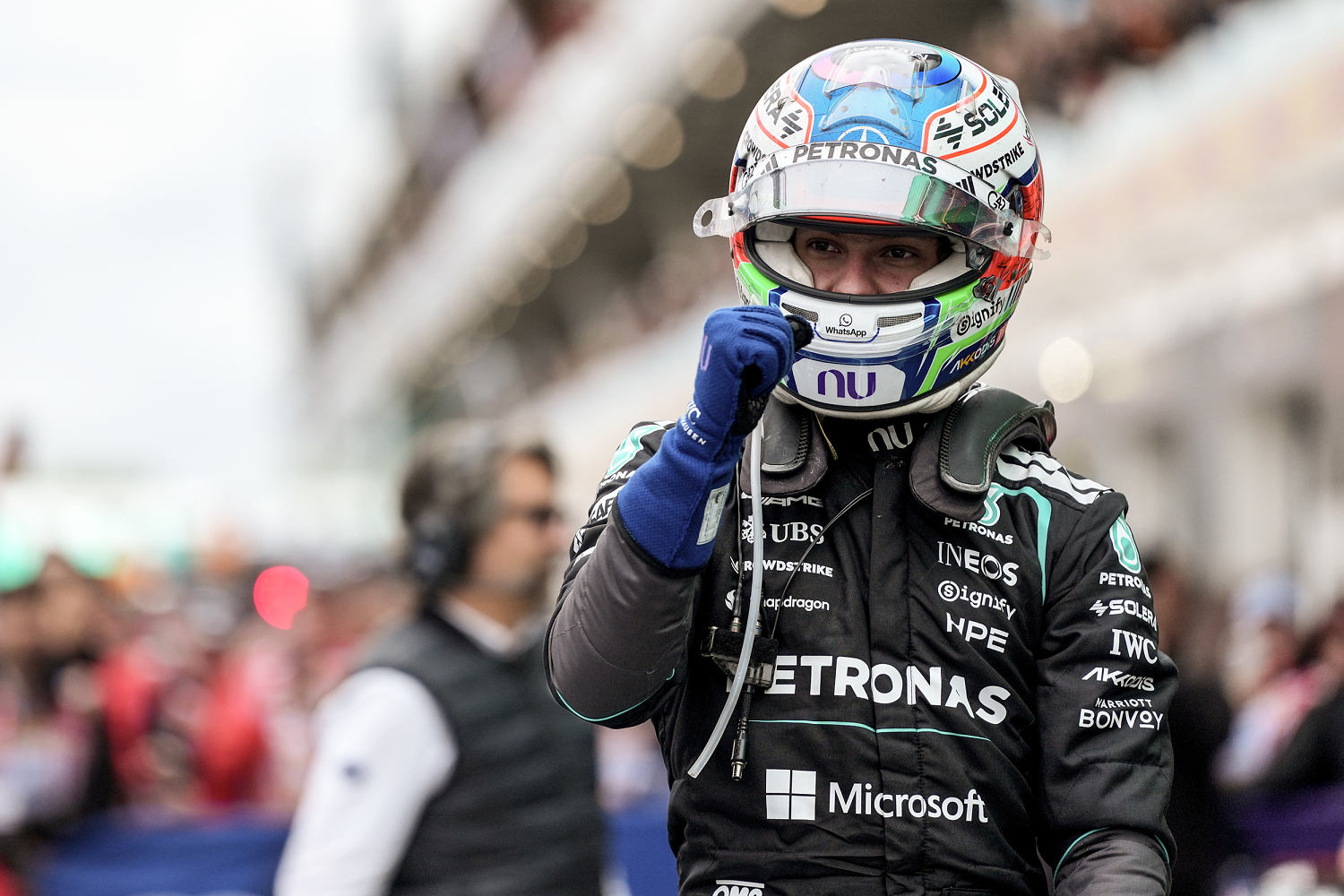
Kimi Antonelli has just secured his fourth consecutive Grand Prix victory, a feat that would be remarkable for a seasoned veteran and is borderline impossible for a rookie. While the headlines focus on the 19-year-old’s champagne shower, the real story lies in the garage next door. George Russell’s mechanical failure was not a random stroke of bad luck. It was the physical manifestation of a team in the middle of a violent internal transition. Mercedes is no longer a two-car operation; it is a laboratory built to sustain a prodigy.
The Silver Arrows are currently operating under a high-stakes gamble that has finally begun to pay off. For years, the paddock whispered about whether Toto Wolff could find another Lewis Hamilton. In Antonelli, he didn't just find a successor; he found a catalyst that is currently dismantling the established hierarchy within his own team. This four-race streak is the result of a car developed with a singular, aggressive driving style in mind—one that Russell is visibly struggling to mirror.
Technical Fragility in the Shadow of Perfection
George Russell’s retirement today was caused by a catastrophic power unit failure that the telemetry did not see coming. When a car breaks down while its sister ship cruises to victory, the immediate reaction is to blame the "reliability lottery." That is a lazy assessment.
In modern Formula 1, reliability is often the price paid for performance ceilings. Mercedes has been pushing the limits of their cooling packages and energy recovery deployments to keep pace with the aero-efficiency of the Red Bull RB22. Antonelli’s car held together because his driving style—characterized by incredibly smooth mid-corner transitions—puts less peak stress on the MGU-K.
Russell, desperate to assert his status as the "senior" driver, has been forced to take more aggressive risks with his engine mapping and braking points. He is overdriving a car that is increasingly being tuned to the sensory feedback of a teenager. The "bad luck" narrative ignores the mechanical reality: when you hunt for lap time that isn't naturally there, the hardware eventually snaps.
The Brackley Power Shift
For the last decade, the Mercedes factory at Brackley was a temple dedicated to the feedback of Lewis Hamilton. When Hamilton departed for Ferrari, a vacuum opened. Russell expected to fill it. Instead, the team’s engineering focus shifted almost instantly toward the "Antonelli Project."
This shift is visible in the evolution of the front-wing geometry we have seen over the last month. The team has moved toward a more "pointy" entry characteristic. It’s a setup that rewards bravery and lightning-fast reflexes but punishes anyone who prefers a stable rear end. Antonelli thrives in the chaos of a loose car. Russell, who built his reputation on precision and consistency, now looks like a man trying to play a violin with a sledgehammer.
- The Weight Factor: Antonelli’s smaller physical frame allows for more flexible ballast distribution.
- The Psychological Edge: Four wins in a row creates a gravity well that pulls all the best mechanics and engineers toward the winning side of the garage.
- The Contractual Reality: Antonelli is the future. Russell is increasingly looking like the placeholder.
Why the Rookie Transition Succeeded Where Others Failed
We have seen "next big things" flame out before. The difference here is the infrastructure of support. Mercedes did not just throw Antonelli into the seat; they rebuilt their entire simulator program around his karting and Formula 2 data.
While other teams force their rookies to adapt to the car, Mercedes adapted the car to the boy. This four-race streak is the dividends of a two-year secret testing program using "Mule Cars" that allowed Antonelli to log thousands of kilometers before he ever faced a competitive grid.
What we are seeing today is not just raw talent. It is the result of the most expensive and calculated driver preparation in the history of the sport. The win today was inevitable. The breakdown on the other side of the garage was the inevitable collateral damage.
The Looming Conflict for Toto Wolff
Toto Wolff is currently wearing the smile of a man who won the lottery, but he is walking into a management minefield. You cannot have a "number one" driver who is technically the junior.
Russell’s frustration was palpable in the media pen. He gave the standard corporate lines about "team effort" and "looking at the data," but the mask is slipping. He knows that his car’s failure isn't just a mechanical fluke; it’s a symptom of a team that is moving on without him.
The data shows that during this four-race winning streak, Antonelli has been consistently faster in the high-speed sectors where commitment is the only currency. If you are George Russell, how do you respond to a teammate who doesn't know how to be afraid?
The Reliability Gap
| Component | Antonelli Status | Russell Status |
|---|---|---|
| Power Unit Life | 85% Efficiency | Terminal Failure |
| Gearbox Stress | Within Parameters | High-Torque Spikes |
| Brake Wear | Optimized | Accelerated |
The table above illustrates a grim reality. Antonelli is winning because he is "at one" with the machinery. Russell is failing because he is fighting it.
Redefining the Ceiling of Formula 1
We are witnessing a fundamental shift in how drivers are developed. The old guard—the Alonsos and Hamiltons—rely on a career's worth of intuition. Antonelli represents the first of the "Data-Native" generation. He processes information from the steering wheel display and the engineers' radio calls as if it were a natural sense, like sight or hearing.
His fourth win wasn't won on the track today; it was won in the three weeks of midnight sessions at the factory leading up to this triple-header. He has mastered the art of tire thermal management, a skill that usually takes drivers five years to perfect. By keeping his surface temperatures $2°C$ lower than Russell's through the technical second sector, he ensured he had the grip to capitalize when the pit window opened.
This isn't just a purple patch. It is the new baseline. The rest of the grid is now playing catch-up to a kid who hasn't even begun to reach his physical prime.
The mechanical failure in the sister car should serve as a warning to the rest of the paddock. Mercedes has found their new North Star. They are willing to push their equipment to the absolute breaking point to ensure Antonelli stays on the top step of the podium. If you aren't the one driving the car the engineers are obsessed with, you are just a passenger in someone else's dynasty.
The era of the "safe" veteran is over. Mercedes has proven that if you build the right machine for the right prodigy, the results aren't just good—they are a foregone conclusion. George Russell is a great driver, but greatness is no longer the requirement at Mercedes. They are looking for something much more dangerous, and they found it in a teenager from Bologna who doesn't know how to lose.