The morning air in West Java usually carries the scent of damp earth and woodsmoke. It is a quiet, rhythmic start to the day. For the passengers on the Turangga express, a line connecting the sprawling city of Surabaya to Bandung, the journey was supposed to be a mundane transition between two points on a map. They were reading, sleeping, or watching the emerald blur of rice paddies through the glass.
Then came the scream of tearing steel.
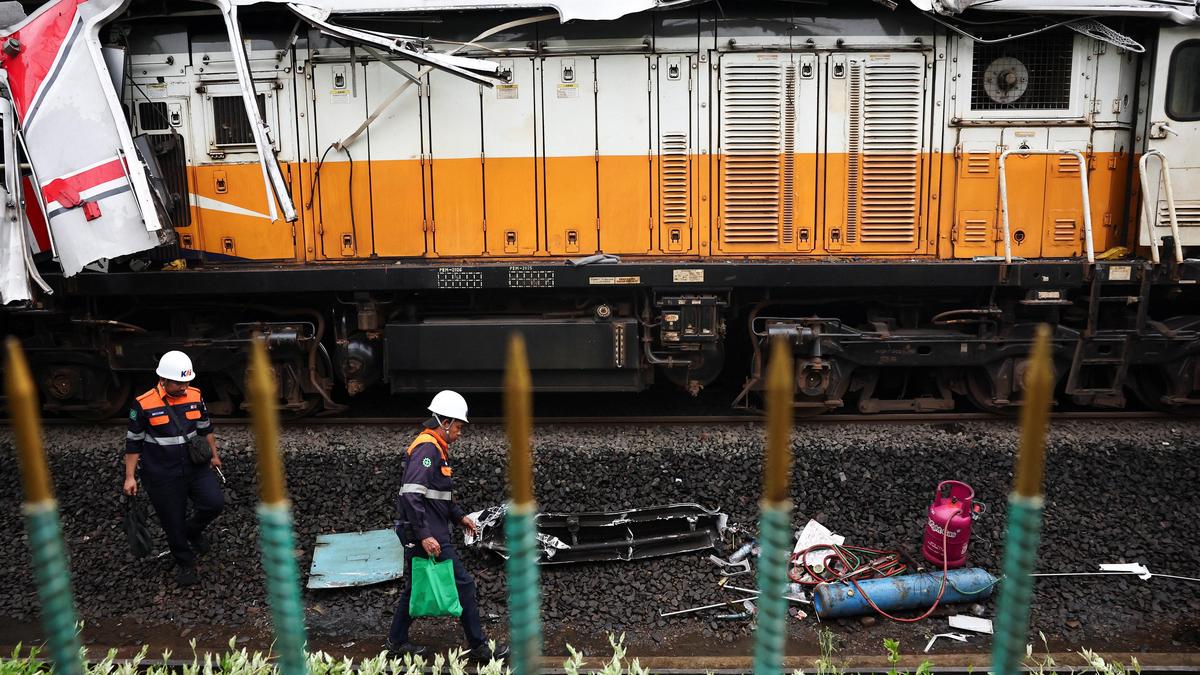
At 6:03 AM, near the Cicalengka station in Bandung Regency, the physics of a normal Friday collapsed. The Turangga express, moving with the heavy momentum of a long-distance traveler, collided head-on with a local Commuter Line Bandung Raya train. The impact was not a singular bang. It was an accordion-like folding of reality. Coaches leaped from the tracks, tilting at impossible angles into the adjacent green fields.
The silence that followed was worse than the noise.
The Cost of a Shared Track
In the immediate aftermath, the numbers began to trickle out, cold and detached. Officials confirmed 14 souls had been lost. Dozens more were injured, their bodies bruised by the violent deceleration that occurs when thousands of tons of machinery meet an immovable force. But a number like "14" is a sterile thing. It doesn't capture the frantic scratching at the debris or the way a mobile phone continues to ring in the dirt, a name like "Mama" or "Home" flashing on a cracked screen that no one will ever pick up.
Indonesia’s railway system is a vital artery, a legacy of colonial engineering expanded into a modern lifeline. Yet, this tragedy exposes the fragile choreography required to keep these arteries flowing. Unlike a highway where a driver can swerve, a train is a prisoner of the rail. Its safety depends entirely on signaling, timing, and the invisible hands in control rooms miles away. When two trains find themselves on the same single track heading toward one another, the disaster is already written in the laws of motion long before the drivers see the headlights.
Consider the perspective of a rescue worker arriving on the scene. You aren't looking at a "transportation incident." You are looking at a jigsaw puzzle made of jagged metal and human hope. Basarnas teams—the nation’s elite search and rescue units—descended into the wreckage with hydraulic shears and heavy cranes. Their job is a grim race. They work in the shadow of overturned carriages that weigh sixty tons, knowing that the structural integrity of the wreck is shifting with every passing hour.
The Invisible Stakes of Infrastructure
We often talk about infrastructure as a matter of budgets, blueprints, and political promises. We forget that infrastructure is a moral contract. When a passenger buys a ticket, they are trusting a vast, invisible network of sensors and human operators to keep them in a bubble of safety.
The Cicalengka crash happened on a stretch of track where the complexity of the rail network becomes apparent. Managing high-speed expresses alongside local commuter lines requires a level of precision that leaves zero margin for error. If a signal fails, or if a manual override is miscommunicated, the result isn't a delay. It’s a catastrophe.
History suggests we have been here before. Indonesia has worked tirelessly to modernize its fleet, introducing high-speed rail and upgraded rolling stock. But the "invisible stakes" lie in the legacy systems that still govern much of the provincial travel. You can have the fastest train in Southeast Asia, but if the signaling logic on a rural branch line falters, the system remains haunted by the ghost of human error.
The Anatomy of the Rescue
As the sun climbed higher over the wreckage, the scale of the labor became visible. Two carriages from the local train and one from the Turangga had been pulverized. To the onlookers standing on the edges of the paddies, it looked like a child had stepped on a toy set. To the rescuers inside, it was a labyrinth.
They moved through the debris not as technicians, but as witnesses. They found personal belongings—a discarded shoe, a half-eaten snack, a book with a folded corner. These are the artifacts of a life interrupted. One rescuer described the sound of the metal cooling, a series of pings and groans that sounded like the train itself was mourning.
The effort to remove the trapped was grueling. It wasn't just about strength; it was about surgical precision. Using heavy machinery to lift a car could cause the remains of another to collapse. They had to stabilize the earth, brace the steel, and whisper encouragement to those they could still hear.
Beyond the Investigation
The National Transportation Safety Committee (KNKT) will eventually release a report. They will speak of signal frequencies, track switches, and perhaps a lapse in protocol. They will provide the "how." But they can never truly address the "why" that lingers in the hearts of the families waiting at the Bandung and Surabaya stations.
The real tragedy of a train crash is its preventability. In a world of automated sensors and failsafe protocols, a head-on collision feels like a relic of a different century. It forces a hard look at the gap between our technological ambitions and our daily operational realities.
We live in an age where we crave speed. We want to shrink the distance between our homes and our workplaces, between our families and our dreams. But that speed requires a foundation of absolute reliability. Every time a tragedy like this occurs, it chips away at the public's communal trust in the machines that move us.
The Empty Seat
Imagine a woman waiting for her husband to return from a business trip. She has prepared a meal. She has checked the clock. She hears the news on the radio—a vague report of a "technical mishap" in Cicalengka. The meal grows cold. The phone remains silent. This is the human element that no news ticker can convey.
The 14 who died were not just passengers. They were the architects of families, the holders of secrets, the voices that someone expected to hear by dinner time. Their absence is a hole in the fabric of their communities that no insurance payout or official apology can mend.
As the cranes finally cleared the last of the mangled steel from the rice fields, the tracks were left scarred but empty. The trains will run again. The commuters will board with their bags and their headphones, perhaps glancing out the window at the spot where the grass is matted down and the earth is scorched. They will move on, because they have to. But the metal cry of that morning will echo in the hills of West Java for a very long time.
Somewhere in a quiet house, a lamp stays on, waiting for a traveler who was only a few miles from home.