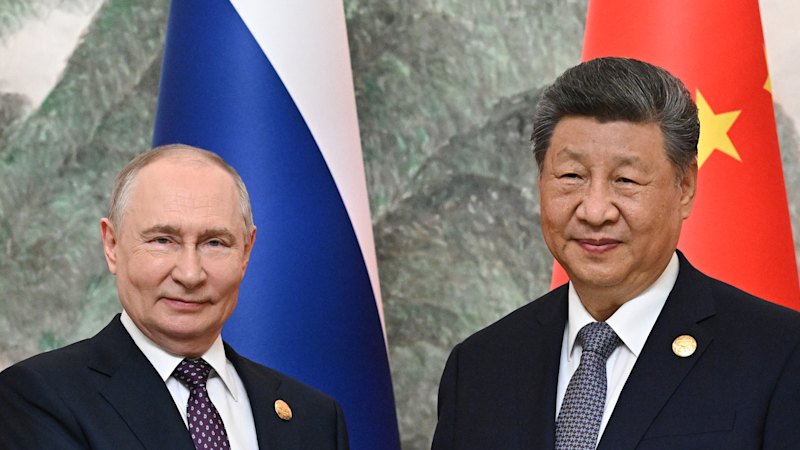
When Australian Prime Minister Anthony Albanese demands tangible deliverables from a summit between US President Donald Trump and Chinese leadership in Shenzhen, he is articulating the survival calculus of a middle power trapped in a bilateral trade and security crossfire. High-level diplomatic optics in a Chinese manufacturing hub do not insulate export-dependent economies from tariff shocks, supply chain fragmentation, or naval escalation in the Indo-Pacific. For Canberra, an unproductive summit translates directly into macroeconomic drag and heightened defense expenditure.
The Structural Asymmetry of the Canberra Position
Australia operates under a structural divergence between its primary security guarantor and its largest trading partner. This split creates a persistent vulnerability where bilateral friction between Washington and Beijing imposes immediate negative externalities on Australian balance sheets without granting Canberra a seat at the negotiating table. If you liked this article, you should look at: this related article.
The mechanism operates through three primary channels:
- Commodity Demand Elasticity: Australian fiscal stability relies heavily on bulk commodity exports—specifically iron ore, metallurgical coal, and liquefied natural gas—destined for Chinese industrial centers like the Pearl River Delta, where Shenzhen sits. When US tariffs compress Chinese manufacturing margins, Chinese demand for raw inputs contracts, depressing Australian terms of trade and federal tax receipts.
- Defense Integration Costs: Under security frameworks like AUKUS, Australia integrates its defense industrial base and force posture with the United States. Escalation in the South China Sea or the Taiwan Strait forces Canberra to accelerate capital allocation toward asymmetric deterrence, straining domestic budgets.
- Regulatory and Tariff Spillover: Secondary sanctions, export controls on dual-use technologies, and retaliatory tariffs force Australian firms to maintain parallel compliance regimes. A technology firm in Sydney or a mining conglomerate in Perth faces rising operational overhead simply to navigate incompatible regulatory standards.
Standard diplomatic commentary treats Albanese’s call for "delivery" as routine political rhetoric. In operational terms, it is a demand for de-escalation mechanisms that stabilize the baseline assumptions required for long-term capital allocation in the Indo-Pacific. For another perspective on this development, check out the latest coverage from The New York Times.
Why Shenzhen Matters as a Negotiating Venue
Selecting Shenzhen rather than Beijing as the site for a US-China leadership summit alters the signaling dynamics of the meeting. Beijing represents state apparatus, ideological posture, and centralized political control. Shenzhen represents the commercial engine of Chinese state capitalism, supply chain integration, and technological execution.
Hosting negotiations in Shenzhen shifts the frame from pure geopolitical rivalry to commercial interdependence. Shenzhen is the headquarters of major Chinese technology, telecommunications, and electric vehicle manufacturers—the exact sectors targeted by US export controls and tariff walls. By meeting in the center of China's hardware ecosystem, both administrations acknowledge that the core friction points are industrial policy, intellectual property, and market access rather than purely territorial disputes.
For an external observer like Australia, a Shenzhen venue raises the stakes of failure. If leaders meet inside the physical hub of global electronics and green-tech manufacturing and still fail to establish guardrails on tariffs or export restrictions, the market signal is unambiguous: economic decoupling is accelerating, and regional supply chains must price in permanent fragmentation.
The Three Failure Modes of Bilateral Summits
When Albanese states that the summit must deliver, he is attempting to hedge against three distinct failure modes common to high-stakes US-China meetings.
1. The Communiqué Illusion
Summits frequently produce broad, non-binding statements reaffirming "open lines of communication" while leaving underlying tariff schedules and entity lists intact. For middle powers, dialogue without policy reversal changes nothing. Australian exporters cannot hedge currency or lock in multi-year off-take agreements based on diplomatic atmosphere. Without concrete adjustments to tariff rates, export licensing, or maritime incident protocols, communication channels merely manage the pace of deterioration.
2. Managed Rivalry as a Permanent Tax
A second failure mode occurs when Washington and Beijing agree to stabilize relations at a high baseline of friction. In this scenario, existing tariffs remain, technology transfer bans harden, and both sides claim victory by preventing an acute crisis. For Canberra, "stabilized friction" functions as a permanent tax on regional growth. Global capital expenditure slows as multinational corporations delay factory construction across Southeast Asia and Australia due to unresolved rules-of-origin disputes.
3. Bilateral Deals at Third-Party Expense
The most acute risk for Australia is a transactional bilateral agreement that resolves a narrow US-China dispute by distorting regional trade flows. Under managed trade arrangements, Beijing might commit to purchasing specific volumes of US agricultural or energy products to secure tariff relief. Because Chinese import capacity is finite, state-directed purchasing of US liquefied natural gas, coal, or beef directly displaces Australian market share. Albanese’s insistence on substantive delivery is an implicit warning against bilateral settlements that achieve equilibrium by cannibalizing third-party suppliers.
The Mechanics of Middle Power Deterrence and Diplomacy
Australia cannot compel either superpower to alter its grand strategy. Instead, Canberra relies on a calibrated mix of diplomatic signaling, trade diversification, and alliance management to raise the political cost of unilateral disruption.
The operational execution of this strategy involves distinct trade-offs:
- Multilateralizing Bilateral Disputes: Australia consistently routes its trade grievances through the World Trade Organization and regional blocs like ASEAN and the Comprehensive and Progressive Agreement for Trans-Pacific Partnership (CPTPP). By framing US-China friction as a threat to regional rules-based trade rather than a bilateral spat, Canberra recruits regional allies to amplify pressure on both Washington and Beijing.
- Supply Chain Substitution: Following previous Chinese trade restrictions on Australian barley, wine, and coal, Australian exporters proved capable of rerouting commodities to alternative markets in India, Japan, and Europe. While iron ore remains difficult to redirect at scale due to China's dominant share of global steel production, the partial diversification of other sectors reduced Beijing's coercive leverage.
- Alliance Leverage: As a critical logistics hub, intelligence partner, and critical minerals supplier for the United States, Australia holds asymmetric leverage in Washington. The US defense industrial base requires Australian lithium, rare earths, and strategic geography to project power in the Western Pacific. Canberra uses this operational necessity to push US policymakers toward economic statecraft that does not inadvertently bankrupt key allies.
Limitations of the Australian Hedge
This balancing strategy faces hard structural limits. No diplomatic framework can fully insulate an open, trade-exposed economy from a systemic rupture between the world's two largest economies.
First, critical minerals processing remains a bottleneck. While Australia extracts vast quantities of lithium and rare earth elements, China controls the overwhelming majority of global refining and processing capacity. Even when Canberra aligns with Washington to build alternative supply chains, the capital expenditure and environmental permitting required to establish domestic refining take years to materialize. In the interim, Australian miners remain tethered to Chinese processing facilities.
Second, security commitments constrain diplomatic flexibility. As Australian naval and air assets operate closer to contested waters alongside US forces, the risk of an accidental collision or radar lock-on increases. An acute military incident in the South China Sea would instantly collapse the space for economic hedging, forcing Canberra into lockstep alignment with Washington regardless of the commercial fallout.
Third, domestic political cycles distort long-term strategy. Trade diversification and defense procurement operate on decadal timelines, whereas electoral cycles in Canberra and Washington operate on three- and four-year clocks. Sudden shifts in US trade policy—such as universal baseline tariffs that hit allies and adversaries alike—can invalidate years of diplomatic groundwork overnight.
Strategic Imperatives for Regional Decision-Makers
Governments and corporate boards operating across the Indo-Pacific cannot treat the Shenzhen summit as a binary event that will either solve or doom regional trade. Regardless of the immediate announcements made by US and Chinese leaders, structural competition over industrial dominance and maritime control will persist.
Decision-makers must execute three specific adjustments:
- Price in Permanent Regulatory Friction: Capital allocation models for cross-border manufacturing and resource extraction must assume enduring export controls and rules-of-origin audits. Supply chains should be structured around regional redundancy rather than single-hub cost optimization.
- Audit Exposure to Managed Trade: Commodity producers and agricultural exporters in third-party nations must stress-test revenue projections against potential US-China bilateral purchase agreements. Securing long-term off-take contracts with secondary buyers in South and Southeast Asia is essential to offset potential volume displacement in mainland China.
- Separate Diplomatic Optics from Policy Execution: Track actual modifications to tariff schedules, entity lists, and military-to-military crisis communication protocols rather than summit rhetoric. Until concrete adjustments appear in customs enforcement and defense posture, treat high-level meetings strictly as risk-management exercises rather than structural resets.