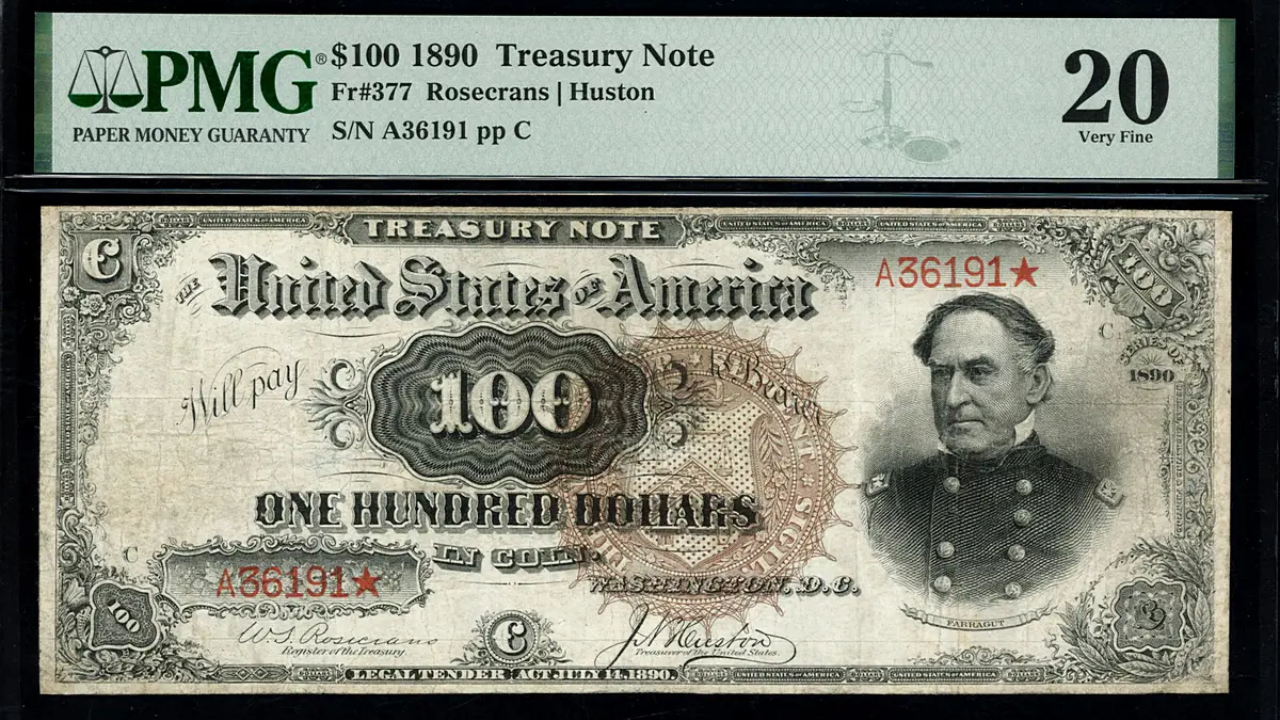
The ink smells like iron and old despair.
Picture a cramped, gas-lit room in Washington, D.C., during the scorching summer of 1890. A tired clerk named Arthur presses a heavy steel plate onto damp cotton paper. He is not making money; he is making ghosts. Outside, horse-drawn carriages rattle over cobblestones, kicking up dust that settles on politicians debating the Sherman Silver Purchase Act. Inside, Arthur lifts the wet sheet. Staring back at him are three enormous zeros, splashed in emerald green across the paper with such wild, rounded typography that they look less like currency and more like sliced fruit. For another view, check out: this related article.
They called it the Watermelon note.
At the time, nobody stopped to admire the art. To the men who clutched these $100 Treasury Notes, they were heavy, awkward, and dangerously fleeting. They were instruments of survival in an economy built on smoke and precarious promises. Nobody knew that a century and a half later, a single scrap of this paper would command millions at auction, trading hands among elite collectors who view them not as dollars, but as holy relics of American financial history. Further analysis on this matter has been published by Refinery29.
Money has a habit of losing its soul the moment we standardize it. We want our cash clean, flat, and forgettable. But in 1890, the United States Treasury was experimenting with design in a desperate bid to thwart counterfeiters who were getting entirely too clever with standard black-and-white engravings. The Bureau of Engraving and Printing rolled out a series of fancy silver certificates featuring dramatic portraits and artistic flourishes.
The crown jewel of this strange era was the Series of 1890 Treasury Note, specifically the hundred-dollar bill featuring a portrait of Major General George Gordon Meade, the hero of Gettysburg. But nobody talks about Meade. They talk about the back.
Dominating the reverse side of the bill is a massive, ornate ornamentation of the number 100. The zeros are so large, so bulbous, and decorated with such intricate watermelon-like green net patterns that the nickname stuck instantly. It was affectionate, slightly mocking, and entirely permanent.
Let us be completely honest about what was happening. The government printed 120,000 of these bills. That sounds like a lot until you realize how quickly money moves, tears, burns, and vanishes in the hands of a working populace. They were bulky. They were suspicious. People looked at them sideways at the general store. Is this real? Why does it look like a melon?
So, people spent them. Banks redeemed them. The Treasury systematically scooped them up and fed them into roaring industrial furnaces to be reduced to pulp. The government did not want quirky art; they wanted predictable liquidity. By the time the bureaucratic gears finished grinding, almost all of them were gone.
Today, numismatists—the quiet archaeologists of currency—know that only about 35 of these notes survive.
Thirty-five.
Think about that number. Walk into a crowded stadium. Every single person you see represents a fraction of the total surviving population of an entire national printing run. If you dropped all known 1890 Watermelon notes onto a single coffee table, they would easily fit inside a shoebox. Yet, collectors routinely mortgage metaphorical kingdoms to acquire one. In recent years, exceptional specimens have fetched over a million dollars.
Why do we care about a piece of paper that spent a hundred years tucked inside the binding of an abandoned ledger or moldering in the damp corner of a Midwestern attic?
Because scarcity is the ultimate storyteller.
Imagine a farmer in Ohio in 1892 slipping one of these bills into his wool vest pocket. He is heading into town to settle a debt for feed and seed. He doesn't know that the federal monetary policy is shifting under his feet like tectonic plates. He doesn't know that the silver panic is coming, that populist anger is brewing, and that the currency he holds in his calloused hand will soon be outlawed, recalled, and melted into historical obscurity. He just knows the bill looks strange, and the merchant squinted at it under the kerosene lamp before nodding.
That interaction is gone. The merchant is dust. The farm has been paved over for a strip mall. But the bill survived.
It slipped through the cracks of systematic destruction. Maybe it fell behind a workbench. Maybe a skeptical grandmother hid it inside an old Bible, refusing to trust the bank down the street. Whatever the mechanism of its preservation, it endured fire, flood, world wars, and the Great Depression.
When you hold a surviving Watermelon note today—behind layers of archival glass, wearing white cotton gloves—you are not looking at an investment vehicle. You are looking at an accident of history. You are staring at the physical manifestation of human frailty and institutional whim. The government tried to erase them, and yet, through pure dumb luck and the sentimental hoarding of forgotten ancestors, a handful slipped away into the dark.
We live in an era of digital digits. Numbers flash on a screen, pixels representing labor, rent, and dreams. Money has never felt less physical, less connected to the messy reality of human hands. We tap plastic; we swipe glass. We rarely touch anything that requires an intricate, multi-ton steel plate pressed against damp paper by a sweating clerk named Arthur.
Perhaps that is why the Watermelon note haunts us. It reminds us that value is an illusion we all agree to share, but history is something carved into physical reality. It proves that the things we throw away today—the strange, the awkward, the eccentric experiments of our current age—might just be the priceless treasures of an incomprehensible future.
The next time you pull a crisp, modern bill from your wallet, look at it. Notice how smooth it is. Notice how sterile. Then close your eyes and imagine the green stripes of a giant, absurd hundred-dollar fruit, glowing faintly in the gaslight of an 1890 printing room, waiting for a miracle just to exist.