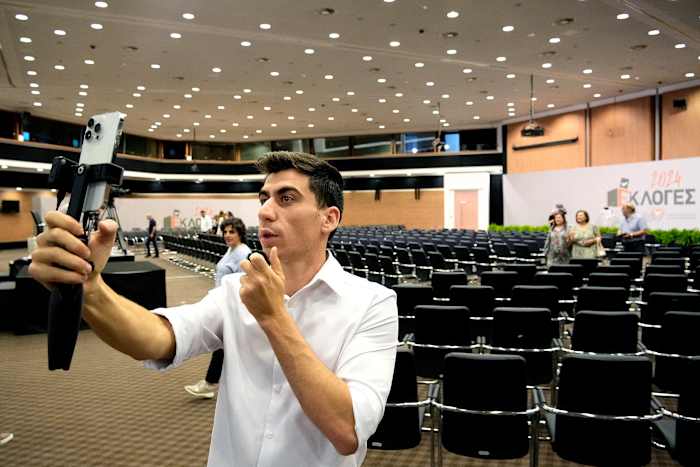
The modern political ecosystem is experiencing a structural decoupling where traditional party discipline is yielding to decentralized, creator-driven influence models. When Cypriot social media personality Fidias Panayiotou secured 19.4% of the vote as an independent in the June 2024 European Parliament (EP) election, mainstream commentators labeled it an anomalous novelty. However, his subsequent maneuver—founding the Direct Democracy party, securing 5.4% of the total vote and four seats in Cyprus’s 56-member House of Representatives, and systematically opting to retain his EP seat while ceding his domestic legislative seat to runner-up Yiannis Laouris—points to a calculated operational strategy. This is not merely an ongoing stunt; it is the deployment of a highly efficient attention-arbitrage model designed to challenge institutional politics.
To understand how a 26-year-old creator built a functional political apparatus in under two years requires evaluating the unit economics of attention, the structural design of what he calls the "Trojan Horse" direct democracy model, and the systemic constraints of modern legislative bodies.
The Economics of Attention Arbitrage in Electoral Systems
Traditional political campaigns operate on high capital expenditure (CapEx) business models. Parties require deep infrastructural investments, including physical headquarters, paid canvassing operations, polling analytics, and major media advertising spend to convert brand awareness into actual votes at the ballot box.
Creator-driven political actors flip this cost function entirely. By substituting paid media with organic algorithm optimization, the customer acquisition cost (CAC) of a voter drops asymptotically toward zero.
The Low-CAC Acquisition Funnel
- Top-of-Funnel (Broad Awareness): High-engagement algorithmic content (e.g., experiential challenges, viral public interactions, and cross-promotional stunts with global figures like Elon Musk). This establishes baseline demographic reach across a broad, non-voter base.
- Middle-of-Funnel (Trust Verification): Transitioning from generic entertainment to localized anti-corruption or transparency narratives. In Cyprus, this exploited deep voter disenchantment with the clientelist "favors-for-votes" framework used by legacy establishments.
- Bottom-of-Funnel (Conversion): Direct call-to-action video updates delivering highly accessible breakdowns of legislative activity. This mechanics-driven communication operates as a retention loop, converting passive content consumers into high-turnout voters.
This optimization explains why Panayiotou’s Direct Democracy party could capture 5.4% of the domestic vote just six months after its inception, despite completely eschewing traditional policy manifestos or formalized party platforms.
The Trojan Horse Architecture: Software-As-A-Party
The core operational thesis of Panayiotou’s Direct Democracy party relies on an architectural framework designed to bypass representative mediation through software. Rather than relying on traditional party committees to draft policies and select candidates, the organization introduces an open-source style app named Agorà.
The platform's operational layout relies on two main structural pillars:
Identity Authentication
Cypriot citizens verify their identity using official state identification cards. This limits participation to legitimate constituents and prevents foreign or automated bot manipulation of the platform's decision engine.
Direct Mandate Delegation
Elected representatives act strictly as administrative proxies. When a piece of legislation comes to a vote in either Nicosia or Brussels, it is published to the app. The verified user base casts a binding digital ballot, and the human representative is contractually or ethically obligated to mirror that collective output in the official legislative chamber.
This mechanism fundamentally shifts the role of an elected official from a trustee making independent judgments to an automated API that executes the aggregated will of a digital network. It presents an innovative, scalable mechanism for direct citizen engagement, yet it introduces significant vulnerability to sudden sentiment volatility and populism, lacking the deliberate debate cycles inherent to committee work.
Game-Theoretic Analysis of the Seat Retainment Decision
On May 25, 2026, following the domestic election cycle, Panayiotou confirmed he would hold his seat in the European Parliament rather than taking up his newly won seat in the Cypriot House of Representatives. While critics attribute this to political indecisiveness, a cold game-theoretic assessment reveals that this maximizes both the brand valuation of his party and its geopolitical leverage.
| Operational Vector | European Parliament Seat (Brussels/Strasbourg) | House of Representatives Seat (Nicosia) |
|---|---|---|
| Audience TAM (Total Addressable Market) | 450 Million EU Citizens | 900,000 Cypriot Citizens |
| Capital Allocation & Resources | High discretionary budgets, staff allowances, and institutional visibility | Restricted national budget, localized committee assignments |
| Network Asymmetry | Access to transnational political networks and global media platforms | Confined to hyper-local legislative battles and regional party friction |
| Organizational Footprint | One Member of the European Parliament representing the brand globally | Four domestic seats occupied, maximizing total head count across both tiers |
By ceding the domestic seat to Yiannis Laouris, Panayiotou avoids a costly vacancies-by-resignation issue and expands the total operational footprint of the Direct Democracy party. The brand now controls four votes in Nicosia while maintaining a high-visibility, well-funded media outpost in Brussels. This layout optimizes total organizational influence per unit of political capital.
Systemic Risks and Structural Vulnerabilities
While this decentralized model achieves unparalleled agility, it possesses fundamental structural flaws that threaten its long-term viability. The reliance on trial-and-error decision-making and digital consensus mechanisms creates distinct vulnerabilities.
The Competence Bottleneck
Complex legislative texts—such as trade agreements, fiscal budgets, and international maritime law—cannot always be reduced to binary smartphone polls without severe information loss. Translating intricate policy trade-offs into UI/UX elements often introduces cognitive bias, where the framing of the question dictates the voter outcome.
Absolute Vulnerability to Asymmetric Information Operations
Because the platform lacks institutional policy experts or internal think tanks, the voting base relies entirely on open-source media for info verification. This makes the system highly susceptible to targeted disinformation campaigns. Panayiotou’s controversial, shifting voting record on geopolitical resolutions—such as international war crimes investigations or Eastern European geopolitical disputes—highlights the erratic output of a platform that lacks structural alignment or clear ideological anchors.
The Rise of Polarized Extremism
The decentralization of the political market benefits more than just digital-native centrists or direct-democracy advocates. The same structural erosion of legacy party control that enabled Panayiotou's ascent also cleared the path for disciplined, highly ideological actors. The ultranationalist National Popular Front (ELAM) capitalized on this institutional fragmentation, expanding its domestic share to nearly 11% and doubling its parliamentary presence to eight seats. The destruction of traditional party gatekeeping lowers the barrier to entry for innovative actors, but it equally lowers it for radical populist forces.
The Strategic Forecast for Creator Driven Governance
The data from the 2024 and 2026 election cycles confirms that creator-driven political movements are transitioning from highly localized experiments into permanent features of democratic systems. They exploit a permanent market inefficiency: mainstream political parties remain optimized for a legacy media ecosystem that no longer commands public attention.
For legacy institutions, attempting to out-produce creators in content volume is a losing strategy. Instead, traditional entities must modernize their own internal software infrastructure, building verified digital feedback loops to claw back the engagement advantage currently held by independent creators.
For the creator-driven model to survive beyond its current infancy, it must rapidly institutionalize its backend. The Agorà framework cannot remain a mere tool for polling sentiment; it must develop robust, decentralized deliberation protocols that allow users to study long-term impacts, weigh expert testimony, and comprehend fiscal trade-offs before casting digital ballots. If these platforms fail to inject rigorous analytical data into their user interfaces, their legislative output will remain unstable, ultimately rendering the movement an efficient engine for gathering attention, but an ineffective vehicle for governance.