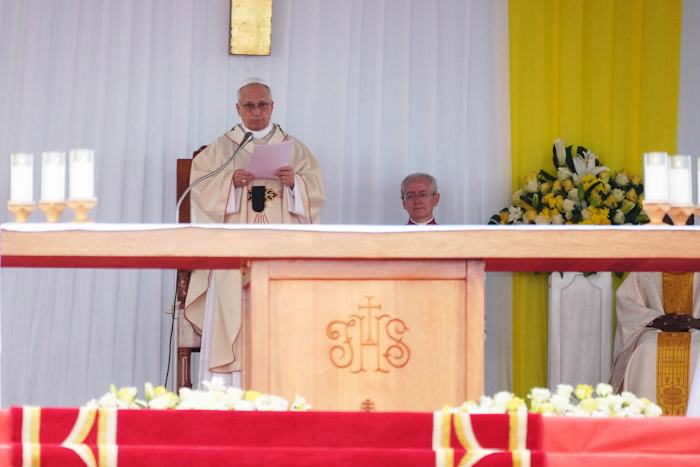
The spectacle is always the same. A high-profile moral authority descends upon a developing nation, gathers a sea of hopeful faces, and delivers a stirring sermon on the evils of greed. The crowd cheers. The international press swoons over the "powerful message." Then, the private jets take off, the dust settles, and the systemic machinery of graft continues to hum exactly as it did before.
Pope Francis’s call for Cameroonian youth to "resist the temptation of corruption" is a masterclass in the lazy consensus that has stalled African development for decades. It treats a structural, economic survival mechanism as a simple lack of character. It asks the most vulnerable members of society—the youth—to perform a feat of moral heroism that would break a saint, all while ignoring the cold, hard logic of why corruption exists in the first place. You might also find this similar story interesting: The Mandelson Fixation Is Why British Politics Is Broken.
If we want to actually kill corruption, we need to stop praying for it to go away and start making it unprofitable.
The Myth of the Moral Vacuum
The standard narrative suggests that corruption happens because people are "bad" or "greedy." This is a fundamental misunderstanding of human incentives. In environments where the rule of law is a suggestion and the state cannot provide basic security or infrastructure, corruption isn't a "temptation." It is an informal tax system. It is a social safety net. It is, quite literally, the grease that allows a rusted engine to turn at all. As highlighted in detailed reports by Al Jazeera, the results are notable.
When a young person in Douala or Yaoundé pays a bribe to get a permit, they aren't "succumbing to evil." They are making a rational economic calculation. The cost of the bribe is lower than the cost of a business failing due to bureaucratic paralysis. Expecting a twenty-year-old with no safety net to "resist" this system is not just unrealistic; it’s cruel. It places the burden of systemic reform on the shoulders of those with the least power to enact it.
Real change doesn't come from a change of heart. It comes from a change of architecture.
The Institutionalized Toll Bridge
Imagine a scenario where a city has only one road, and that road is blocked by a massive boulder. A local official offers to move the boulder for five dollars. You can stand there and preach to the official about the ethics of public service, or you can build a second road.
Most "anti-corruption" initiatives, including the Vatican’s rhetorical approach, focus on lecturing the guy with the boulder. A contrarian approach focuses on building the second road.
Corruption thrives in the dark and in the bottleneck. Cameroon ranks 142nd out of 180 countries on Transparency International’s Corruption Perceptions Index. This isn't because Cameroonians are inherently less moral than Danes. It's because the "bottleneck" in Cameroon is everywhere. Every interaction with the state is a potential toll bridge.
The Math of Graft
Let's look at the variables. Corruption ($C$) is often modeled as:
$$C = M + D - A$$
Where:
- M is Monopoly (The official is the only source for a service).
- D is Discretion (The official gets to decide who wins and loses).
- A is Accountability (The likelihood of getting caught and punished).
If you want to lower $C$, you don't talk about "temptation." You attack M and D while boosting A.
- Kill the Monopoly: Digitalize services. If I can renew my driver’s license on a smartphone without talking to a human, the "temptation" to bribe disappears because the opportunity has been engineered out of existence.
- Strip the Discretion: Standardize rules. If a permit is granted automatically upon meeting three clear criteria, the official loses their power to extort.
- Automate Accountability: Blockchain and distributed ledgers are more effective at stopping theft than ten thousand sermons. You can't argue with a cryptographically signed audit trail.
The "Youth as Saviors" Fallacy
There is a patronizing tendency to frame "the youth" as a magical clean slate that will wash away the sins of their fathers. This is a fantasy.
The youth are not a separate species. They are products of their environment. If a young Cameroonian sees that the only path to wealth and security is through the civil service and political patronage, they will pursue those paths. They have to. The "lazy consensus" ignores the fact that the current generation of corrupt officials were once the "hopeful youth" being cheered at a Mass thirty years ago.
I have worked with founders across the continent who are exhausted by this rhetoric. They don't want moral guidance; they want a functional banking system. They don't want to be told to be "honest"; they want a court system that enforces contracts so they don't have to rely on "favors" to get paid.
The High Cost of Cleanliness
Being "clean" in a corrupt system is an expensive luxury. If you refuse to play the game, you lose your contract. You lose your job. Your family goes hungry.
When we tell young people to "resist corruption" without providing an alternative path to prosperity, we are effectively telling them to accept poverty as a badge of honor. This is the "nuance" that the religious and NGO sectors constantly miss. Poverty is the primary driver of corruption. You cannot solve the latter while the former remains the default state for 40% of the population.
Wealth creation is the ultimate anti-corruption tool. When people have "skin in the game"—property rights, tradable assets, and a stake in a stable economy—the incentive to burn the system down for a quick bribe diminishes. Corruption is a high-time-preference activity. It’s about getting yours now because tomorrow is uncertain. Stability allows for low-time-preference thinking: investing in the future.
Stop Moralizing, Start Engineering
We need to stop treating corruption as a theological problem and start treating it as a design flaw.
The most successful anti-corruption drives in history didn't happen because of a sudden surge in piety. They happened because of administrative reform. Look at Singapore in the 1960s or Georgia in the early 2000s. They didn't just ask people to be nice. They fired the entire traffic police force. They slashed regulations. They made it easier to be legal than to be illegal.
Three Brutal Truths About African Graft
- Transparency is a Buzzword, Not a Solution: Knowing that someone is stealing doesn't help if the person stealing also owns the police force. We need enforcement, not just "visibility."
- Aid is Part of the Problem: Pouring billions in foreign aid into weak institutional frameworks is like pouring water into a bucket made of lace. It creates a massive "rent-seeking" incentive where the smartest minds in the country spend their time chasing grants instead of building businesses.
- Democracy Without Property Rights is a Circus: Voting for a new leader every five years means nothing if that leader can still seize your land or freeze your bank account at whim.
The focus on the "temptation" of the individual is a convenient distraction for the failures of the state. It allows leaders to stand on stage with the Pope, nod solemnly about the need for integrity, and then go back to their offices to sign off on the next skewed infrastructure project.
The Actionable Pivot
If you are a young person in a system defined by graft, your "moral resistance" should not be passive. It should be disruptive.
Don't just "not participate." Build systems that bypass the need for permission. The rise of decentralized finance (DeFi) in Africa isn't just a tech trend; it’s a massive, silent protest against corrupt central banks and failing currencies. When you move your wealth into an asset the state can't touch, you are performing a more effective anti-corruption act than any protest march.
Build companies that export services globally. If your customers are in London or New York, the local bureaucrat has less leverage over your throat. Use technology to make yourself "un-extortable."
The Pope is right that corruption kills hope. But he is wrong about the cure. You don't defeat a parasite by asking it to have a conscience. You defeat it by making the host impossible to feed on.
Stop waiting for a moral revolution. Start building the technical one.
Design the system so that even a "bad" person has to act honestly to get ahead. That is the only way Cameroon—or any other nation—actually changes. Everything else is just theatre for the cameras.