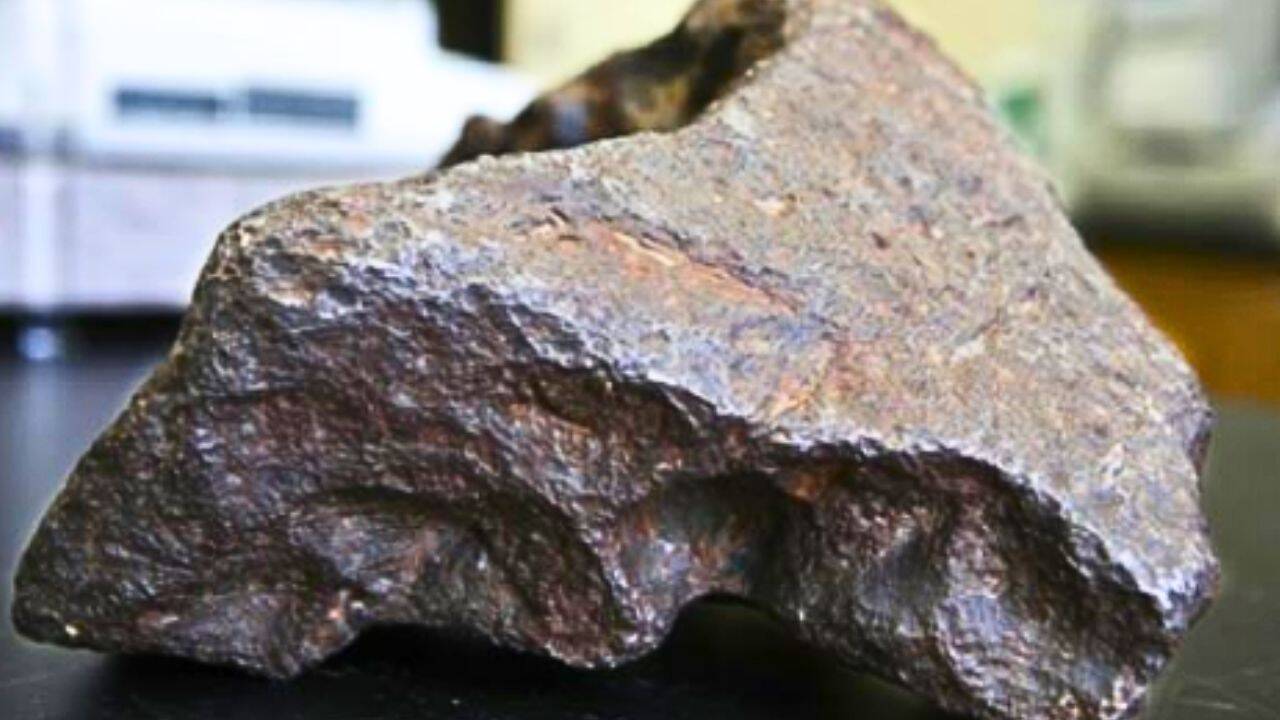
A heavy, lumpy hunk of metal weighing 10.22 kilograms served as an ordinary barn doorstop in Edmore, Michigan, for over thirty years, unaware it was actually an iron nickel space rock worth a small fortune. This extraordinary artifact, now known as the Edmore meteorite, highlights a bizarre reality of planetary science. People often live alongside priceless cosmic fragments without ever realizing their true nature.
Mona Sirly and her husband acquired a farm in Edmore back in 1988. The previous owner casually handed over the property along with a strange, heavy rock that had been used for decades simply to prop the wooden door open against the wind. When Sirly finally sold the farm in 2018, she kept the doorstop, sensing it might hold more value than scrap iron. She took it to Central Michigan University, where geology professor Mona Sirbu examined the heavy stone and immediately recognized it as something far more significant than common terrestrial slag.
The subsequent analysis revealed that the Edmore meteorite consists of approximately eighty-eight percent iron and twelve percent nickel, with minor traces of other rare elements. This composition places it firmly in the category of iron meteorites, which originate from the cores of ancient, differentiated asteroids that broke apart long ago in the solar system. Most space rocks entering Earth's atmosphere burn up or shatter into tiny fragments. Large iron masses survive the fiery descent far better than stony chondrites, making them exceptionally dense, highly magnetic, and remarkably durable.
For thirty years, this cosmic visitor endured midwestern winters, rain, mud, and the casual kicks of farm equipment. It functioned effectively as a doorstop because of its sheer weight and irregular, wedge like shape. The irony remains striking. A specimen that traveled millions of miles across the vacuum of space, survived a catastrophic atmospheric entry, and landed silently in a Michigan field ended up relegated to manual labor in an agricultural outbuilding.
The scientific value of such a discovery extends far beyond its market price. Meteorites serve as pristine time capsules from the early formation of the solar system. They provide researchers with direct physical samples of planetary building blocks that formed over four and a half billion years ago. Every new find helps geochemists map the distribution of siderophile elements across different celestial bodies. When a specimen remains hidden in private hands for decades, science loses decades of potential analysis time.
Fortunately, the Edmore meteorite eventually found its way to a proper institution. It was acquired by the Smithsonian Institution's National Museum of Natural History, with a portion also purchased by the Abrams Planetarium at Michigan State University. Researchers can now study its Widmanstätten patterns—the intricate crystalline structures that only form when molten metal cools at an unimaginably slow rate over millions of years inside an asteroid's core.
Stories like the Edmore discovery surface with surprising regularity. Farm tools, garden ornaments, and household wedges frequently turn out to be rare meteorites simply because untrained eyes mistake dense, heavy metallic rocks for industrial waste or heavy machinery components. People assume that anything unusual found in a dirt field must be man made scrap left behind by previous generations.
The financial valuation of such finds creates an intense tension between private ownership and public scientific preservation. While finders possess legal rights to objects discovered on their private land, the scientific community relies heavily on voluntary donations or institutional purchases to secure these unique planetary archives. When a twenty two pound chunk of iron fetches tens of thousands of dollars on the commercial market, it transforms ordinary farmers into accidental treasure hunters.
Yet, the true worth of the Edmore meteorite is not measured in currency. It represents a physical link to the chaotic early days of our stellar neighborhood, a remnant of a shattered world that drifted through the dark for eons before colliding with a patch of Michigan grass.
The barn door is gone, but the rock remains, no longer holding back the wind, but holding the attention of scientists who continue to decode the history written in its dense, rusted iron matrix.