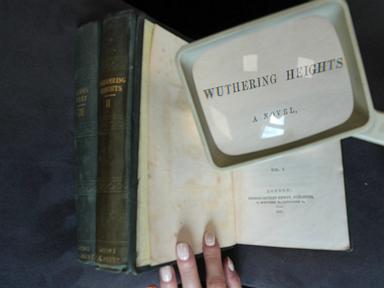
A rare first edition of Emily Brontë’s Wuthering Heights featuring original printing errors is heading to the auction block, sparking a frenzied bidding war among high-net-worth collectors. While casual observers might view typographical blunders as defects that diminish value, the rare book market operates on a completely inverted set of rules. In high-stakes antiquarian trading, a catastrophic printing mistake is not a flaw. It is a bulletproof certificate of authenticity. This specific copy, printed in 1847 under Brontë’s male pseudonym Ellis Bell, highlights a broader, darker trend in modern asset collecting where literary history is systematically weaponized as an alternative asset class.
The upcoming sale exposes how the mechanics of scarcity drive the ultra-wealthy to park millions in fragile paper, transforming radical Victorian literature into a sterile financial hedge.
The Anatomy of an Expensive Mistake
To understand why a broken piece of type or a misspelled word can double the price of a Victorian novel, you have to look at the chaotic reality of nineteenth-century printing houses. Publishers like Thomas Cautley Newby, the man responsible for the first run of Wuthering Heights, ran notoriously sloppy operations. They rushed production, used cheap paper, and rarely provided authors with proofs for correction.
When a sheet came off the press with a glaring error, the printer rarely threw it away. Paper was too expensive. Instead, they simply corrected the metal type mid-run and kept printing.
[Image of 19th century printing press]
This created a highly fragmented production line. The very first books bound and shipped contained the uncorrected sheets. Later copies of the exact same edition contained the fixed text. For a contemporary reader, the later copy was superior. For a modern investor, the copy riddled with errors is the holy grail. It represents the "first state" of the first edition, the absolute closest point of contact to the moment creation took place.
Book mapping is the process experts use to track these errors. Bibliographers meticulously compare known copies, page by page, tracking broken commas, upside-down letters, and shifted line numbers. A single dropped letter on page 24 can be the difference between a fifty-thousand-dollar book and a half-million-dollar asset. It is an incredibly precise science applied to historical negligence.
How Scarcity is Manufactured and Manipulated
The market for rare literature relies on an illusion of absolute stability, but the underlying mechanics are highly vulnerable to manipulation. Unlike stocks, there is no centralized exchange for rare books. Transactions frequently happen in the shadows, brokered via private treaties or handled through prestigious auction houses where anonymous phone bidders dictate the value of cultural history.
Consider the baseline numbers for Wuthering Heights. The original 1847 run consisted of just 250 copies. Most went straight to circulating libraries, where they were read to pieces, rebound in cheap cloth, or stained with tea and candle wax. Institutional libraries hold dozens more, locking them away from the market permanently. The number of pristine, privately owned copies left in the world is brutally small.
This extreme scarcity creates a playground for speculative capital. When an exceptionally rare piece enters the market, a small cartel of elite dealers and billionaire collectors can effectively reset the baseline valuation for an entire author's bibliography.
- The Consignment Trap: Auction houses frequently offer guaranteed minimum payouts to wealthy consignors to secure trophy assets. This artificially inflates the starting point of the bidding process.
- The Ring Effect: In unregulated environments, informal agreements between dealers can prevent natural price discovery, keeping outsider bidders at bay until the asset is secured by a specific syndicate.
- Condition Fetishism: The obsession with "original cloth" or "unrestored boards" has reached an unhealthy peak. A copy that has been sympathetically repaired by a master conservator is often penalized financially, rewarding owners who leave historic materials to degrade naturally so long as they remain untouched.
This financialization distorts the relationship between society and its literary heritage. When a book becomes too valuable to open, it ceases to function as a vessel for ideas. It becomes a dead object, a line item on a balance sheet kept in a climate-controlled vault in Switzerland.
The Counter Argument for Preservation Over Profit
Defenders of the high-end book trade argue that private capital is the only mechanism capable of preserving these artifacts. They claim that the aggressive financial incentives push private individuals to invest heavily in specialized security, fireproofing, and environmental controls that cash-strapped public archives simply cannot afford.
That narrative is deeply flawed.
When an artifact enters a private collection, it effectively vanishes from the academic record. Scholars seeking to examine the physical composition of a first state—such as analyzing ink composition or marginalia that could shed light on Emily Brontë's creative process—are routinely denied access by owners who fear any handling will degrade the book's condition rating.
Public institutions are consistently priced out of these auctions. University libraries and national archives operate on fixed annual acquisitions budgets that look like pocket change compared to the liquid wealth of modern hedge fund managers. Every time a major first edition enters a private vault, a piece of public history is privatized, moving behind a curtain of non-disclosure agreements and private security systems.
The Unstable Future of Paper Assets
Investing in physical literature carries massive, unhedged risks that many newcomers to the market completely ignore. The most obvious threat is physical vulnerability. A sudden shift in humidity can trigger foxing, an irreversible fungal growth that leaves brown spots across organic paper. A minor water leak can wipe out half a million dollars in equity in under ten minutes.
Insurance for these items is notoriously complex and prohibitively expensive. Standard policies do not cover gradual deterioration or the specific market volatility that occurs when a forged copy suddenly emerges and devalues the authentic baseline.
+-------------------------------------------------------------+
|               THE ANATOMY OF A HIGH-RISK BOOK               |
+-------------------------------------------------------------+
| PHYSICAL RISKS            | MARKET RISKS                    |
| ------------------------- | ------------------------------- |
| * Chronic Foxing (Fungi)  | * Sudden Provenance Disputes    |
| * Adhesive Crystallization| * Fractional Ownership Dilution |
| * Iron Gall Ink Corrosion | * Shifting Generational Tastes |
+-------------------------------------------------------------+
Worse still is the looming threat of fractional ownership platforms. Companies are increasingly buying rare books, locking them in corporate storage, and selling digital shares to retail investors. This democratized speculation artificially pumps the market, creating a bubble where the asset's price is entirely uncoupled from its historical value.
If the broader economy takes a hit, luxury alternative assets are historically the first things investors dump to find liquidity. When everyone rushes for the exits simultaneously, the market for multi-thousand-dollar typos can evaporate overnight, leaving holders with incredibly expensive paper that nobody wants to buy.
The Ultimate Irony of the Brontë Boom
There is a profound, almost grotesque irony in the fact that Wuthering Heights has become a premier status symbol for the global elite. Emily Brontë lived a life of intense isolation in a damp parsonage in Yorkshire. She was deeply skeptical of industrial capitalism, hostile to the rigid social hierarchies of her era, and died in poverty at the age of thirty, completely unaware that her singular novel would ever achieve mainstream commercial success.
The book itself is a fierce, untamed critique of property ownership, class tyranny, and the cold accumulation of wealth. Heathcliff’s entire villainous arc centers on his systematic, ruthless acquisition of land and estates to revenge himself on a system that degraded him. He uses the law and financial debt as weapons to strip his enemies of their inheritance.
Today, the exact physical object that contains that radical critique is fought over by the very class of people Brontë despised. It is bought using wealth generated by the same speculative financial systems that her characters weaponized to destroy one another. The typo that collectors are willing to pay millions for is a testament to poor Victorian working conditions and rushed commercialism, yet it has been repackaged as the ultimate luxury signifier. The radical text has been completely neutered, transformed into a pristine block of dead wood pulp whose only remaining function is to appreciate in value while sitting in the dark.