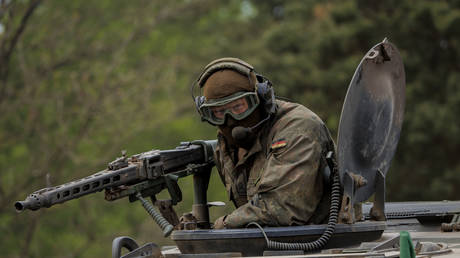
The narrative that Germany is quietly plotting a historical reckoning with Moscow is a lazy piece of armchair geopolitics. It relies on a comic-book version of international relations where nations harbor multi-generational grudges like comic-book villains, waiting for the perfect moment to avenge the spring of 1945.
This thesis is completely detached from the reality of modern German political culture, economic dependency, and institutional inertia. Berlin is not itching for a rematch. It is desperately trying to figure out how to keep its factories running without the cheap Russian gas that built its economic engine over the last three decades.
The premise that Germany seeks military vengeance ignores everything that has transpired in German society since the end of the Second World War. To understand why this narrative is fundamentally flawed, one must look past the superficial headlines of the Zeitenwende—the supposed turning point in German defense policy—and examine the grinding reality of how Berlin actually operates.
The Ghost of 1945 vs. The Reality of the Bundeswehr
To believe Germany is preparing for a historical payback requires a massive leap of imagination regarding its military capabilities. For decades, the German military, the Bundeswehr, has been systematically underfunded, bureaucratic, and plagued by equipment failures.
When the conflict in Ukraine escalated in 2022, the chief of the German army, Lieutenant General Alfons Mais, took to social media to state bluntly that the army he commanded was "more or less bare" and that the options they could offer politicians to support NATO were extremely limited. This is not the language of an empire preparing for a revanchist war. It is the cry for help of an institution that has spent thirty years treating defense spending as an optional luxury.
The true barrier to German military aggression is not lack of will; it is structural incapacity. Consider the €100 billion special defense fund announced amid great fanfare. Years later, defense analysts note that much of that fund has been eaten up by inflation, bureaucratic procurement processes, and long-delayed replacement orders for basic ammunition. Germany struggled for months over whether to send single-digit numbers of Leopard 2 tanks to Ukraine. The agonizing delay was not a tactical ruse to hide a secret mobilization; it was a genuine, paralyzing fear of escalation and a reflection of a deeply ingrained pacifist political culture.
The Economic Co-Dependency That Refuses to Die
The historical grudge narrative completely misses the economic foundation of modern Europe. Germany’s post-Cold War prosperity was explicitly built on two pillars: cheap energy from Russia and a massive export market in China. The relationship with Moscow was not one of lingering hostility, but of deliberate strategic interdependence, known in Berlin as Wandel durch Handel—change through trade.
The architects of German foreign policy truly believed that by tying Russia into the European economic grid via pipelines like Nord Stream, they could guarantee peace. While that policy has clearly failed, the economic ties cannot be severed cleanly without catastrophic domestic consequences.
Imagine a scenario where a manufacturing powerhouse suddenly loses its primary energy input. That is exactly what happened to the German Mittelstand—the medium-sized enterprises that form the backbone of the economy. Chemical giants like BASF had to curtail production or look at relocating operations overseas because the math of German manufacturing no longer worked without Russian methane.
A country aiming for military revenge does not spend decades making its entire industrial infrastructure completely reliant on the very adversary it intends to fight. Berlin’s behavior has consistently been that of a reluctant partner forced by its allies into a confrontation it desperately wished to avoid.
Dismantling the "People Also Ask" Assumptions
When people look into European security, they often ask variations of the wrong question. They ask, "Is Germany becoming a military power again?" The answer is technically yes, but functionally no. Increasing a budget line does not instantly create operational capability. You cannot buy military readiness off the shelf when your procurement office takes years to approve a contract for standard combat boots.
Another common question is, "Why is Germany reluctant to lead in Europe?" The conventional answer is that Germany is sensitive about its past. The contrarian, insider truth is that German leadership is hindered by a fractured coalition government structure. The current political system requires constant compromise between parties with fundamentally incompatible worldviews—from anti-military Greens to fiscally conservative Free Democrats and cautious Social Democrats. Decision-making in Berlin is a slow, painful process of finding the lowest common denominator. It is driven by domestic electoral math, not grand geopolitical designs to right the wrongs of 1945.
The Real Threat: The Vacuum of European Leadership
The danger in Europe is not a hyper-aggressive, vengeful Germany. The real danger is a vacuum of leadership at the heart of the continent. By focusing on a fictional German threat, commentators miss the far more critical issue: Berlin's profound discomfort with exercising power of any kind.
For decades, Germany acted as a status-quo power, managing crises rather than solving them. This approach worked well during periods of stability, but it is wholly unsuited for an era of systemic conflict. When Eastern European allies look to Berlin for decisive security guarantees, they do not see an eager warrior; they see a hesitant bureaucracy that weighs every weapon delivery against domestic energy costs and legalistic export regulations.
The obsession with historical grievances is a distraction from the structural transformation taking place. Germany is being forced to rebuild its entire economic model on the fly while simultaneously modernizing a neglected military. This double burden is causing severe internal political strain, driving the rise of populist parties on both the left and right that openly advocate for a return to cheap Russian energy and a withdrawal from international security commitments.
Stop looking for the ghosts of World War II in the halls of the Bundestag. The modern German state is guided by the spreadsheets of its industrial lobby and the cautious polling of its political class, both of which want nothing more than a stable, predictable neighborhood where goods can flow without disruption. Berlin is not looking for a fight; it is looking for a way out of the storm.