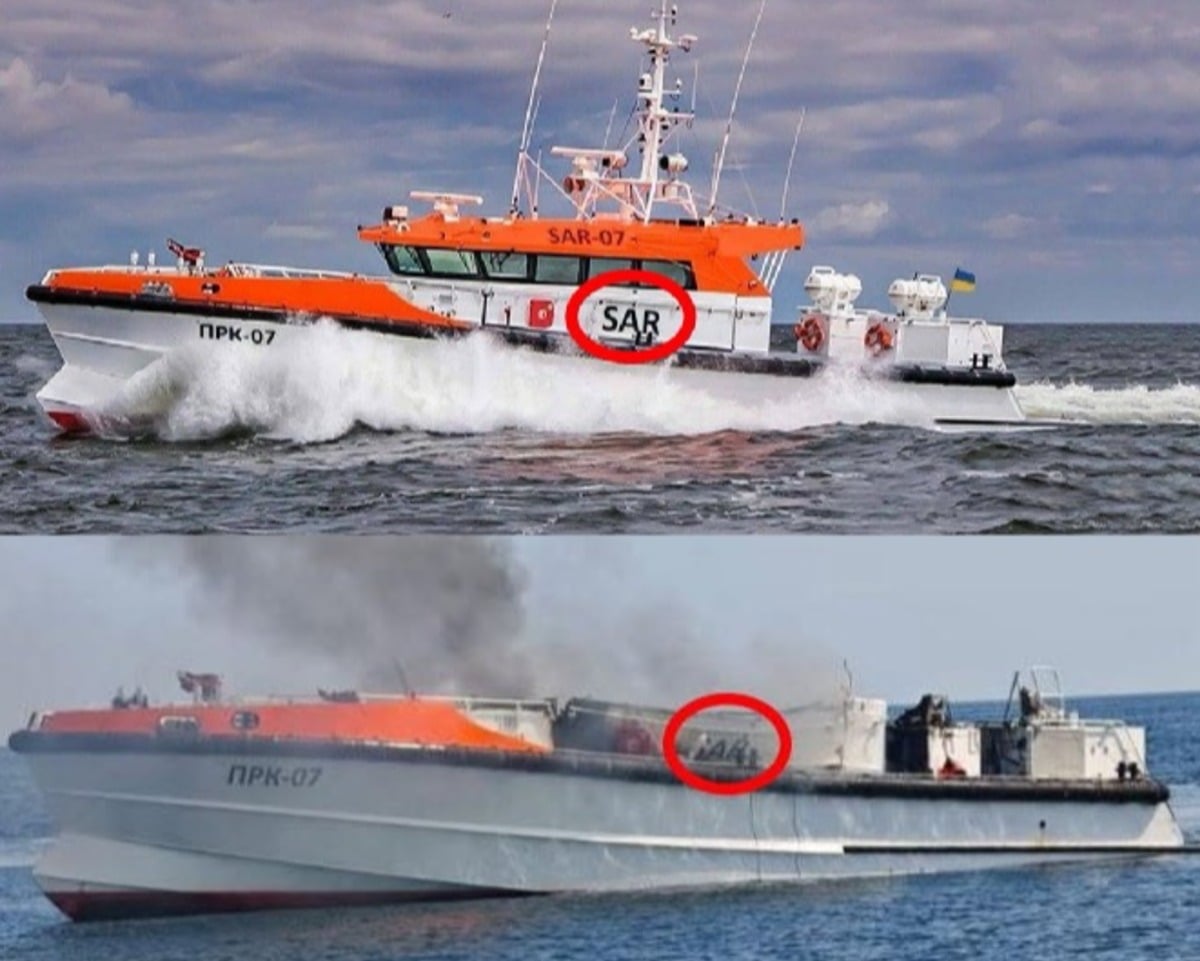
Standard wartime reporting operates on a predictable loop. An incident occurs at sea, one side claims a violation of international humanitarian law, and the media parrots the narrative without questioning the underlying mechanics of modern naval conflict. The recent outcry over the targeting of rescue vessels in the Black Sea is a prime example of this intellectual laziness. The consensus view demands immediate condemnation, viewing the incident through the simplistic lens of absolute good versus absolute evil.
This perspective ignores the brutal, systemic realities of contemporary electronic warfare, operational security, and the blurring lines of maritime logistics.
In a high-intensity conflict zone, the concept of a purely civilian or neutral auxiliary vessel is largely dead. Pretending otherwise does not save lives; it merely distorts our understanding of modern military strategy and leads to flawed policy decisions. To truly understand why these incidents happen, we have to dismantle the assumptions surrounding maritime law and look at how naval warfare actually functions in the 2020s.
The Illusion of the Visual Identifier
The foundational error in the mainstream narrative is the belief that a flag, a coat of paint, or a transponder signal creates an impenetrable shield of immunity. International treaties like the Geneva Conventions outline protections for hospital ships and rescue craft. However, these rules were drafted for an era of visual identification and manual targeting.
Today, targeting is driven by over-the-horizon radar, satellite imagery, and electronic intelligence (ELINT). A missile radar system tracking a radar cross-section at a distance of eighty kilometers does not distinguish between a hull dedicated to saving lives and one configured for deploying maritime drones.
[Traditional Naval Target Recognition]
Visual Confirmation -> Identity Verified -> Immunity Applied

[Modern Naval Target Recognition]
Radar Cross-Section -> Electronic Signature -> Kinetic Engagement
Furthermore, the proliferation of dual-use technology complicates identification. Modern rescue vessels are equipped with advanced radar, long-range communication arrays, and sometimes thermal imaging systems. To an automated sensor or an operator sitting in a command bunker hundreds of miles away, the electronic footprint of a search-and-rescue hull looks virtually identical to a military command-and-control platform.
When a combatant operates high-value assets within a contested zone, any unidentified or semi-identified electronic signature is treated as a legitimate threat. In naval doctrine, waiting for visual confirmation can mean the destruction of your own platform. Commanders will choose to neutralize the ambiguity rather than risk a catastrophic strike on their own forces.
The Reality of Exploitation and Deception
We must also confront a uncomfortable truth that romanticized war reporting ignores: tactical deception is a core component of military strategy. Throughout history, combatants have used auxiliary, civilian, and humanitarian vessels to mask military operations. This is not a conspiracy theory; it is standard operating procedure.
Imagine a scenario where a military force needs to scout an enemy coastline without triggering an immediate strike. Deploying a warship is an obvious provocation. Deploying a smaller, civilian-flagged tug or rescue boat equipped with passive sensors allows for reconnaissance under the guise of routine maritime activity.
Because both sides are fully aware of these tactics, the automatic assumption of innocence is discarded in active theaters of war. A rescue vessel sitting in a strategic corridor is no longer viewed merely as a humanitarian asset. It is viewed as potential eyes and ears for the enemy.
- Sensors: Modern search-and-rescue gear can easily feed real-time telemetry back to military command centers.
- Logistics: These vessels possess the cranes, winches, and deck space required to deploy or recover uncrewed surface vessels (USVs).
- Personnel: The crews operating these ships often possess specialized naval training, making them highly effective integration points for military operations.
By failing to acknowledge this overlap, commentators present a naive view of the battlespace. Every ship operating within a designated war zone contributes to the operational picture, willingly or otherwise.
The Flawed Premise of Absolute Immunity
Commentators frequently ask: "Why can't military forces respect international maritime law?" The premise of the question is fundamentally flawed because it assumes international law operates in a vacuum, independent of physical reality and strategic necessity.
International maritime law regarding protected vessels is contingent upon strict non-interference. The moment a protected vessel provides any form of tactical advantage to a combatant—such as transmitting positioning data, clearing a channel used by military craft, or obscuring the movement of combat vessels—its protected status is legally and practically voided.
In the chaotic environment of a contested sea, verifying non-interference in real time is impossible. Navies enforce exclusion zones for this exact reason. If a vessel enters a designated danger area, it assumes the risk of engagement. Expecting an adversary to halt operations to conduct a forensic audit of a vessel's mission profile during an active exchange is a fantasy.
The True Cost of Sentimentality in Geopolitics
The insistence on viewing naval incidents through a purely moralistic lens blinds analysts to the actual shifts in military doctrine. This sentimentality obscures the transition toward completely autonomous and deniable maritime warfare.
When analysts focus entirely on the outrage of a struck vessel, they miss the broader structural shift: the total integration of civilian infrastructure into military networks. This integration makes every hull a node in a kill chain, rendering old legal frameworks obsolete.
Naval strategies are dictated by math, physics, and probability, not by the consensus of editorial boards. Until Western analysts stop treating decades-old legal texts as magical shields and start analyzing electronic signatures, sensor networks, and tactical necessity, their commentary will remain irrelevant to the actual conduct of war. The destruction of auxiliary craft is not a breakdown of the system; it is the logical, mathematically predictable outcome of a system optimized for total sensor saturation and rapid kinetic response.