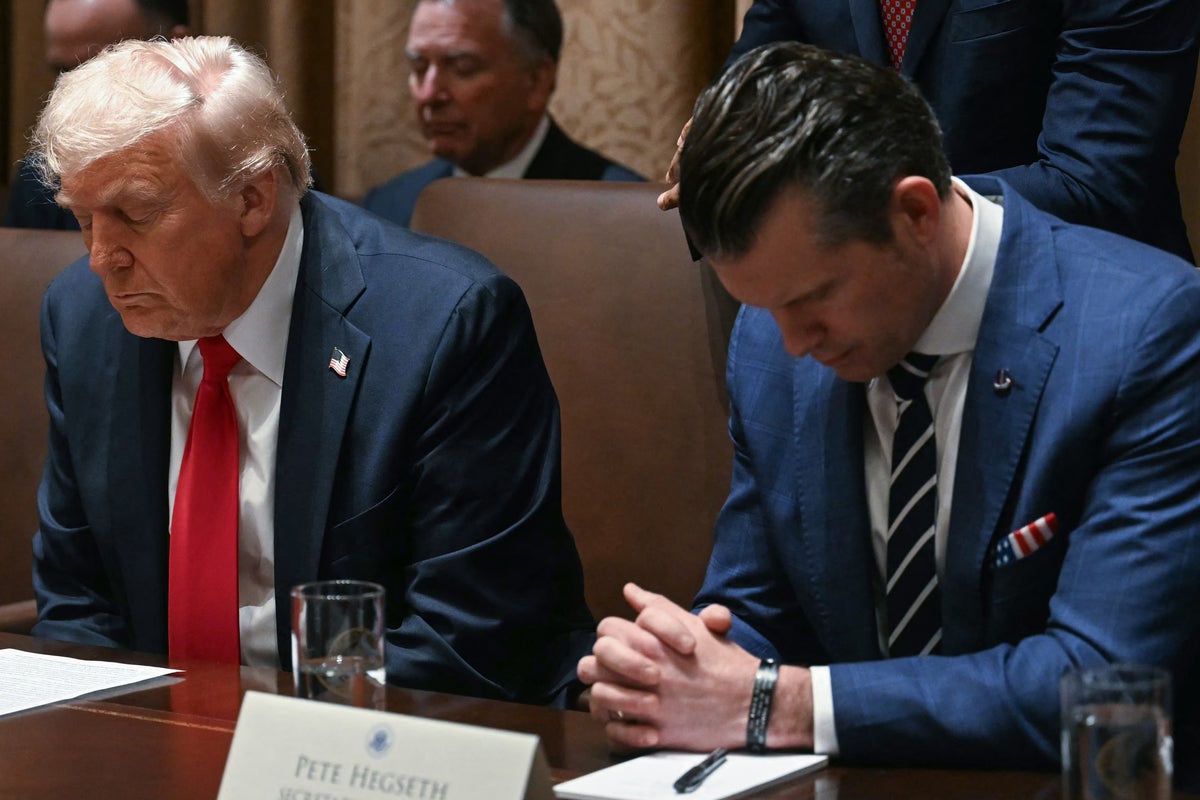
The media is currently hyperventilating over a phantom menace. They look at the incoming administration’s talk of "Crusaders" and "spiritual warfare" and scream about the death of democracy. They claim America wants a sanitized, secular military that operates on the cold logic of a spreadsheet.
They are dead wrong.
The "lazy consensus" suggests that religious language in the Pentagon is a bug. It isn’t. It’s the original source code. Critics argue that Pete Hegseth’s rhetoric or Donald Trump’s appeals to faith will alienate the ranks and ignite global holy wars. This assumes we currently live in a world governed by rationalist diplomacy. We don't. We live in a world where our enemies are fueled by absolute metaphysical certainty, while we try to fight them with HR manuals and DEI initiatives.
The secularization of the American military hasn't made us more efficient; it has made us hollow.
The False Idol of Objective Warfare
The argument against religious rhetoric rests on a fundamental misunderstanding of what a soldier is. If you treat a soldier like a biological machine that executes orders based on a legalistic contract, you lose the moment the "ROI" of staying alive outweighs the "ROI" of the mission.
Secular liberalism has no answer for the "Why?" of the foxhole.
I’ve sat in rooms where bureaucrats discuss "kinetic solutions" and "asymmetric advantages" as if war were a game of Tetris. It’s a comforting lie. War is, and always has been, a theological event. It is the moment where life meets its limit and demands a justification beyond a paycheck or a pension plan. When the media demands that leadership scrap religious rhetoric, they are asking for a military that lacks a soul. A soulless military doesn't win; it merely occupies until the budget runs out.
Why "Neutrality" is a Strategic Deficit
Critics point to the "Crusader" imagery used by figures like Hegseth as a recruitment disaster. They claim it offends our allies and emboldens our enemies.
Let’s look at the data—or rather, the lack of it. Where is the evidence that "neutral" rhetoric has improved our standing in the Middle East over the last twenty years? We spent two decades using the language of "nation-building," "democratic values," and "institutional reform." We were the most secularized force in history. The result? We were outlasted by men with rusted AK-47s who believed they were doing the work of the divine.
If you are fighting an opponent who believes their cause is written in the stars, and you respond with a PowerPoint presentation on "Western liberal norms," you have already lost. You aren't just outgunned; you are out-motivated.
The shift toward religious or "militant-tradition" rhetoric isn't about starting a literal Inquisition. It’s about psychological parity. It’s about reclaiming a narrative of purpose that is more powerful than the nihilism of modern consumer culture.
The Professionalism Trap
The "professional" class—the ones writing the op-eds—believe that "God" has no place in the chain of command because it’s "unprofessional."
Define "professional."
In the last decade, our "professional" military leadership oversaw a botched withdrawal from Afghanistan that was a masterclass in incompetence. They’ve presided over a recruiting crisis that is currently gutting the Navy and the Army. They’ve focused on "climate literacy" while our hypersonic capabilities fell behind China's.
If this is what "professionalism" looks like, we should be begging for a bit of zealotry.
The critics are terrified that religious rhetoric will lead to a lack of discipline. History suggests the opposite. The most disciplined, lethal forces in history—from the New Model Army to the Samurai—were driven by a fusion of military duty and spiritual conviction. When you believe you are accountable to something higher than a JAG officer, you don't cut corners.
The Hidden Diversity of the Ranks
The media loves to pretend the military is a microcosm of a Brooklyn coffee shop. It isn't.
The people who actually pull triggers are disproportionately from the South, the Midwest, and highly religious communities. They aren't "offended" by mentions of God. They are alienated by the absence of Him. When the Pentagon scrubs its language to satisfy a handful of activists in D.C., it creates a massive cultural rift between the leadership and the boots on the ground.
By attacking Trump or Hegseth for using religious imagery, the media is effectively telling the warrior class: "We want your labor, but we despise your values."
That is the fastest way to break a volunteer force. If the military continues to prioritize the sensibilities of people who would never dream of enlisting, it will soon find itself with plenty of "correct" language and zero soldiers.
The Reality of Global Perception
There is a naive belief that if we just stop talking about Christianity or Western tradition, our enemies will stop hating us. This is the "secular savior" complex.
To the IRGC in Iran or the extremists in the Levant, America is already a religious actor. They don't see us as a neutral secular state; they see us as the "Great Satan" or the vanguard of a decadent Western theology. Scrubbing our own rhetoric doesn't change their perception; it just leaves us without a counter-narrative.
By embracing a more assertive, tradition-rooted identity, the U.S. stops pretending and starts communicating in a language the rest of the world actually understands. The world doesn't respect a vacuum. It respects strength and conviction.
The Risk No One Admits
Is there a downside? Of course.
The danger isn't that we become a theocracy. The danger is that the rhetoric becomes a mask for mediocrity. You can call yourself a "Crusader" all you want, but if you can't maintain a carrier strike group or pass an audit, the words are meaningless. Rhetoric is a force multiplier, not a replacement for competence.
But the current obsession with "scrapping the religious rhetoric" isn't about competence. It’s about domestic political control. It’s about ensuring that the military remains an instrument of the current social engineering project rather than an independent bastion of traditional grit.
Stop Asking the Wrong Questions
People often ask: "How do we keep the military inclusive while using religious language?"
That is the wrong question.
The real question is: "How do we make the military lethal again?"
If the answer involves tapping into the deep, historical, and religious roots of the American fighting spirit, then that is what must be done. The military is not a laboratory for social harmony. It is a killing machine designed to protect the state.
If the language of faith, tradition, and "spiritual warfare" helps the machine function—by increasing morale, providing a moral framework for violence, and connecting the soldier to a cause greater than themselves—then it is functionally superior to anything a HR department has ever produced.
The critics aren't worried about "safety." They are worried about losing their grip on the narrative. They want a military that looks like them, thinks like them, and fears the same things they do.
But you don't win wars with a military that fears being "offensive." You win with a military that fears nothing because it believes its cause is righteous.
The era of the "neutral" warrior is over. It was an anomaly of the post-Cold War dream, a brief moment where we thought we could manage the world with spreadsheets. That dream died in the mountains of the Hindu Kush and the streets of Fallujah.
It's time to stop apologizing for the language of conviction. If you want a military that can win, you have to give them something worth dying for. And "secular pluralism" isn't it.
Get over the rhetoric. Fix the mission.