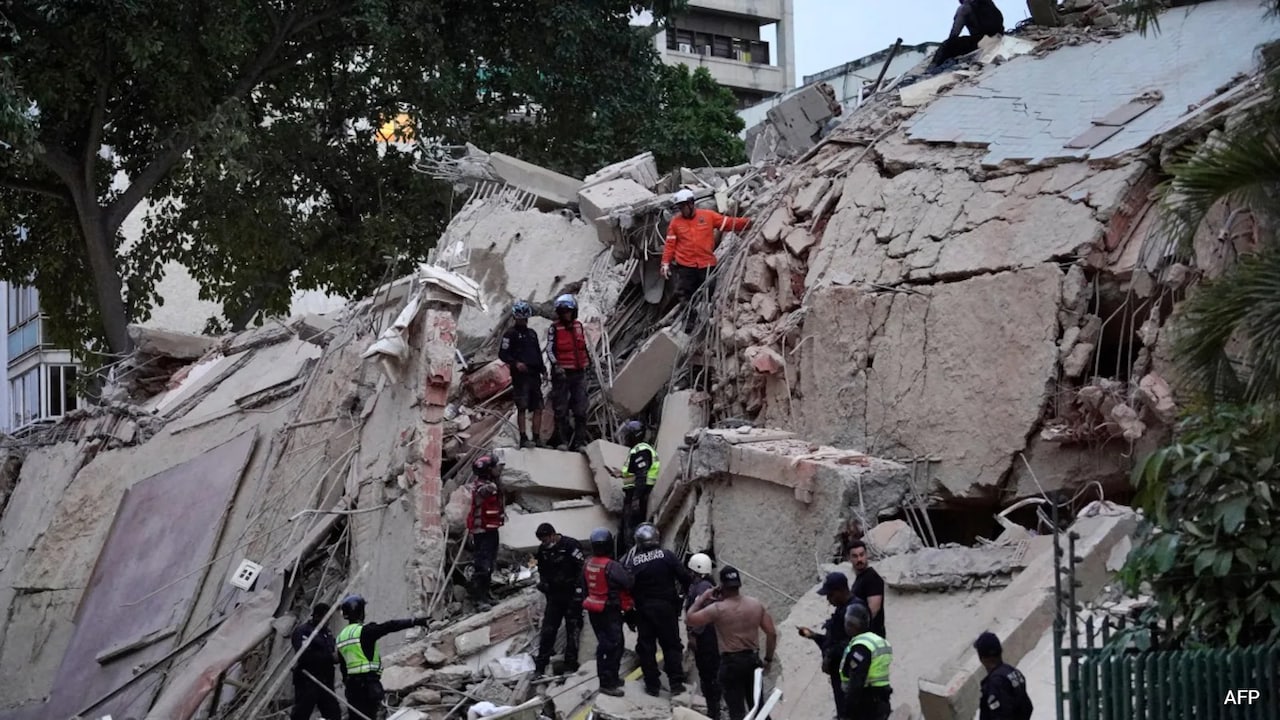
The media loves a freak show. When two massive earthquakes struck Venezuela within hours of each other, the mainstream press hit the panic button, trotting out the word "doublet" as if they had discovered a two-headed calf. The narrative was predictable: a bizarre, near-impossible coincidence that baffled scientists and defied the natural order of geology.
It is a comforting narrative because it implies that our normal state of affairs is predictable. It suggests that earthquakes are polite enough to happen one at a time, clear their schedules, and give us room to breathe.
That narrative is a lie.
Doublet earthquakes are not freak anomalies. They are not mysterious coincidences. They are the inevitable, mathematically predictable result of stress transfer within an interconnected web of crustal faults. Calling them "twins" or "freak events" is a fundamental failure of public risk communication. It treats fault lines like isolated pieces of string rather than what they actually are: a tightly wound, chaotic system of springs where tripping one inevitably snaps the next.
The Lazy Consensus of the Isolated Fault
Go read any standard explainer on the Venezuelan events. They will tell you that a doublet occurs when two earthquakes of nearly equal magnitude happen in close spatial and temporal proximity. They will treat the second event as a bizarre echo or a stroke of terrible luck.
This is fundamentally flawed.
Mainstream analysis isolates tectonic faults. It views the San Sebastian fault or the El Pilar fault zone as independent entities operating in their own private silos. When an earthquake happens, traditional models calculate the energy released and assume the immediate area has been safely "depressurized" for the foreseeable future.
This vacuum-based thinking is dangerous. When a fault ruptures, it does not just release energy into the ether; it shoves that energy directly down the throat of its neighbors.
The Cold Math of Coulomb Stress Transfer
To understand why doublets are a feature, not a bug, of tectonic plate boundaries, you have to look at Coulomb stress transfer. This is not a radical fringe theory; it is foundational geophysics that the public facing media routinely ignores because it destroys their sensationalist "freak accident" headlines.
Imagine a block of wood held in place by tight rubber bands on all sides. If you cut one rubber band, that specific tension drops to zero. But the tension on the remaining bands does not disappear. It instantly spikes.
When the first earthquake hits in a complex zone like the Caribbean-South American plate boundary, the slip on the fault plane alters the stress field in the surrounding crust. We can calculate this using a straightforward relationship:
$$\Delta\sigma_f = \Delta\tau + \mu' \Delta\sigma_n$$
Where $\Delta\sigma_f$ is the change in Coulomb failure stress, $\Delta\tau$ is the change in shear stress, $\mu'$ is the effective coefficient of friction, and $\Delta\sigma_n$ is the change in normal stress.
If $\Delta\sigma_f$ increases by even a fraction of a bar, any nearby fault that was already sitting near its breaking point is instantly pushed over the edge. It does not need weeks or months to cook. It needs seconds. The second major shock is not a separate event triggered by a mysterious cosmic echo; it is the continuation of the first rupture, interrupted only by the physical limits of the rock.
The Flawed Premise of Aftershock Classification
People frequently ask: "How do we know it was a doublet and not just a massive aftershock?"
The very premise of the question is broken. The distinction between a mainshock-aftershock sequence and a doublet is an arbitrary, man-made classification system designed to make data look neat on spreadsheets.
- The Mainstream Definition: A true aftershock must be significantly smaller than the mainshock (usually at least one full magnitude unit lower, following Bath's Law). If the second event matches or nears the first in magnitude, we call it a doublet.
- The Reality: The earth does not care about Bath's Law. The mechanical process driving a magnitude 5 aftershock and a magnitude 7 "doublet" is identical: stress redistribution.
By categorizing doublets as rare structural anomalies, geological agencies inadvertently give the public a false sense of security after a standard mainshock. They imply that if an aftershock happens, it will naturally be smaller and less destructive. This leaves populations completely unprepared for the reality that a fault system can, and often will, deliver a one-two punch of equal ferocity.
I have spent years analyzing how risk models fail during major seismic crises. Time and again, agencies treat the initial rupture as the climax of the event. They map the zone, issue a standard warning about declining aftershock frequencies based on Omori's Law, and pat themselves on the back. Then the second vault snaps, and the entire emergency response infrastructure collapses because nobody planned for a second identical impact zone.
Venezuela Was Not a Coincidence
Let's look at the actual geography that the consensus pieces gloss over. The northern coast of Venezuela is a chaotic collision zone where the Caribbean plate slides eastward relative to the South American plate at a rate of roughly twenty millimeters per year.
   [ Caribbean Plate ]   ---> Moving East
----------------------------------------- Fault Zone
   [ South American Plate ] <--- Moving West
This is not a single, clean line in the dirt. It is a highly fragmented strike-slip system defined by major faults like the Boconó, San Sebastián, and El Pilar, flanked by an intricate network of smaller, blind thrust faults.
When you trigger a major strike-slip event in a highly fragmented environment like the El Pilar system, you are violently loading stress onto adjacent strands. The geology of Venezuela makes it an absolute factory for stress synchronization. The crust there is heavily fractured, meaning the distance stress needs to travel to find another critical fault is incredibly short.
To call the resulting sequential ruptures "twins" implies a freak biological anomaly. In reality, it is basic structural mechanics. If you pull the trigger on a double-barreled shotgun, you don't act shocked when the second barrel fires.
The Cost of the Single-Fault Delusion
The obsession with mapping single, isolated faults and calculating their individual maximum credible earthquakes is costing lives.
Building codes in developing nations—and even many developed ones—are calculated based on probabilistic seismic hazard analyses that assume independent earthquake occurrences. They calculate the likelihood of a single major shake and design structures to withstand that specific acceleration vector.
They do not design for the doublet.
They do not design for a structure to be violently shaken, structurally compromised, its concrete cracked and its rebar exposed, only to be hit forty-eight hours later by an identical load from a completely different angle. A building that survives a magnitude 6.5 with minor structural damage will completely pancake when hit by a second 6.5 while its structural integrity is already compromised.
The downside to acknowledging this reality is stark. If we admit that doublets and multi-fault ruptures are a regular, systemic feature of plate tectonics rather than rare anomalies, our entire approach to seismic engineering and insurance risk has to change. It means current hazard maps are fundamentally underestimating the true risk profile of plate boundaries. It means retrofitting structures is not just about surviving the big one; it is about surviving the big ones.
Stop looking at the Venezuelan earthquakes as a bizarre natural phenomenon to be studied from a safe distance. They are a warning shot. The earth does not reset its clock after the first shake. It just reloads.