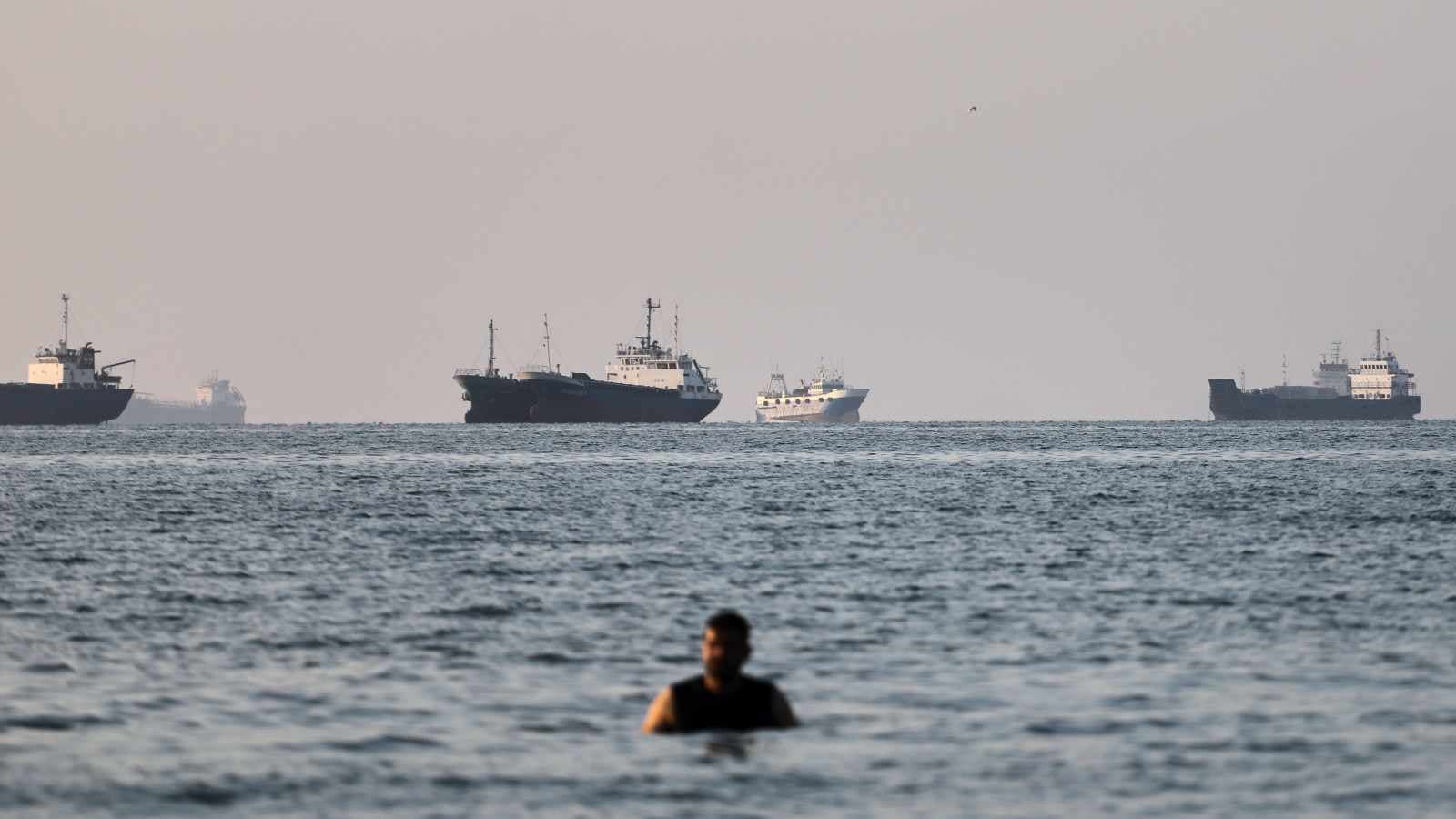
The coffee in the crew mess of an ultra-large crude carrier is always bad. It tastes of rust, descaled pipes, and cheap chicory. But at three in the morning, somewhere forty miles off the coast of Oman, nobody is drinking it for the flavor. They drink it to stay awake while looking at a radar screen that feels entirely too small for the weight of the world pressing down on it.
A modern supertanker is an island of steel. It stretches three football fields in length, carries two million barrels of unrefined wealth, and moves with the agonizing momentum of a glacier. If the captain orders a full crash stop right now, the ship will still slide five miles before it halts. It is a massive, floating prize. And inside the Strait of Hormuz, it is also a target.
Most people only think about these ships when the gas pumps at their local station start ticking upward by twenty cents a gallon. We treat the global energy supply like water from a kitchen tap. You turn the handle, and it flows. But the tap relies on a thirty-mile-wide strip of water that separates Iran from the Arabian Peninsula.
Through this single corridor passes a fifth of the world’s petroleum every single day. If you want to understand how a localized political grudge can suddenly turn into a global panic, you have to look past the press releases and the satellite imagery. You have to stand on the bridge of a ship that feels like a bullseye.
The Geography of Anxiety
The radar blip was small. It lacked the distinct signature of a commercial fishing vessel or the steady, predictable vector of a container ship.
On the bridge, the third mate adjusted the gain. The blip remained. It was moving at thirty-five knots, cutting straight through the inbound shipping lane. In the Persian Gulf, speed is rarely a sign of good intentions.
For decades, the strategic calculus of the Middle East has been defined by asymmetric leverage. Iran knows it cannot match the sheer blue-water naval power of the United States or its regional allies. It does not try to. Instead, it has spent forty years mastering the art of the bottleneck.
The Strait of Hormuz is not an open ocean; it is a tactical funnel. The actual deep-water channels used by these massive tankers are only two miles wide in either direction, separated by a two-mile buffer zone. This means every drop of oil leaving Kuwait, Iraq, Saudi Arabia, and the United Arab Emirates must pass through a gauntlet that sits entirely within the striking distance of Iran’s Islamic Revolutionary Guard Corps Navy.
They do not need a massive armada to disrupt this flow. They use fast attack craft. They use low-altitude anti-ship cruise missiles hidden in the jagged coastal ridges of Bandar Abbas. They use sea mines, drifting quietly just below the surface, designed to rip the double hulls off a vessel and spill its cargo into the turquoise water.
When tensions rise between Washington and Tehran, the friction is felt here first. A diplomatic breakdown in a European conference room translates directly into an altered course, a darkened transponder, and a crew staring through night-vision goggles at the black water.
The Invisible Network
Consider what happens next when a single hull is breached in these waters.
The immediate reaction is physical. Metal tears. Seawater rushes into a ballast tank. Alarm klaxons wake men who have been working fourteen-hour shifts. The smell of burning fuel oil fills the corridors. But the secondary explosion happens thousands of miles away, on electronic trading floors in London and Singapore, completely silent and infinitely faster.
The global economy is built on the assumption that the future can be predicted. Insurance companies underwrite shipping lanes based on historical probabilities. When an oil tanker is hit by a limpet mine or targeted by a drone, those probabilities evaporate.
Within minutes of a confirmed strike, the "war risk premium" for vessels operating in the Gulf skyrockets. Shipping companies are suddenly forced to pay hundreds of thousands of dollars more just to send a vessel through the Strait. Some refuse to go entirely. Others anchor outside the Gulf, waiting for military escorts that may or may not arrive.
This is the hidden cost of geopolitical brinkmanship. It is a tax levied on every consumer, hidden inside the price of a plastic toy, a gallon of milk, or a flight across the country. The escalation is never just military. It is an economic shockwave that travels along the exact same shipping lanes that carry the oil.
The Human Geometry of a Strike
We tend to speak about these events in the abstract language of international relations. We talk about "state actors," "kinetic options," and "deterrence posture." But a ship is not a line item on a defense budget. It is a workplace.
The men and women who crew these tankers are rarely citizens of the nations whose flags fly from the stern. They are largely from the Philippines, India, Ukraine, and China. They are mariners who spend eight months a year away from their families, sending money home to pay for school tuition or mortgages. They did not sign up to be geopolitical chess pieces.
Imagine standing on the wing of the bridge, looking out into the humid Gulf night. The air smells of salt and heavy fuel oil. You know that if a missile hits the superstructure, your cabin—the one with the photos of your kids taped to the bulkhead—will be the first thing to burn. You know that the nearest navy ship is fifty miles away, and fifty miles is an eternity when steel is melting.
This is the psychological reality of the modern maritime chokepoint. The escalation isn't just a headline; it is a palpable weight that settles over a crew. It changes how people walk, how they talk, and how they sleep. Every unexpected vibration of the ship's massive diesel engine becomes a moment of sudden, chest-tightening panic.
The Limits of Iron
The standard response to this anxiety is the deployment of force. Gray hulls arrive. Destroyers with Aegis combat systems and missile cruisers take up positions along the shipping lanes. The horizon becomes crowded with the silhouettes of Western naval power.
But there is an inherent flaw in trying to protect a two-mile-wide channel with multi-billion-dollar warships. They are designed for the open ocean, for fleet-on-fleet engagements where distances are measured in hundreds of miles. In the narrow confines of the Strait, their technological advantages are compressed.
A fast attack craft, constructed from fiberglass and packed with high explosives, costs less than a single tire on an F-35 fighter jet. If thirty of them swarm a destroyer simultaneously from different directions, the math changes. The defender has to be perfect every single time. The attacker only has to get lucky once.
This is why the escalation cycle here is so difficult to break. Every action taken to increase security often looks to the other side like a preparation for war. A defensive patrol by a U.S. Navy vessel is viewed by Tehran as an existential threat on its doorstep. A defensive mining exercise by Iran is viewed by the world as an attempt to choke off global civilization.
The margin for error is non-existent. A single nervous officer on either side, a misunderstood radio transmission, or a navigational error can turn a tense standoff into an open conflict that neither side actually wants, but neither side can afford to back down from.
The Quiet Aftermath
By dawn, the small blip on the radar had veered away, disappearing back into the coastal haze of the Iranian islands. The tension on the bridge didn't vanish; it just dissolved back into the routine of the watch. The third mate made an entry in the logbook in neat, block letters. A non-event. A false alarm. This time.
The supertanker continued its slow, heavy turn toward the open waters of the Arabian Sea, its belly full of crude oil destined for a refinery on the other side of the planet. In a few weeks, that oil will be turned into gasoline, diesel, and aviation fuel. People will pump it into their cars while checking their phones, completely unaware of the thirty-mile stretch of water where their morning commute was weighed against the possibility of fire.
The world keeps moving because the ships keep moving. But the water in the Strait doesn't forget. It remains there, perfectly still, waiting for the next spark to catch.


