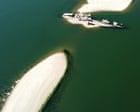
Climate change isn't just an abstract headline about rising temperatures. Sometimes, it digs up the darkest parts of our history. When severe droughts hit Europe, major rivers shrink down to bare mud. That's when things appear. Right now, dozens of sunken World War II warships are breaking the surface of the Danube River near Prahovo in eastern Serbia.
These aren't random boats. They belong to Nazi Germany's Black Sea fleet, scuttled back in 1944 to avoid capture by the advancing Soviet army. For nearly eighty years, they sat underwater, acting as hidden underwater hazards for modern commercial shipping. Now, they are blocking navigation channels and leaking toxic fuel into one of Europe's most vital waterways.
If you think this is just a cool historical curiosity, you're missing the massive economic and environmental disaster happening in real-time. Let's break down what's actually going on underneath the surface.
The Ghost Fleet of 1944
History tells a brutal story about the final days of World War II. By late 1944, the Nazi military machine was crumbling on the Eastern Front. Vice-Admiral Paul Brinkmann ordered the sinking of nearly two hundred ships belonging to the Nazi Black Sea fleet along the Danube.
They did this to keep the vessels out of Soviet hands. They also wanted to block the river route to slow down Allied advances. The plan worked too well. The German fleet sank themselves right in a narrow choke point near the Serbian port town of Prahovo.
The ships went down with tons of unexploded ammunition, heavy artillery, and fuel tanks still intact. For decades, they rested on the riverbed, buried under layers of silt. Local fishermen knew they were down there. Cargo captains knew they existed because their propellers would occasionally clip a submerged steel mast. But nobody could do much about it because the water was simply too deep and the current too fierce.
Until the rivers dried up.
Why the Danube Is Shrinking
Europe is experiencing historic dry spells. Rainfall has plummeted across Central and Eastern Europe over recent summers, and winter snowpacks in the Alps are shrinking. The Danube, which stretches nearly 1,850 miles from Germany to the Black Sea, has dropped to critically low levels.
When water levels plunge, the geography of the riverbed changes entirely. The massive hulls of these German warships, once completely submerged under meters of murky water, now jut out into the open air. Rusted gun turrets, twisted steel decks, and jagged propellers are visible from the riverbanks.
This exposure creates an immediate logistical nightmare. The Danube is a major international trade corridor. Grain, coal, and manufactured goods move up and down this river every single day. When Nazi shipwrecks narrow the navigable width of the channel from 180 meters down to just 100 meters, cargo ships get bottlenecked. Barges run aground on the very wrecks that sank eighty years ago.
Serbia's transport ministry has watched millions of dollars vanish as shipping companies are forced to carry partial loads or halt operations entirely during peak drought months.
The Environmental Time Bomb
The physical blockage is only half the problem. The real threat is what's still locked inside these decaying metal husks.
Think about it. These ships were loaded for war. They carried fuel, oil, lubricants, and high explosives. For eight decades, the cold water and river silt kept most of these materials sealed inside deteriorating steel hulls. As the river level drops and summer heat bakes the exposed metal, those hulls are cracking further.
Experts from the Serbian Ministry of Construction, Transport and Infrastructure have pointed out that many of these vessels still contain live ordnance. Divers and salvage crews cannot simply hook a crane to a sunken destroyer and pull it out. Every single piece of metal has to be inspected for explosives before it can be cut or moved.
Meanwhile, localized oil spills leak out whenever the current shifts the sediment around the wrecks. The Danube supports fragile ecosystems, local fishing industries, and municipal water supplies for millions of people living along its banks. Letting decades-old military fuel bleed into the water supply is not an option.
The Impossible Cleanup Job
Removing these wrecks sounds straightforward on paper. You bring in heavy cranes, cut the ships apart, and haul the scrap away. Reality is much more complicated.
The European Union and the Serbian government have tried to tackle this project for years. In late 2022, the Serbian government launched a tender to salvage the Prahovo fleet. The estimated cost of the operation cleared thirty million euros. That price tag covers clearing the main shipping lane, neutralizing unexploded ordnance, and safely disposing of hazardous materials.
Yet, progress is painfully slow. Working in a major international river requires complex cross-border coordination. Heavy equipment must be staged in tricky river terrain. Every ton of mud removed risks unearthing more dangerous military hardware that has been sitting undisturbed since the mid-twentieth century.
Private salvage companies deal with extreme safety protocols because a single mistake with a cutting torch near a half-century-old torpedo shell could prove catastrophic.
What This Means for the Future of European Waterways
This situation gives us a clear look at how climate change intersects with the physical remnants of human history. We are entering an era where extreme weather resurrects the past whether we want it to or not.
As global temperatures climb and European river basins face recurring droughts, expect more surprises. The Danube won't be the only river coughing up old debris. Rivers across Europe and North America hide thousands of industrial artifacts, old vehicles, and wartime wreckage from decades past.
If you rely on global supply chains, pay attention to these regional bottlenecks. A drought in Serbia ripples out to grain prices in Western Europe and manufacturing schedules across the continent. When old wars literally block modern trade, the cost of climate inaction stops being theoretical. It shows up directly on shipping manifests and utility bills.
The German fleet thought they were burying their secrets forever at the bottom of the Danube. They were wrong. The river is giving them back, and cleaning up the mess is going to take decades, billions of dollars, and a massive amount of technical precision. Stop waiting for conditions to return to normal because normal isn't coming back. The work of adapting to a drastically altered physical landscape has to start with clearing the obstacles right in front of us.