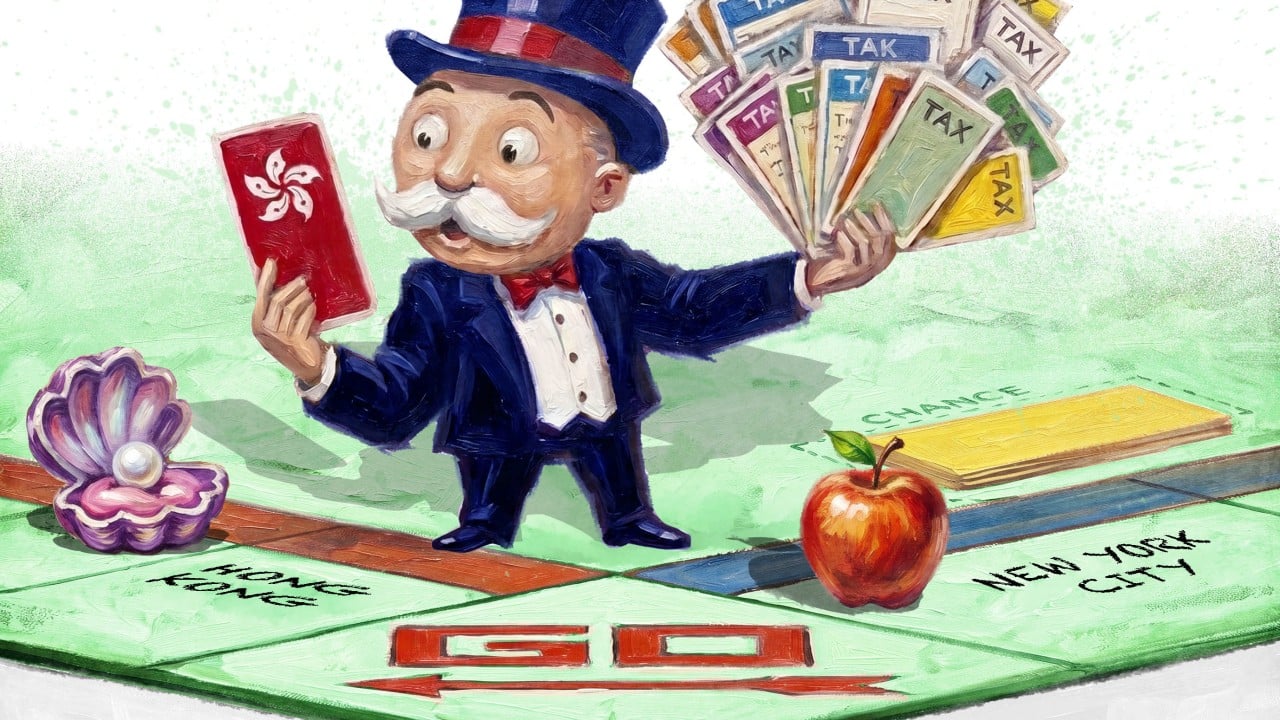
Every time Albany or City Hall floats a new millionaire surtax, the same tired financial journalism template gets dusted off. A headline declares that Wall Street is packing its bags, and an opportunistic Asian hub—usually Hong Kong, sometimes Singapore—is framed as the inevitable beneficiary.
It is lazy, binary thinking. Worse, it fundamentally misunderstands how global capital actually moves in the twenty-first century.
The premise behind the "Big Apple vs. Pearl of the Orient" narrative rests on a dangerously simplistic equation: High taxes equal capital flight, and low taxes equal capital inflow. If global finance operated like a basic arbitrage spreadsheet, every hedge fund manager in Midtown would have relocated to the Cayman Islands or Dubai decades ago. They haven't. And they certainly aren't booking one-way flights to Chek Lap Kok because New York’s top marginal combined state and city income tax rate hovers near 14.8 percent.
To believe that New York’s fiscal policy is Hong Kong’s golden ticket requires ignoring the structural realities of liquidity, legal certainty, and talent density. Tax rates are a variable in corporate site selection, yes. They are rarely the deciding factor when the trade-off is market depth versus geopolitical friction.
The Myth of the Tax-Driven Exodus
Let’s look at the mechanics of high-earning financial professionals. When a managing director at a bulge-bracket bank or a partner at a multi-strategy hedge fund complains about New York taxes, they are loud, articulate, and well-connected to financial reporters. Their complaints make great copy.
Their actual behavior tells a completely different story.
I have sat in boardrooms where executives spent six figures on tax consultants to model a move to zero-income-tax jurisdictions, only to kill the project the moment they looked at their recruiting pipeline. Why? Because you cannot build a $20 billion credit desk out of thin air. You need hundreds of specialized analysts, quantitative researchers, prime brokerage reps, and restructuring attorneys within a three-mile radius.
New York possesses an agglomeration economy that no tax cut can replicate. The sheer velocity of capital, the concentration of institutional limited partners, and the depth of the US equity and debt markets create an ecosystem where the marginal dollar earned far outweighs the marginal dollar taxed.
When New York residents do leave for tax reasons, they don't cross the Pacific. They move down the I-95 corridor to Palm Beach or Miami. Even then, the pattern is telling: firms open satellite offices in Brickell for the managing partners to establish 183-day residency, while keeping the core trading, risk management, and technology infrastructure firmly anchored in Manhattan. A tax-motivated move to Florida is a lifestyle and accounting adjustment; a move to Hong Kong is a total overhaul of a firm’s operational, regulatory, and geopolitical risk profile.
Hong Kong’s Real Bottleneck Isn't Wall Street’s Tax Rate
The argument that New York's tax hikes "open the door" for Hong Kong assumes that Hong Kong’s primary obstacle to growth over the past several years has been a lack of competitiveness on tax rates.
That is laughable. Hong Kong has maintained one of the most attractive territorial tax regimes in the developed world for decades. Corporate profits tax is capped at 16.5 percent (with a two-tiered rate starting at 8.25 percent), salaries tax tops out at a flat 15 percent standard rate, and there is zero tax on capital gains, dividends, or estate transfers.
On paper, Hong Kong has beaten New York on tax efficiency every single day since the British colonial era. Yet, over the last half-decade, the city has fought an uphill battle to retain its status as Asia's premier financial hub.
Why hasn't a 15 percent flat tax triggered a stampede of Western capital into Victoria Harbour? Because global allocators price regulatory predictability and geopolitical neutrality orders of magnitude higher than personal income tax savings.
Institutional capital—pension funds, sovereign wealth funds, endowments—operates under strict fiduciary mandates. Their primary mandate is preservation of capital and rule-of-law certainty. While Hong Kong’s Common Law system remains distinct from Mainland China's civil code under the "One Country, Two Systems" framework, the perception among Western compliance departments has shifted irrevocably.
When a compliance officer in London or New York evaluates cross-border data flows, sanctions exposure, and national security legislation, a 15 percent income tax rate does not enter the risk matrix. What enters the matrix is the cost of maintaining dual technology stacks to comply with conflicting US and Chinese data laws, the reputational risk of geopolitical flare-ups, and the reality that Western investment banks have spent the last three years shrinking their Asia-Pacific deal teams due to a prolonged drought in Chinese offshore IPOs.
The Tale of Two Capital Markets
Comparing New York and Hong Kong as direct, zero-sum competitors reveals a fundamental misunderstanding of what each city actually sells. They are not selling the same product.
New York is the capital of global capital formation and deep liquidity. The New York Stock Exchange and Nasdaq command a combined market capitalization exceeding $50 trillion. If a founder in Tel Aviv, São Paulo, or Stockholm wants the highest possible valuation multiple and the deepest pool of institutional buyers, they list in New York. No tax hike in Albany changes the price-to-earnings multiples on the Nasdaq.
Hong Kong, by contrast, is the offshore financial gateway to Mainland China. Its core value proposition is serving as the bridge between international capital and Chinese state-owned enterprises, tech giants, and onshore wealth.
Look at the Hang Seng Index versus the S&P 500 over the last five years. The divergence has nothing to do with marginal tax brackets in Manhattan and everything to do with China’s macroeconomic pivot, property sector deleveraging, and domestic regulatory crackdowns on private enterprise.
When Mainland Chinese companies stop listing offshore, Hong Kong’s equity capital markets freeze. When Beijing’s stimulus measures falter, Hong Kong’s wealth management inflows slow down. Conversely, when Beijing opens the southbound Stock Connect spigot, Hong Kong surges.
New York’s tax policy is completely irrelevant to Hong Kong’s primary economic engine. Pretending that a millionaire surtax in New York will somehow revive IPO volumes on the Hong Kong Exchanges and Clearing (HKEX) is like arguing that higher parking fees in Chicago will boost wheat exports in Buenos Aires. The two systems operate on entirely different macroeconomic catalysts.
Where the Displaced Capital Actually Goes
If we accept the reality that punitive taxation does erode competitiveness at the margins—and it does—we still have to ask where that marginal capital actually flows.
When a hedge fund, family office, or private equity shop decides that New York’s combined tax burden and regulatory overhead have finally crossed the threshold of pain, Hong Kong isn't even on the shortlist. The actual winners of New York’s fiscal overreach are jurisdictions that offer low taxes without forcing Western firms to navigate complex geopolitical fault lines:
- Miami and West Palm Beach: Zero state income tax, identical time zone to Wall Street, a three-hour direct flight to Teterboro, and seamless integration with US federal banking and securities laws.
- Dallas and Austin: Rapidly becoming "Y'all Street," attracting massive back-office, middle-office, and asset management operations from giants like Goldman Sachs and Charles Schwab due to low corporate overhead, zero state income tax, and pro-business regulatory environments.
- London and Zurich: For international talent looking for European time zones and established wealth management infrastructure without the US global taxation regime (for non-US citizens).
- Singapore: Within Asia itself, Singapore—not Hong Kong—has been the primary beneficiary of regional wealth migration. Singapore offers comparable tax incentives (a 17 percent corporate rate, zero capital gains tax, and generous family office tax exemptions under Sections 13O and 13U) paired with strict geopolitical non-alignment.
Notice a pattern? Every single true beneficiary of New York’s tax hikes either sits inside the United States legal umbrella or operates as a neutral, non-aligned international hub.
The Real Threat to New York Isn't Hong Kong
To be clear, defending New York against the "Hong Kong will eat its lunch" narrative is not an endorsement of New York’s fiscal policy. City and state lawmakers in New York are playing a dangerous game of chicken with their own tax base.
In New York City, the top 1 percent of earners account for roughly 40 to 50 percent of the city's personal income tax revenue. That is an extraordinarily narrow, volatile foundation upon which to build a $100 billion-plus municipal budget. When you push the combined state and local marginal rate near 15 percent—and pair it with aggressive corporate franchise taxes and deteriorating quality-of-life metrics—you invite structural erosion.
However, that erosion does not look like a sudden, dramatic headline where JPMorgan Chase moves its global headquarters to Central, Hong Kong.
It looks like quiet, relentless hollowing-out. It looks like a private equity firm keeping its front-office dealmakers in Manhattan while moving 400 compliance, accounting, and IT jobs to Salt Lake City or Dallas. It looks like a founder choosing to incorporate and domicile their next venture in Austin rather than Brooklyn. It looks like a slow bleed of tax receipts that forces New York to raise taxes again to cover budget deficits, accelerating the domestic migration loop.
This is a domestic redistribution of American financial power, not an international transfer of hegemony from the Hudson River to the Pearl River Delta.
What Smart Allocators Are Actually Watching
If you are an investor, a corporate strategist, or a financial executive trying to read the tea leaves on global financial hubs, stop reading breathless op-eds pitting New York against Hong Kong over tax brackets. You are looking at the wrong dashboard.
If you want to know whether New York is losing its grip, ignore Asian tax rates and watch domestic commercial real estate absorption in Sunbelt cities, FINRA registered representative transfers by state, and New York State Comptroller tax receipt shortfalls. Those numbers tell you the real story of Wall Street's geographic decentralization.
If you want to know whether Hong Kong is staging a genuine comeback, ignore Albany’s budget debates and watch onshore Chinese household savings rates, the volume of southbound capital flowing through the Shanghai-Hong Kong Stock Connect, and the pace of RMB internationalization. Hong Kong’s destiny is tied to Beijing’s monetary and regulatory posture, full stop.
Financial centers do not rise and fall because one city tweaks its top marginal tax rate by two percentage points. They rise and fall based on where trust is deepest, where the rule of law is most predictable, and where buyers and sellers can transact at the largest scale with the least friction.
New York has a tax problem. Hong Kong has a geopolitical positioning problem. Neither city solves the other's dilemma, and pretending they are locked in a zero-sum battle over marginal tax rates is just financial fiction for people who don't understand how global markets work.