The teacup did not fall, but it danced.
In a small, second-floor apartment in the southwestern Iranian city of Ahvaz, Hani, a thirty-four-year-old schoolteacher, stared at the porcelain rim rattling against its saucer. The sound was a tiny, domestic treble to the bass note that followed—a low, rhythmic thudding that seemed to vibrate upward through the soles of his feet before it even registered in his ears.
Then came the flash. It was not the yellow of fire, but a cold, chemical white that bleached the night sky, turning the brick facades of his neighborhood into stark, overexposed photographs.
"My hands are shaking," Hani said later, his voice carrying the flat, exhausted cadence of someone who has spent the last week measuring his life in twelve-hour increments. "There were at least eleven or twelve explosions. My ears are exploding."
He did not go to the window. In Ahvaz, as in Bandar Abbas, Qeshm Island, and the ancient dusty stretches of Semnan, civilians have learned the geometry of modern aerial warfare. You do not look at the sky. You seek the center of the room, away from the glass that will inevitably turn into a thousand microscopic knives when the pressure wave hits.
For six consecutive nights, the sky over Iran has belonged to the United States military.
The Steel Wall and the Water
To understand why a schoolteacher’s teacup is rattling in Ahvaz, one must look hundreds of miles to the south, where the Persian Gulf squeezes into a tiny, hook-shaped choke point. The Strait of Hormuz is not a grand, boundless ocean. It is a narrow corridor of gray-blue water through which one-fifth of the world’s energy supplies must pass. It is the jugular vein of global commerce.
Earlier this summer, a fragile peace seemed possible. A Pakistan-mediated memorandum of understanding had paused months of bitter fighting. The agreements were precise, written in the bloodless legalese of international diplomacy: Iran would not target commercial shipping, and the United States would ease its economic chokehold.
But paper is highly flammable in the Middle East.
According to Washington, Iranian forces broke the truce, firing on commercial vessels navigating the strait. The White House responded not with a diplomatic cable, but with what US Central Command calls a "steel wall"—a total naval blockade of Iran's ports.
The mechanics of this blockade are happening right now, far out at sea, away from the cameras. Consider the M/T Wen Yao, a lumbering commercial vessel slicing through the Gulf of Oman on Thursday. To its crew, the horizon was empty until a gray speck materialized, growing into a US Navy destroyer. Armed US Marines boarded the vessel to search its manifest, ensuring "full compliance" with American orders. Nearby, another tanker, the Curacao-flagged Belma, lay disabled in the water, its engines silenced by American forces after it refused to turn back.
When the sea is closed, the land pays the price.
The Arithmetic of Attrition
In Washington, the language used to describe the six-day campaign is clinical. Officials speak of "degrading military capabilities" and "targeting command nodes". They point to F-35A stealth fighters gliding silently through the upper atmosphere, refueled by lumbering tankers high above the clouds, completely invisible to the naked eye until their precision-guided munitions find their targets.
But on the ground, military capabilities are not abstract. They are built of concrete, steel, and human labor.
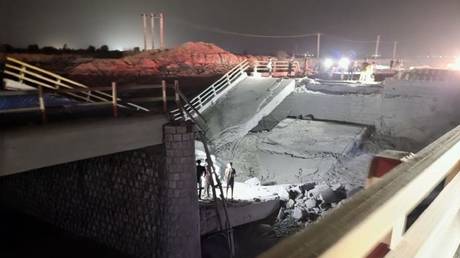
On Thursday night, American missiles struck the port city of Bandar Abbas, home to Iran's largest commercial harbor and navy yards. They tore through the airstrip at Iranshahr Airport in the southeast. They collapsed two vital bridges and shattered the railway station in the coastal town of Bandar Khamir.
To a military strategist, a bridge is a logistical supply route. To a local farmer, it is how he gets his produce to market. To a family, it is the only road to the nearest hospital. When you destroy a bridge, you do not just stop an army; you slice the tendons of a community.
The air strikes are creeping closer to the bone. From Washington, the rhetoric has shifted from surgical military deterrence to a broader, more devastating promise. The White House has warned that if Tehran does not return to the negotiating table, the targets will shift from military installations to the civilian grid.
"We’re going to hit them very hard," came the warning from the American leadership. "Next week comes the power plants. Next week comes the bridges. We’re going to knock out all their power plants."
Imagine the heat of an Iranian July without refrigeration, without water pumps, without light. This is the invisible leverage being applied in real-time.
The Dual Realities of War
There is a bizarre, surreal dissonance to this conflict.
At the very moment American bombs were falling on Bandar Abbas, White House Press Secretary Karoline Leavitt stood behind a podium in Washington and told reporters that diplomatic channels remained open. "Iran very much continues to talk to the United States... and express that they want to make a deal," she said, even as she defended the relentless bombardment.
To the diplomats, this is a high-stakes game of leverage. You strike the opponent’s hand to make them sign the paper faster. On Wednesday, President Trump even welcomed what he called a goodwill gesture from Tehran—the release of Dena Karari, an American citizen who had been detained in Iran.
But in Tehran's Valiasr Square, a lone man stood holding an Iranian flag, his face darkened by the shadow of a war that has suddenly returned. For ordinary citizens, there is no "leverage"—there is only the terrifying unpredictability of what happens next.
Tehran has already begun striking back, launching missiles and drones at American military outposts in Jordan, Kuwait, and Bahrain. The Iranian military has warned that if its civilian power plants are touched, every piece of infrastructure in the region will become a target.
The regional web is tightening. Israel is reportedly preparing for a massive escalation in the coming week. Jordan, Kuwait, and Bahrain find themselves caught in the crossfire of two giants who cannot find a way to stop hitting each other.
The Echo in the Dark
We often think of war as a series of grand movements—troop deployments, treaties, naval blockades. But war is actually experienced in the dark, in the quiet moments between the sirens.
It is experienced by the doctors evacuating a children's cancer hospital in Ahvaz, carrying patients on gurneys down darkened stairwells because the generators might fail if the local grid goes down. It is experienced by the merchant sailors on the Gulf, watching the gray hull of a foreign navy ship draw near, wondering if this is the day their cargo becomes a casualty of a war they did not choose.
And it is experienced by Hani, sitting in his kitchen, waiting for the seventh night to begin.
The sirens will eventually wail again. The F-35s will return to the skies. The politicians in Washington and Tehran will issue their midnight statements, claiming victory, demanding surrender. But beneath the thunder of the strikes, the bridges of Bandar Khamir lie in ruins, and the water in the Strait of Hormuz remains cold, deep, and incredibly quiet.