Midnight in Los Angeles rarely smells like ozone and asphalt anymore. Sometimes, it smells like damp fur, crushed eucalyptus leaves, and the sharp, feral musk of an apex predator that has forgotten where its mountains end and the pavement begins.
Elena Vance heard the gate rattle first.
It was a metallic, hollow sound that cut through the low-frequency drone of the 405 freeway three miles away. She sat up in her Laurel Canyon bed, the cool California air pressing against her skin through the open window. For ten years, the midnight noises had been predictable: the muffled bass of a passing car, the skitter of a raccoon raiding a plastic bin, the distant siren echoing off concrete canyons.
This was different. This was heavy.
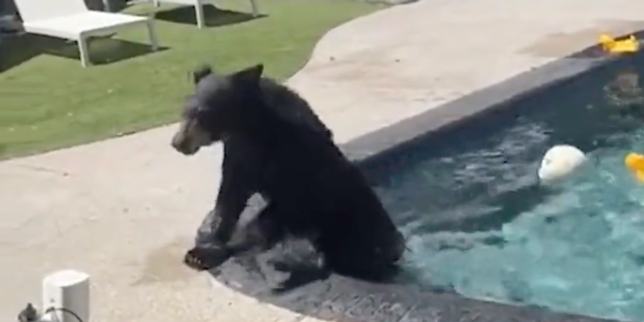
She crept to the kitchen, avoiding the floorboard that always groaned, and pressed her face against the cold glass of the sliding door. Standing on her manicured porch, casually sniffing a terracotta planter filled with drooping petunias, was a three-hundred-pound black bear.
He didn't look like a monster. In the amber glow of her motion-sensor floodlight, he looked tired. His coat was dusted with dry brush, his left ear notched from some forgotten territorial dispute in the scrub oak above. He glanced up, his eyes catching the light—not with the mindless terror of a trapped animal, but with an ancient, calculating weariness. Then, with a grunt that vibrated through the glass, he heaved his bulk over the low brick wall and dissolved back into the shadows of the chaparral.
Elena was not alone. Across the sprawling, sun-baked grid of Los Angeles, from the steep, winding switchbacks of Griffith Park down to the leafy fringes of Pasadena and the rugged pockets of the Santa Monica Mountains, an invisible boundary line has dissolved. The wild is moving in. And we are no longer just neighbors sharing a zip code; we are roommates in a volatile, rapidly shrinking home.
The Architecture of Encroachment
To understand why the bears are coming down the mountain, you have to look at the map not as a city planner, but as an animal with a nose that can smell a rotting avocado from two miles away.
Los Angeles is an ecological collision zone. It is a basin rimmed by steep, fire-scarred mountain ranges, choked by concrete, and irrigated by millions of leaky sprinkler systems and overflowing trash cans. For decades, a fragile truce held. The animals stayed high; the humans stayed low.
But the math of survival has shifted.
Consider the sequence of events that pushed these creatures out of the backcountry. Years of erratic drought have baked the chaparral into tinder, turning native berry patches and seasonal streams into barren dust. When the natural larders fail, the urban interface looks less like a hostile human settlement and more like an endless, all-you-can-eat buffet. Why spend three hours clawing through dry bark for a beetle grub when a single rolling plastic bin on Vista Del Mar contains discarded sourdough, pizza crusts, and half a melon?
Wildlife biologists call this the urban-wildland interface, but that clinical phrase sanitizes what is actually happening. It is an invasion fueled by convenience.
We built our suburbs directly into their migration corridors. We carved winding roads through ancient oak groves, replaced native brush with green lawns that demand thousands of gallons of imported water, and left our garbage cans unsecured because we wanted to sleep without the clatter of a heavy lid. The bears didn't choose our world; we expanded into theirs, paved over their dining rooms, and then left the refrigerator door wide open on the front porch.
Encounters at the Edge
Out in the foothills, the stories are starting to sound like folklore, except they happen on Tuesday afternoons.
Ask Mark Jensen, who lives down a steep gravel drive in Sierra Madre. He was working from his home office, staring at a spreadsheet, when his golden retriever started barking with a frantic, high-pitched urgency that made the hair on the back of his neck stand up.
Mark didn't grab a weapon. He grabbed his phone, expecting a coyote eyeing a small pet. Instead, when he rounded the corner into his kitchen, he found a mother bear and two cubs rummaging through his pantry like college students after a late-night study session. They had pushed through the flimsy screen door, hopped the counter, and were currently debating the merits of organic peanut butter versus discount cereal.
"You don't feel anger in that moment," Mark told me later, sitting on his porch while a hawk drifted lazily over the canyon. "You feel small. You realize that against three hundred pounds of muscle and claws, your entire modern life—your mortgage, your Wi-Fi router, your car insurance—is completely irrelevant. You are just a hairless ape standing in a kitchen that belongs to them now."
The mother didn't charge. She didn't roar. She simply paused, a jar of Skippy crunched in her massive jaws, stared at Mark with an expression of profound indifference, and backed out the door, her cubs tumbling after her like shaggy bowling balls.
These encounters are multiplying. Statistics from the California Department of Fish and Wildlife paint a stark picture: bear sightings in urban and suburban zones have climbed steadily over the last decade. It is not because the bear population is exploding out of control; it is because the behavioral adaptation is spreading. Bears are remarkably intelligent animals. They teach their young where the easy calories are. A mother who learns to pop open a residential gate passes that trick down to her cubs. Within two generations, you have an entire lineage of urban-adapted bruins who look at a suburban driveway the way a suburbanite looks at a drive-thru.
The Cost of Convenience
The tragedy of this coexistence is that it almost always ends badly for the animal.
When a wild creature loses its fear of humans, it is often labeled a "nuisance." When it wanders into a schoolyard or wanders down a busy commercial strip in search of garbage, panic sets in. Police are called. Crowds gather, holding up smartphones like modern torches and pitchforks, flashing lights and screaming. The animal, terrified by the strobe effect of human civilization, climbs a tree to escape the noise.
And then comes the sedative dart.
Too often, the story ends with a grim press release: Relocated to a remote wilderness area. But relocation for an older, habituated bear is rarely a fairy tale. Placed into a strange territory, a displaced urban bear often starves, gets killed by dominant local males who already own the best hunting grounds, or simply walks fifty miles back to the only home it knows—the neighborhoods with the unsecured garbage cans.
We have created a system where our own sloppy habits are a death sentence for our neighbors.
It is easy to blame the wildlife. It is easier still to demand that animal control officers come out and remove every creature that makes us uncomfortable. But that is an illusion. You cannot fence off a mountain range. You cannot pave over nature and expect nature to simply respect the property lines we drew on a map with a sharpie.
Living with the Shadow
The sun is dropping behind the Santa Monica Mountains now, painting the smog-softened sky in shades of bruised purple and burnt orange. Down on the boulevard, the evening commute is a grinding river of brake lights and honking horns. People are rushing home to dinners they didn't hunt and houses protected by smart security systems.
Up here in the quiet fringes, the floodlights are clicking on.
Elena Vance walks out onto her porch with a heavy-duty padlock she bought at the hardware store this morning. She is strapping it across her green waste bin, looping the steel cable through the handle and around a sturdy oak post. It is an extra chore at the end of a long day—one more friction point in a world that already feels too crowded, too demanding.
She looks up toward the dark ridge where the chaparral meets the sky. There is no movement up there right now. Just the wind sighing through the dry leaves and the distant, constant hum of the city below.
She knows he will be back. Animals don't forget where the honey is.
She won't call the authorities, and she won't leave out a welcoming committee. She will just lock her trash, bring her dog inside before dark, and accept the quiet, humbling truth of where she lives: at the very edge of the wild, where every closed door is only ever a suggestion.